
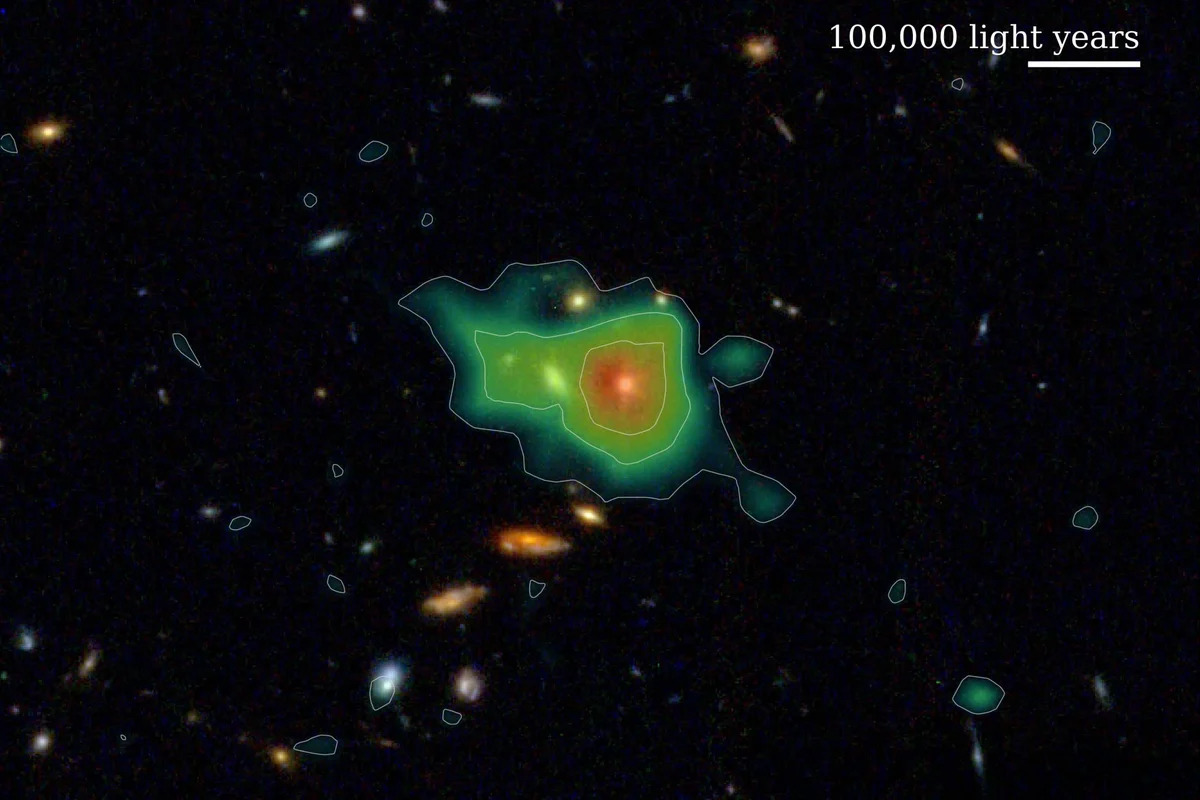
Hydrogen gas clouds surrounding galaxies are far more prevalent than previously thought, according to a new study that reveals hidden pockets of the universe’s first element.
Between 10 billion and 12 billion years ago, a period known as the “cosmic noon”, galaxies were forming stars at their peak rate. This would have needed immense supplies of hydrogen gas, the main ingredient for star formation. However, until recently, just about 3,000 of these gas halos had been detected in the universe.
The latest research increases this number to over 33,000, giving researchers with a more complete dataset to study how early galaxies began and evolved.
Since hydrogen doesn’t emit light on its own, it is detected mostly when it is close enough to energy sources like galaxies filled with ultraviolet-emitting stars, which cause the gas molecules to glow.
Finding this faint signal, however, requires long observations with highly sensitive instruments, which are always readily available. This is why only the brightest and most extreme hydrogen gas halos have been discovered so far.
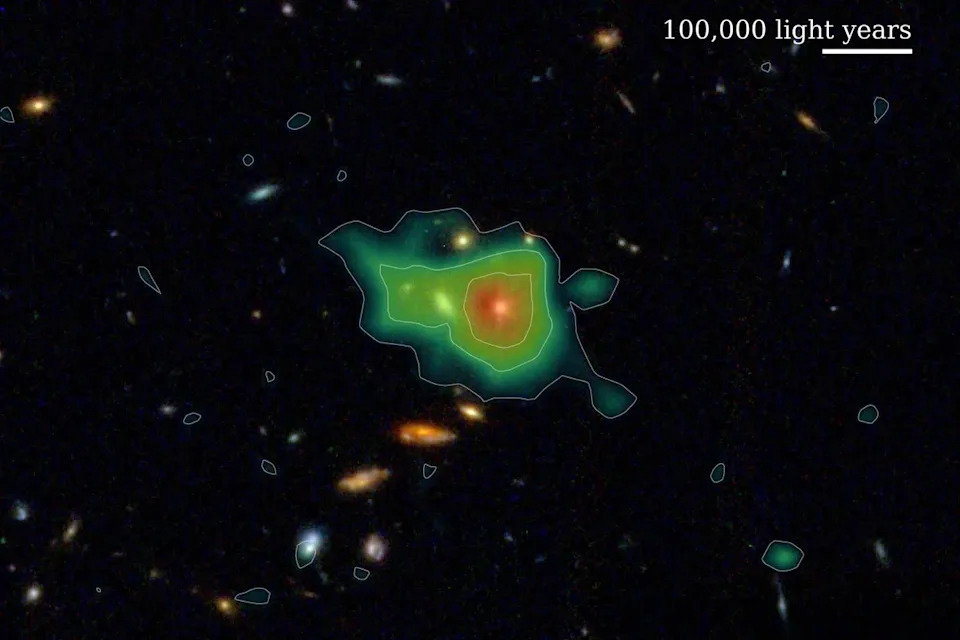
A halo of hydrogen gas detected by the Hobby-Eberly Telescope Dark Energy Experiment (Nasa)
The new study used the Hobby-Eberly Telescope at the McDonald Observatory in Texas to capture nearly half a petabyte of data on galaxies and the regions in between.
In this trove of data, scientists identified new hydrogen gas halos ranging from tens of thousands to hundreds of thousands of light years across.
Some of these are simple, football-shaped clouds around a single galaxy, while others are large, irregular structures that contain multiple galaxies.
“Those are the fun ones. They look like giant amoebas with tendrils extending into space,” said Erin Mentuch Cooper, an author of the study published in the Astrophysical Journal.
The researchers hope to study the newly discovered halos in detail to better understand the sources of the universe’s “missing” hydrogen.
“There are various models for galaxies in this epoch that largely work and seem to make sense, but there are gaps and holes,” said Dustin Davis, a postdoctoral researcher at the University of Texas at Austin.
“Now we can focus on individual halos and see at a greater detail the physics and mechanics of what’s going on. And then we can fix or throw out the models and try again.”