
New research suggests that relic black holes from before the big bang may still shape galaxies today. These black holes could explain dark matter, one of the biggest unsolved questions in cosmology.
Generally speaking, black holes are regions of spacetime where matter is compressed into a tiny space. Dark matter, meanwhile, is matter that does not reflect or absorb light. We know it exists because of its gravitational influence on galaxies and other cosmic structures.
It can be viewed as the “glue” that holds galaxies together, but we do not know what it is made of at a fundamental level. Most physicists think dark matter is composed of an as-yet-undiscovered sub-atomic particle.
But ancient black holes from before the big bang also fit the bill. They are dark, but also carry mass – exactly the properties required.
I have explored this idea in a new paper. Of course, the idea of relic black holes also requires a re-think of the big bang itself.
For nearly a century, cosmologists traced the history of the universe back to this single, dramatic moment. But maybe this wasn’t the absolute beginning of time. Perhaps there was a universe before the big bang.
Under this scenario, the universe collapsed before undergoing an expansion. The big bang represents the transition between the two phases.

A conventional view of how the universe came to be. Here, the Big Bang is immediately followed by a period of rapid expansion known as inflation.
Bicep2 Collaboration
The big bang model has been remarkably successful. It explains the cosmic microwave background – the afterglow of the early universe – and predicts the large scale distribution of galaxies with astonishing accuracy.
But in Einstein’s theory of general relativity, it is also a singularity – a point where density becomes infinite and the known laws of physics break down.
Many physicists interpret this not as a physical reality, but as a sign that something is missing. Singularities are less like physical objects and more like mathematical warnings: they tell us that our current theories cannot describe the earliest moments of the universe.
A bounce, not a bang
One alternative is a bouncing cosmology. In this picture, the universe undergoes a phase of contraction before the big bang, reaching an extremely high – but finite – density. Instead of collapsing into a singularity, it rebounds, beginning a new expanding phase.
Bouncing models have been explored for decades, often requiring modifications to gravity or exotic new ingredients. But our work shows that a bounce can arise as a regular solution within standard physics, when gravity and the effects of quantum mechanics – the laws governing nature at the tiniest scales – are consistently taken into account.
In standard cosmology, the big bang is quickly followed by a period where the early universe undergoes a period of rapid and exponential expansion. This stage, known as inflation, effectively erases all traces of earlier structures.
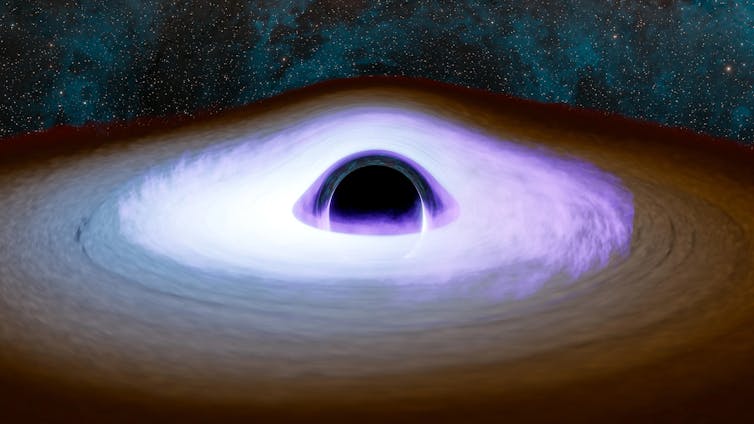
Illustration of a large black hole. Could relic black holes explain the mystery of dark matter?
NASA/Caltech-IPAC/Robert Hurt
The situation is different for a bouncing universe. In our work, we found that things larger than 90 metres could have survived the transition from collapse to expansion. This leaves behind “relics” that carry information from a previous cosmic epoch. These relics can include black holes, gravitational waves and density fluctuations.
Quantum physics contains a powerful clue to how this is possible. According to the Pauli exclusion principle – a cornerstone of quantum theory – matter becomes “degenerate” at extremely high densities. The matter generates a pressure that resists further compression even in the absence of heat.
In our model, a similar effect operates on cosmological scales. It may explain why the universe doesn’t collapse completely – and why structures formed before or during the bounce can survive into the expanding phase.
Surviving the apocalypse
We identify two main routes through which relic black holes can arise.
The first one is direct survival. Compact objects and perturbations (fluctuations in density or gravity) generated during the collapse phase of the universe can persist through the bounce.
The second route is even more intriguing. During contraction, matter naturally clumps under gravity, forming structures similar to the halos that host galaxies today. After the bounce, they are able to collapse efficiently into black holes.
Galaxies and stars from the contraction phase effectively collapse into black holes, erasing most of their detailed structure but preserving their mass.
Could these black holes be dark matter? For decades, the leading candidate has been a fundamental particle — but none has been detected despite extensive searches.
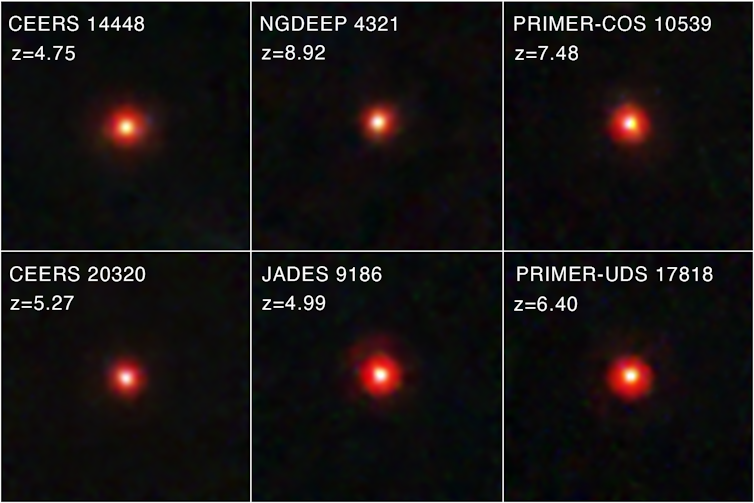
Could the ‘little red dots’ seen by JWST represent relic black holes?
Image: NASA, ESA, CSA, STScI, Dale Kocevski (Colby College)
Relic black holes offer a compelling alternative. If the bounce produces enough of them, they could make up a significant — perhaps dominant — fraction of dark matter.
This idea may also connect to one of the most intriguing observational puzzles of recent years.
The James Webb Space Telescope (JWST) has revealed a population of compact, extremely red objects in the early universe, sometimes called “little red dots”. These astronomical sources appear to be unexpectedly massive and luminous only a few hundred million years after the big bang.
Many astronomers suspect they are associated with rapidly growing black holes – perhaps the seeds of the supermassive black holes found at the centres of galaxies today. But their existence is difficult to explain within standard cosmology. How could such massive objects form so quickly?
Relic black holes provide a natural explanation. If massive seeds already existed immediately after the bounce, the early universe would not need to start from scratch. Supermassive black holes could grow from ancient survivors rather than newly formed objects.
In this sense, JWST may already be glimpsing the descendants of pre-bounce relics.
A new cosmological framework
Taken together, the bounce scenario offers a unified way to address several long-standing problems in cosmology.
The big bang singularity is replaced by a quantum transition. This transition could be related to the concept of the “Einstein–Rosen bridge”: a mathematical link between two disparate regions of spacetime.
Inflation emerges naturally from the dynamics near the bounce.
Dark energy can be related to the global structure of a finite universe.
Dark matter may be composed of relic black holes —perhaps our own universe started as one.
Gravitational waves could carry signals from a previous cosmic phase.
Supermassive black holes may have ancient origins consistent with recent JWST observations.
Much work remains to be done. These ideas must be tested against data – from gravitational-wave backgrounds to galaxy surveys and precision measurements of the cosmic microwave background.
But the possibility is profound: the universe may not have begun once, but may have rebounded. And the dark structures shaping galaxies today could be relics from a time before the big bang.