
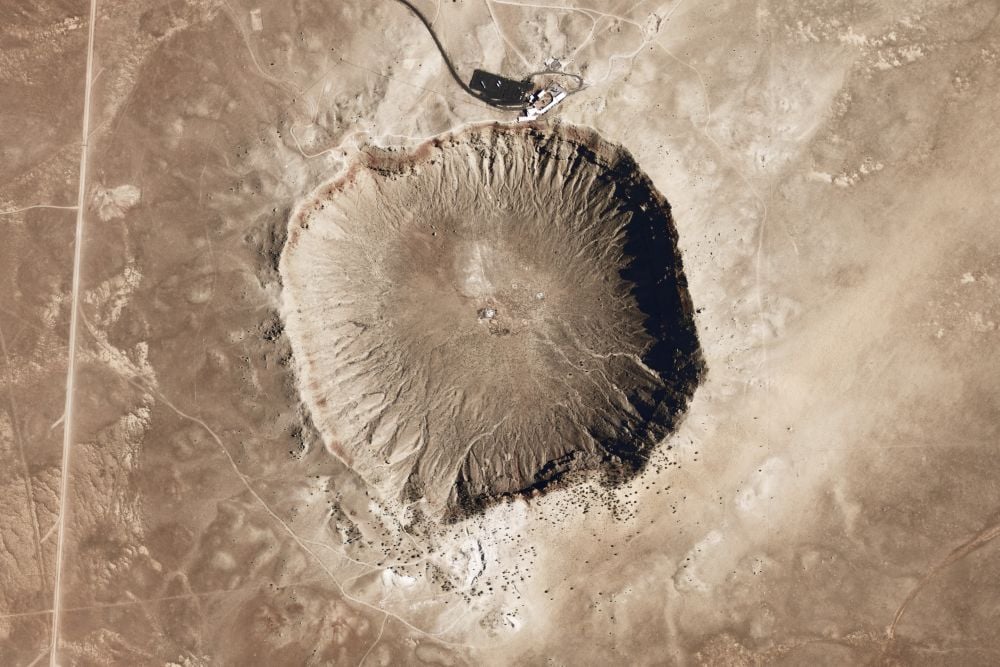
Earth and the course of life on Earth have been shaped by impacts. Scientists have uncovered links between massive impacts and changes in climate that altered the planet forever. But the further scientists look into the past to try to understand these changes, the more difficult it is to link them together.
Impact craters don’t retain their shapes for long on Earth. When examining ancient craters, researchers are dealing with degraded structures that don’t reveal all of the impactor’s secrets. Impactor size, angle of impact, velocity, even the composition of the impactor can all change a crater’s shape, making it difficult to determine how energetic the impact was, and impact energy is critical to understanding how impacts shaped life on Earth.
The Zhamanshin impact crater in Kazakhstan is believed to be the most recent hypervelocity cratering impact event. The impactor struck Earth around 900,000 years ago during the Pleistocene. It may have caused a nuclear winter, but scientists think it wasn’t powerful enough to trigger a mass extinction.
The Zhamanshin crater is visible on the surface and measures about 14 km in diameter. The belief that it was not powerful enough to cause an extreme aftermath is based largely on that crater size. But new research is casting doubt on that measurement, which in turn casts doubt on the effects of the impact. Could the Zhamanshin impact have triggered more powerful changes than thought?
The new research is titled “The Zhamanshin Impact Event: Potential Implications for Environmental Responses and Biological Linkages on Earth and Beyond.” It’s been submitted to the Planetary Science Journal, and is currently available at arxiv.org. The lead author is James Garvin from the Sciences and Exploration Directorate at NASA’s Goddard Space Flight Center.
There are a handful of complex impact craters from the last 1 million years, and they’re all degraded to different degress by erosion. “Zhamanshin is the youngest (< 0.90 Ma) and likely best-preserved complex impact structure known within the Earth record within the past one million years,” the authors write.
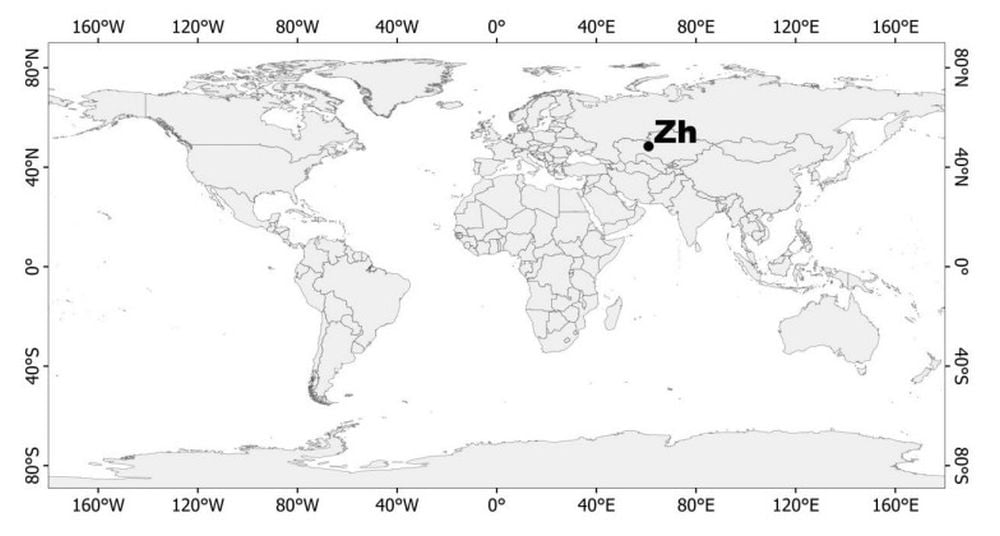 The Zhamanshin impact crater is located in Kazakhstan. Image Credit: Garvin et al. 2026. PSJ.
It may seem difficult to get the size of an impact crater wrong, especially one that was created only 900,000 years ago. But lead author Garvin has been arguing for years that some craters, including Zhamanshin, are actually multi-ringed craters with outer rings at large distances from the easily visible inner rings. These rings don’t pop out of the landscape in visual images, but remote-sensing techniques like LiDAR can detect them.
“Analysis designed to reduce uncertainty in the dimensions of the Zhamanshin structure employing high resolution topography demonstrated that it likely generated a ~ 26.5 km diameter multi-ring crater,” the authors write. “This is at least two times larger than the current best estimates.”
The researchers measured the elevation of small peaks in the area around the main crater to determine the size of the outer rings.
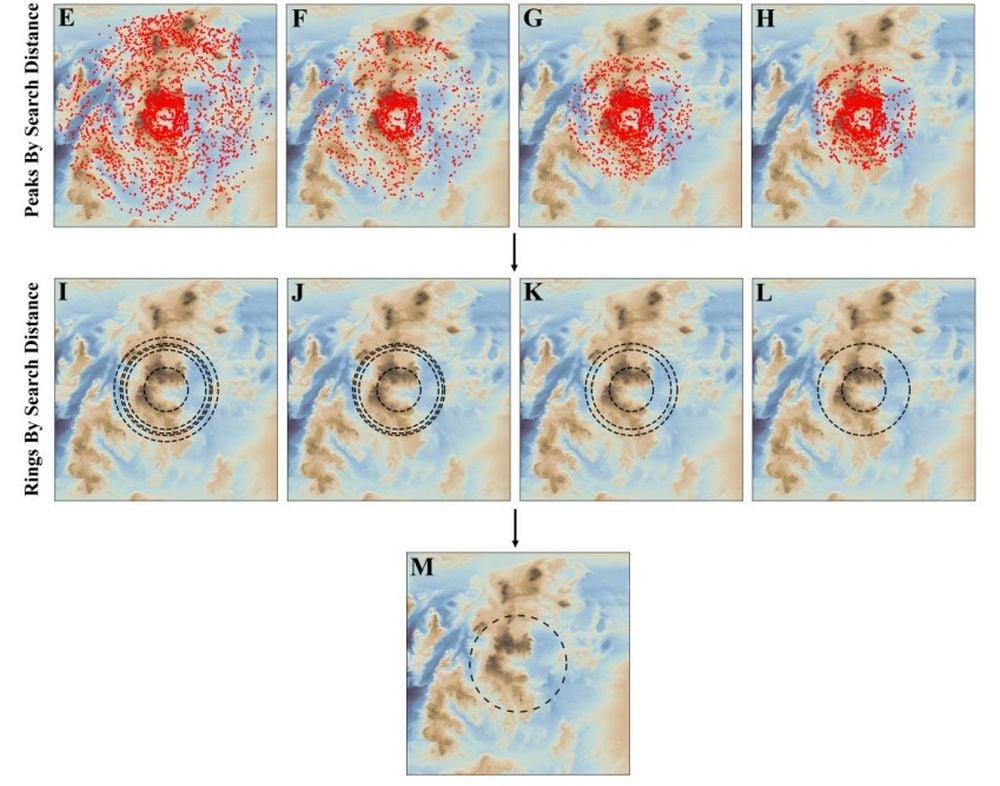 The top row shows measurements of small peaks in the region around the main crater. The middle row shows different ring solutions. The bottom panel shows the final apparent outer ring solution. Image Credit: Garvin et al. 2026. PSJ.
They also used five different types of Digital Elevation Models (DEM) from LiDAR and other data sources to determine the diameter of the entire crater.
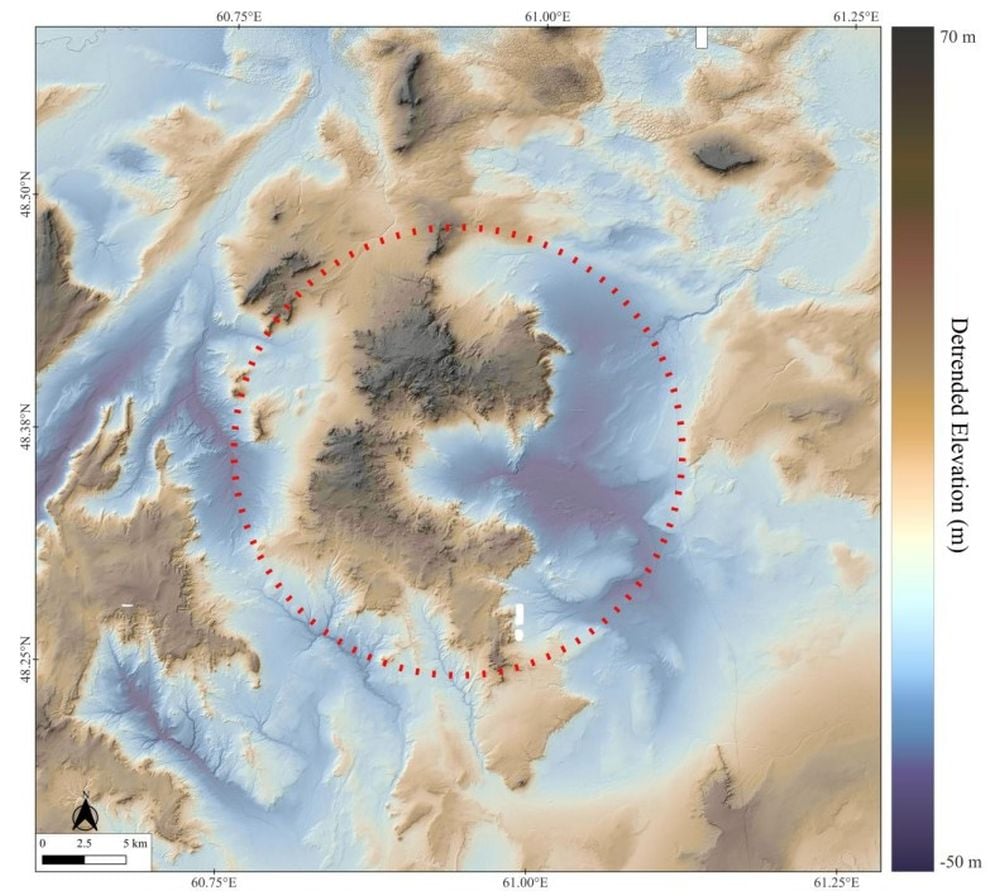 This is the highest spatial resolution elevation data available for the Zhamanshin impact region. The red dotted line shows the predicted outer ring of the crater. Image Credit: Garvin et al. 2026. PSJ.
Size matters in craters because it’s directly linked to impact energy. If Zhamanshin is two times larger than thought, then its impact energy and effect on Earth were also far more pronounced.
“Using a range of accepted impactor sizes, velocities, compositions, and angles of impact, such impacts typically yield kinetic energies of impact over 240,000 Megatons
(TNT),” the researchers explain. The combined explosive power of both WW2 atomic bombs was only about 35 kilotons.
That puts the Zhamanshin impact in the same category as other more energetic explosions throughout Earth’s history, like the eruptions that occurred in the Yellowstone Caldera. These events were powerful enough to create global climate impacts. “The factor of two discrepancy in the dimensions of Zhamanshin increases the kinetic energy yield by factors of 7-10, with significantly larger environmental consequences,” the researchers write.
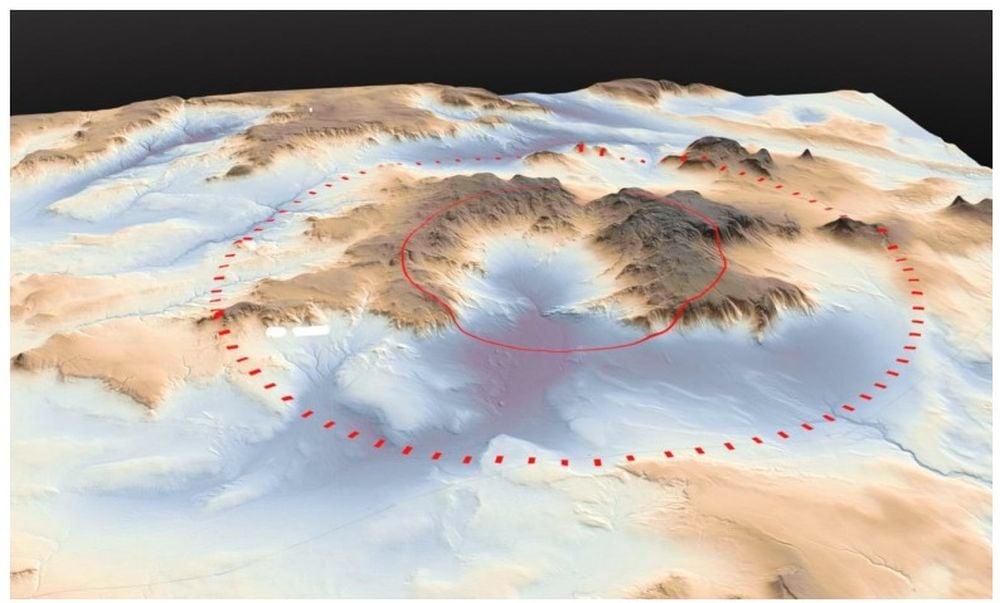 An oblique view of the crater DEM. The solid red line indicates the 12.5 km inner ring diameter. The dotted red line indicates the 26.4-26.8 km predicted outer ring. Image Credit: Garvin et al. 2026. PSJ.
In the researchers’ view, it’s critical to examine Zhamanshin in this context, since it could be responsible for abrupt climate changes with biological consequences that happened around 900,000 years ago. “Quantitative study of Earth’s hypervelocity impacts is essential as they could have affected plant and animal populations amidst various environmental challenges during periods of known climate variations,” Garvin and his colleagues explain.
The issue is that Zhamanshin’s outer rings are not clearly visible. Previous research by Garvin and others has shown that the crater has been modified by erosion. Research also shows that the outer ring region is covered in loess. Loess is wind-blown silt that formed during the last ice age as glaciers ground rocks into dust. The loess is obscuring the full extent of the crater’s outer rings, according to this research.
“The deposition of widespread loess atop the landscape further subdues its relief in comparison to other contemporaneous complex craters,” the authors explain. Runoff from the nearby Aral Sea could also help explain why the crater’s full extent has been difficult to discern.
So if the Zhamanshin impact was far more powerful than thought, what does that mean for our understanding of Earth at the time?
“The environmental consequences of a ~ 26.5 km diameter impact cratering event in the ~ 870,000 (± 20,000) yr (BCE) time interval of Earth history (early Middle Pleistocene Transition) have not previously been considered,” the authors write. “The duration of the post-impact events and whether they were of consequence to regional (or beyond) biological systems is not known nor established at this time.”
The authors write that further analysis of climate records from this time period involving pollen, spores, and even fossilized plankton, could discover any biological effects from the Zhamanshin impact. “The terrestrial impact record for the past one million years is of known consequence to the evolution of biological systems on Earth and additional efforts to unravel its incomplete history are compelling, considering key goals associated with planetary protection of Earth,” the researchers explain.
Researchers have uncovered changes on Earth following the Zhamanshin impact. The impact occurred during the Mid-Pleistocene Transition, when the behavior of Earth’s glaciers changed significantly. The two may be linked, but as of now there’s no direct evidence connecting them via cause and effect. “The duration of the post impact events and whether they were of consequence to regional (or beyond) biological systems is not known nor established at this time,” the authors write.
As the climate changes, the landscape changes. Climate, landscape, and biological changes are all interrelated, something that won’t surprise Universe Today readers. While impactors from space have an external source, once they impact Earth, they become part of these interrelating cycles and cause-effect relationships. Where exactly Zhamanshin fits in isn’t clear, but if it was so much more powerful than originally thought, it must have played a role.
“These initial results, while suggestive, require follow on research in the form of regional geophysical surveys like those conducted at complex impact structures
such as Haughton and others including the Ries impact event at ~ 14.8 Ma,” the authors write.
If these results lead to a better understanding of actual impact crater sizes, then the results also apply to other planets.
“Extending this work to the most recent multi-ringed complex impact events on Mars is another fertile area of research to be considered in an astrobiological context and in support of NASA’s Moon to Mars exploration priorities,” the authors conclude.