
Never miss an important update on your stock portfolio and cut through the noise. Over 7 million investors trust Simply Wall St to stay informed where it matters for FREE.
General Motors (NYSE:GM) has recalled over 270,000 Chevrolet Malibu vehicles to address faulty rearview cameras linked to safety risks.
The company is also recalling nearly 33,000 Corvette sports cars due to turn signal malfunctions that could reduce driver awareness on the road.
GM has confirmed its first in house power unit will debut with Cadillac in Formula 1 in 2029, marking a new phase in its motorsports program.
These developments arrive as GM trades around $79.46 on the NYSE, with the stock up 9.2% over the past week and 9.8% over the past month. Over the past year the share price has risen 80.2%, and over three years the return stands at 132.1%, while the year to date move is a 1.9% decline. For investors, the mix of product quality issues and a higher profile in global racing adds new context to recent share performance.
The recalls highlight operational and regulatory risk that could affect costs, brand perception, and management focus. At the same time, the planned 2029 Formula 1 power unit points to long term engineering ambitions that may feed back into GM’s broader vehicle technology. Readers may want to watch how management addresses safety issues and execution on the Cadillac F1 project as part of assessing GM’s overall risk and opportunity profile.
Stay updated on the most important news stories for General Motors by adding it to your watchlist or portfolio. Alternatively, explore our Community to discover new perspectives on General Motors.
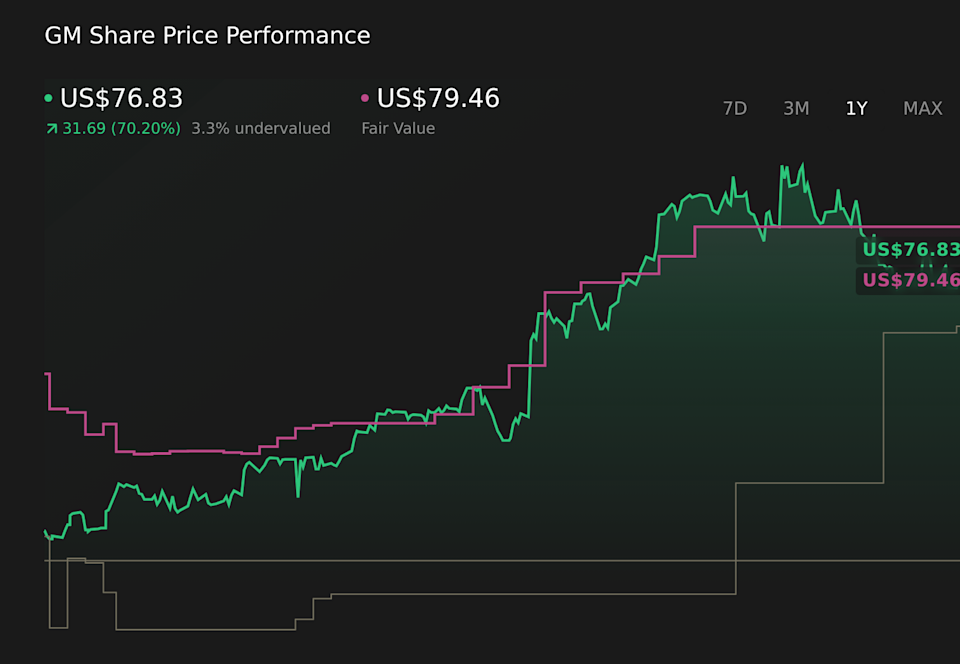 NYSE:GM 1-Year Stock Price Chart
The Malibu and Corvette recalls sit squarely in the regulatory and legal bucket for General Motors. Safety-related defects can attract close attention from the National Highway Traffic Safety Administration, raise the risk of fines if remedies are judged inadequate, and feed into broader legal exposure, especially with the separate Cadillac Lyriq class action already in play. Recalls also tend to lift warranty and repair costs and can strain dealer relationships while fixes are rolled out. In parallel, the 2029 Formula 1 power unit puts GM on a path that could require heavy long-term investment in powertrain technology and compliance with evolving F1 technical rules, with limited short term financial contribution.
The recalls reinforce the existing narrative that product quality and software reliability are key as GM pushes deeper into advanced vehicles, including EVs and high performance programs like Cadillac F1.
Higher warranty costs and legal scrutiny could work against expectations that efficiency gains and cost control will support stronger margins over time.
The Cadillac F1 power unit program introduces a motorsport specific R&D track that is not fully reflected in many long term auto-focused narratives, yet it could influence future powertrain and software development priorities.
Knowing what a company is worth starts with understanding its story. Check out one of the top narratives in the Simply Wall St Community for General Motors to help decide what it’s worth to you.
⚠️ Additional safety recalls or an expansion of current campaigns could keep warranty expenses elevated and draw further regulatory attention.
⚠️ The combination of recalls and the Lyriq lawsuit may weigh on brand perception and could lead to tighter oversight of software and electronics in GM vehicles.
🎁 Proactive recalls and free repair programs may help limit longer term legal exposure and maintain trust with regulators and customers.
🎁 Developing an in house F1 power unit can create technical know how that later feeds into road car powertrains and control systems, supporting GM’s engineering credentials versus peers such as Ford and Stellantis.
From here, keep an eye on the total cost of the Malibu and Corvette recalls, any updates from NHTSA or other regulators, and whether further safety campaigns emerge across GM’s portfolio. Progress updates on the Cadillac F1 power unit, including spending levels and technology transfer to consumer vehicles, will also matter. Analysts have flagged several existing risks around debt, margins, and quality, so investors may want to track how recall activity and legal cases evolve against those concerns.
To ensure you’re always in the loop on how the latest news impacts the investment narrative for General Motors, head to the community page for General Motors to never miss an update on the top community narratives.
This article by Simply Wall St is general in nature. We provide commentary based on historical data and analyst forecasts only using an unbiased methodology and our articles are not intended to be financial advice. It does not constitute a recommendation to buy or sell any stock, and does not take account of your objectives, or your financial situation. We aim to bring you long-term focused analysis driven by fundamental data. Note that our analysis may not factor in the latest price-sensitive company announcements or qualitative material. Simply Wall St has no position in any stocks mentioned.
Companies discussed in this article include GM.
Have feedback on this article? Concerned about the content? Get in touch with us directly. Alternatively, email editorial-team@simplywallst.com