

Listen to this article
Estimated 4 minutes
The audio version of this article is generated by AI-based technology. Mispronunciations can occur. We are working with our partners to continually review and improve the results.
William Bruneau’s third experience using Montreal’s light-rail network didn’t go as planned.
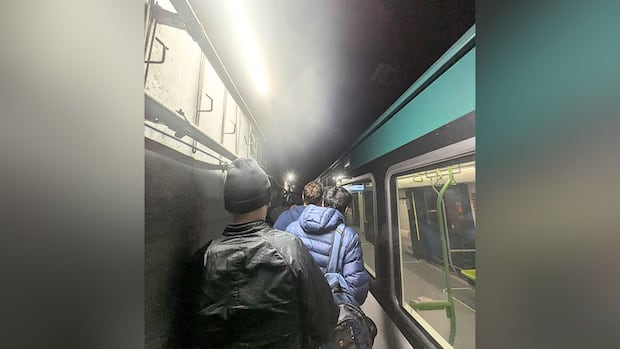
On Friday night, after attending an event in Montreal, he was heading back to Deux-Montagnes, north of Montreal, around midnight when the REM broke down between McGill and Édouard-Montpetit stations.
Bruneau said he waited more than 40 minutes before staff opened the train doors and explained that passengers would be evacuated through a tunnel connecting the two stations. The REM confirmed the intervention occurred a little before 1 a.m.
“There was the 900-metre walk in the tunnel, which would have been pretty scary for an elderly [person] or someone with a physical condition,” Bruneau said.
Once passengers reached Édouard-Montpetit station, Bruneau said inspectors told them to wait for shuttle buses. According to him, while some people rushed out to find alternative transportation, he and others stayed behind, expecting further instructions.
But Bruneau said those buses never came. He said passengers were told they would need to find their own way home.
“There’s literally nothing available, the Metro is closed, the buses, there are a couple of lines that run during the night, but they cannot get you to Deux-Montagnes so there were literally no options,” he said.
Bruneau ultimately paid about $50 for an Uber ride.
For him, the issue isn’t that the REM broke down, but how the issue was managed afterward.
No compensation is ‘very ridiculous’: passenger
On Saturday morning, a few hours after the incident, Bruneau contacted REM customer service to request a refund.
He said the agent on the phone refused, telling him he should have rushed to the Metro before it closed instead of waiting for staff’s instructions.
However, after reviewing his route, Bruneau believed he still wouldn’t have made it to Deux-Montagnes, as he would’ve missed both the Metro and his connecting bus.
He now hopes to receive compensation and see improvements in how such situations are handled.
“I believe that something should be done for everyone that was involved that night and had to call parents to come pick them up or take taxis or take Ubers,” he said.
WATCH | The REM has broken down several times since its 2023 launch: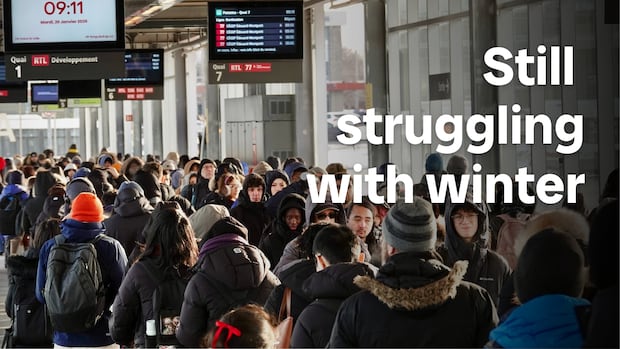
It’s been a(nother) tough winter for the REM. What’s going on?
Many who use Montreal’s light-rail network have been feeling frustrated recently due to winter-related delays and stoppages on the network. Experts say it’s difficult for engineers to predict and prepare for intense weather patterns.
Christina Mantzioros, another passenger stranded on Friday, shared similar concerns. She said there was little communication about what was happening or whether passengers were in any danger when the train stopped.
Like Bruneau, she ended up paying for an Uber ride — about $25 — and also wishes for a refund from the REM.
“I find it very ridiculous that they’re not able to compensate for that. There’s no consequence on their end,” said Mantzioros.
“They need to have some accountability and provide some sort of recourse for people who are using their services.”
REM admits to ‘blind spot’
Isabelle Mercille, spokesperson for REM operator Pulsar, acknowledged that the response on Friday was not “optimal.”
“There is a blind spot in our contingency plan,” she told CBC in a phone interview.
“Especially with the upcoming Metro closures, so we need to review with our partners what we’re deploying and how we’re deploying it to ensure this doesn’t happen again.”
In a statement to CBC, Pulsar said Friday’s operation concluded after the Metro closed for stations where it serves as “the alternative transportation option specified in the plan.”
“The procedure will be reviewed in consultation with the partners responsible for the REM contingency plan,” read the statement.
According to Mercille, standard procedure in the event of a service disruption is to activate a contingency plan after 20 minutes of interruption.
She said that plan was triggered on April 11 and involved four trains at four different locations. She added that buses were dispatched to three of those locations but admitted there were no Metros for people stuck between McGill and Édouard-Montpetit stations.
She encourages anyone affected by the incident to get in touch — again — with customer service, adding that their cases will be taken care of.
In response to questions about accessibility, she said a protocol is in place to assist passengers with reduced mobility, which includes evacuation via the tunnel.
“We would like to remind everyone that passenger safety and support remain our top priority,” read Pulsar’s statement.