
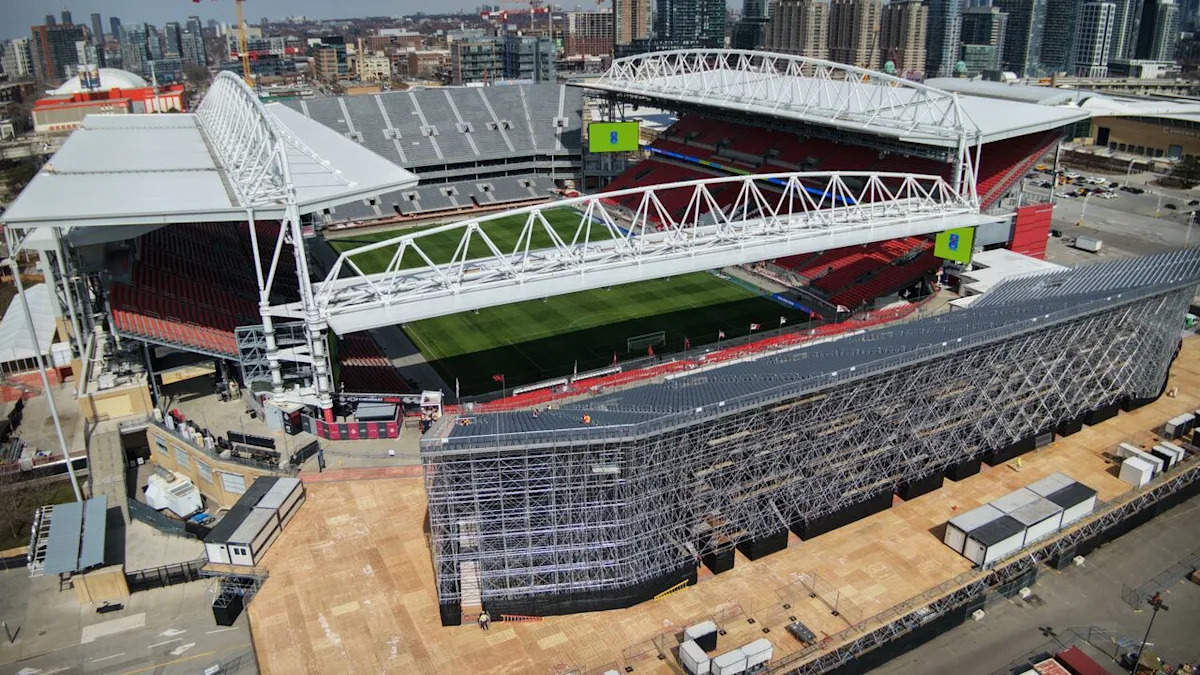
With less than 60 days to go until the 2026 FIFA World Cup descends on Toronto, the city’s police force has made public its safety plan for the tournament, with a few exercises still left to do in preparation for one of the world’s biggest sporting events.
The safety plan was presented to the police service’s board Monday, with a focus on four sites: the stadium and fan festival locations downtown, Downsview Park in North York and Centennial Park in Etobicoke. The downtown sites will be swarmed with fans during the tournament, while Team Canada will be practicing at Downsview Park, as will some visiting teams at Centennial.
A variety of units will be involved, from police dogs sweeping the stadium to mounted units keeping a handle on large crowds. Toronto police officers on the ground will be joined by officers from the RCMP, Durham, York, Peel regions and Ontario Provincial Police for extra support.
“This team has been at this for the past three and half years,” said Toronto police Insp. Barry O’Neill. “In preparation for the world’s largest event coming to the City of Toronto.”
The city’s emergency task force, meaning the team of officers who respond to high-risk emergency situations, will also be part of the plan, stationed both at the stadium and fan festival. There will also be members of the explosive disposal unit working with the teams tasked with keeping public order, as well as increased patrols from the city’s marine unit.
Police anticipating uptick in protests
The city will host six matches during the World Cup, five in June and one in early July, at Toronto Stadium, the temporary name for BMO Field during the tournament. Between the Fort York fan festival site and the expanded Toronto stadium, 65,000 people will be swarming the city’s waterfront for the games
“Obviously with football there is the hooliganism that comes along with it that is not as prevalent when it comes to the World Cup,” said O’Neill. “We will see an uptick most likely in protests and demonstrations. The reason for that is just the global media presence.”
He said the last World Cup had a global audience reach in the billions, which means any potential protest has the chance to be seen by a lot of eyeballs.
Police say information they’ve received from FIFA indicates about 70 per cent of ticket holders coming to matches will be international travellers.
“A lot of these fans are coming from countries where they’re very used to walking,” O’Neill said. That means there may have to be improvised road closures to keep fans safe as they flood the streets.
But there are also planned restrictions on where people can drive and park, said Coun. Shelley Carroll, chair of the police board. Carroll said at the meeting she wants to ensure the city plays a role in making everyone aware of them.
“I worry that the Toronto Police Service will be held accountable, but it’s a bigger community information piece,” she said.
Carroll said they’ve learned that organizers for the Paris 2024 Olympic Games began broadly communicating road closures in April for the July games. A news release about Toronto’s mobility plan issued in late March says there will be road closures, but doesn’t list where.
Police will simulate plans with upcoming match
While preparations have long been in the works, police still have a few exercises to conduct before kickoff.
On Wednesday, police will be doing a “mass casualty exercise” in partnership with local hospitals, the board heard. Then, on May 9 when Inter Miami and global superstar Lionel Messi come to play Toronto FC, police will have the chance to simulate what a FIFA match day will look like.
In addition to the more obvious issues of rowdy fans and protests, police say they are also preparing for a potential uptick in human trafficking, which the presentation said statistically increases in cities hosting international sporting events.
The service is also working on public education when it comes to potential ticket sales fraud related to the highly sought-after matches.
“Obviously, we saw that with Taylor Swift,” O’Neill said.