
University of Amsterdam researchers have unveiled a new type of human-made ‘metamaterials’ that can learn, change shape, and move on their own, without an external operator or an internal circuit controlling their actions.
The research team behind the invention said their metamaterials can also adapt their shape-changing strategy, perform unprogrammed ‘reflex’ actions, and learn to move around in ways similar to those of actual living systems.
In the future, they are exploring the development of more advanced versions of their metamaterials that can learn different locomotion ‘gaits,’ allowing them to traverse unusual or complex terrains. They are also exploring imbuing their materials with a facility for probabilistic adaptation rather than deterministic adaptation, similar to how actual living systems work.
Intelligent Metamaterials That Can Learn and Move Inspired by Living Systems
In a statement announcing the research, the University of Amsterdam team notes that normal, non-living materials have predictable responses to external stimuli, such as heat or pressure. Conversely, living materials such as cells can adapt to stimuli and even make choices regarding their reactions.
Recent advances in materials science have led to the creation of modern ‘metamaterials’ that combine the benefits of natural materials. For example, a material that offers electrical conductivity but does not withstand extreme heat could be combined with a second material with strong heat resistance to create a conductive metamaterial that operates in harsher conditions, such as outer space. Still, even the most advanced metamaterials cannot react like living systems.
Some advancements by the university’s Machine Materials Lab led to materials capable of what the researchers termed “brainless locomotion,” where ‘odd’ objects designed by the research team showed the seemingly lifelike ability to crawl, roll, or wiggle over unpredictable terrain without any human interaction. However, the team concedes, those objects were incapable of memorizing or learning new behaviors.
Now, the researchers have taken that research to a new level, resulting in synthetic metamaterials that can learn and adapt without a centralized ‘brain’.
Chains of Tiny Microcontrollers Work Together to Complete Tasks
To create a material that can learn and move on its own, the team assembled chains of tiny, identical motorized hinges linked together by a skeleton made from an elastic fiber. Each individual hinge contains a microcontroller that monitors how far the hinge is rotated and can remember its past movements.
Critically, individual hinges can exchange this information with their nearby hinges, allowing each one to respond by exerting a torque. Depending on the required response, the hinge can adjust its stiffness and preferred position. The research team said these results demonstrate that a combined metamaterial “learns to adopt a new shape” in response to external stimuli.
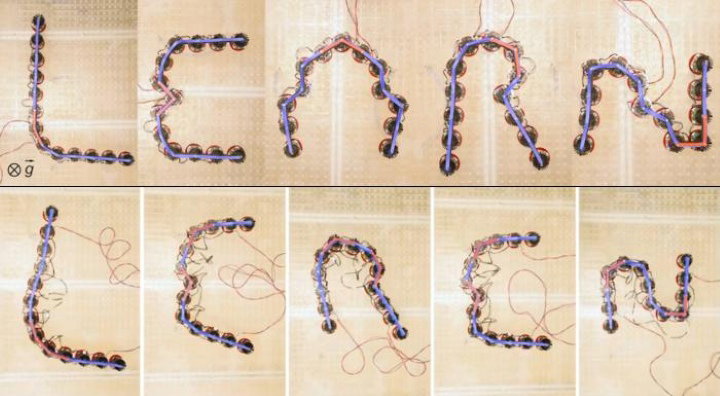
To test their material’s ability to learn and move on its own, the team trained it. After teaching it to react to external stimuli to achieve a desired shape, the team’s metamaterial was able to change its shape to spell the word ‘learn” in English and in Dutch (Leren).
 The new metamaterials can learn to take on any shape – here, they have learned the letters that spell ‘learn’, or in Dutch: ‘leren’. Image Credit: Yao Du et al.
Further testing showed that the new material can forget old shapes and learn new ones through trial and error. The material can also learn or remember multiple shapes at once or even switch rapidly between shapes. The researchers noted that this unprecedented level of versatility and autonomy enables their metamaterial to “perform advanced tasks such as grabbing an object or moving around (locomotion).”
“The most exciting observation of our research was that learning gives our metamaterials the ability to evolve,” explained Yao Du, PhD candidate in the Machine Materials Lab at the UvA and first author of the paper. “Once the system starts to learn, the possibilities of where it ends up feel almost limitless,”
“Improving Robustness and Flexibility in Complex Environments”
When discussing the implications of their new metamaterial that can learn and move on its own, the UvA team noted that the growing interest in robotics and advanced materials has increased “dramatically over the last few years,” including ‘smart’ metamaterials that don’t need external controls to provide intelligent functions.

As for their research, DU said the team aims to achieve a “learning time-dependent behaviour” in their material rather than one that forms a static shape. This includes developing metamaterials that can learn different locomotion gaits, such as crawling or rolling, “depending on environmental stimuli.”
DU said the team is also planning to investigate “stochastic scenarios” where noise and uncertainty are part of the learning process, similar to actual living systems.
“In such cases, the system would adapt probabilistically rather than deterministically, improving robustness and flexibility in complex environments,” the researcher explained.
The study “Metamaterials that learn to change shape” was published in Nature Physics.
Christopher Plain is a Science Fiction and Fantasy novelist and Head Science Writer at The Debrief. Follow and connect with him on X, learn about his books at plainfiction.com, or email him directly at christopher@thedebrief.org.