
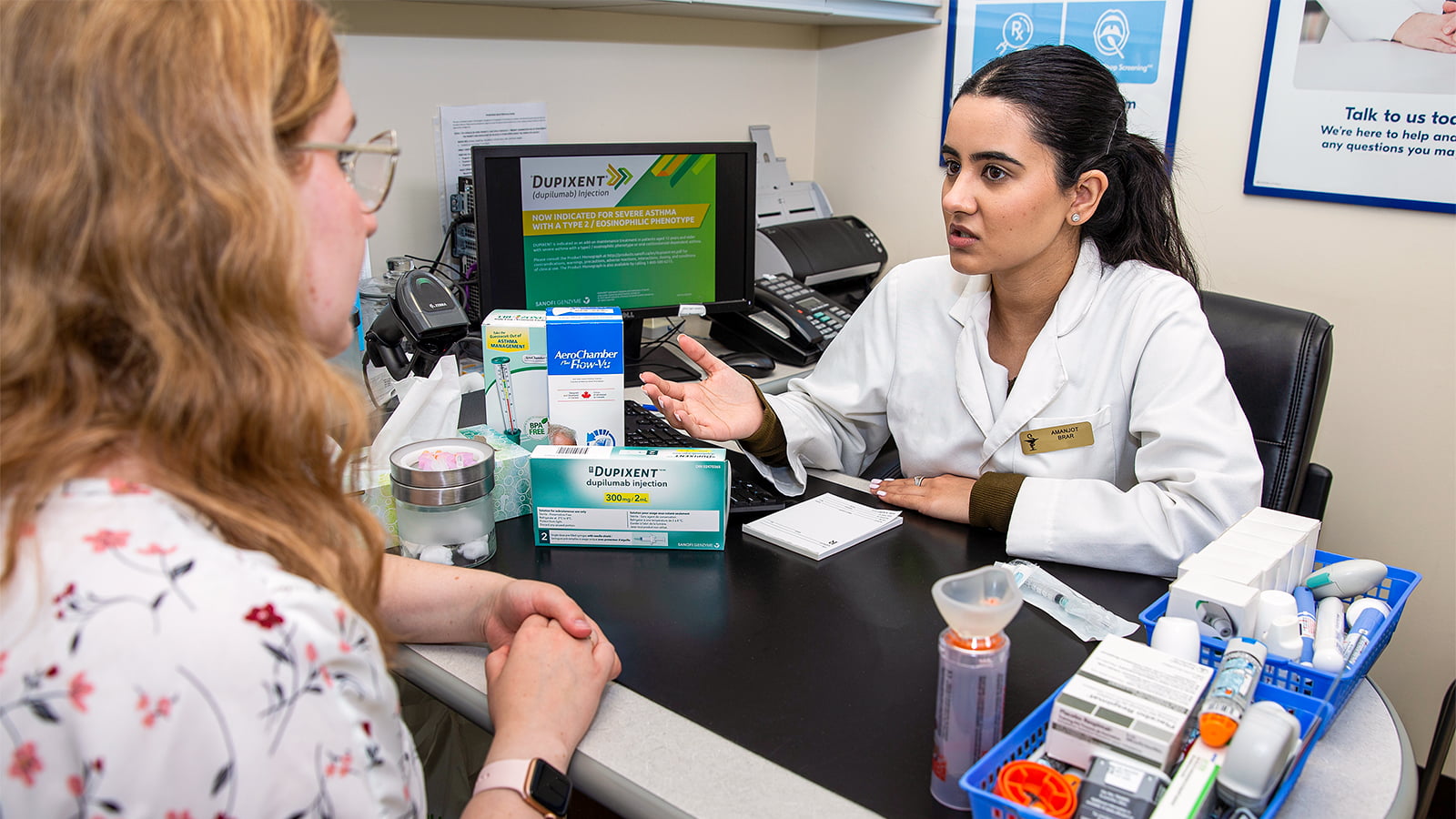
The next time you need medical advice for a common ailment like acne, insomnia or pink eye, consider visiting your pharmacist.
Pharmacists in Alberta have the widest scope of practice in Canada, and more than 100 new community pharmacy care clinics across the province are designed to complement what is offered by physicians, walk-in clinics and emergency departments.
A new study from University of Alberta researchers reports that the community pharmacy care clinics are improving access to primary care services.
“Patients can come to a pharmacy to get primary care and chronic conditions managed, and that can decrease pressure on the rest of the health-care system,” says principal investigator Scot Simpson, professor in the Faculty of Pharmacy and Pharmaceutical Sciences.
“This is not about replacing family doctors, it’s about enhanced access to care,” says first author Yazid Al Harmaneh, assistant professor of pharmacology in the Faculty of Medicine & Dentistry. “Wherever you go, there is a pharmacy. There is a clear need and a clear gap that these care clinics are fulfilling.”
The new community pharmacy care clinics go beyond the traditional prescription drop-off and pick-up window within a community pharmacy setting, usually offering a separate “clinic” room where pharmacists can assess patients privately. They will assess what’s wrong, prescribe or adjust medications, do some on-site tests and refer you to a family physician or a specialist if you need one.
The researchers tracked patient needs at the province’s first community pharmacy care clinic in Lethbridge between June 2022 and January 2023. A total of 3,305 people visited the clinic 4,962 times, reporting 4,917 reasons for seeking care when surveyed. The mean age of the patients was 32 years, and 62 per cent were women.
One in three people who visited the pharmacy clinic said they did not have a family doctor. Eighty per cent of visits were for assessment and management of an acute common ailment. Fourteen per cent of the visits were for chronic diseases such as high blood pressure or diabetes, and for mental health concerns. Three per cent were for testing or vaccinations.
People who said they didn’t have a family doctor were more likely to visit the pharmacy care clinic two or more times. Nearly 10 per cent of patients said they would have gone to an emergency department or a walk-in clinic if the pharmacy clinic hadn’t been there.
Pharmacists in Alberta are allowed to prescribe most medications except narcotics, order lab tests, administer injections, do throat swabs and other point-of-care testing, advise on tobacco cessation, manage chronic disease and make referrals for further care.
“The most important thing to know is that we are here for you,” says Al Harmaneh. “If for any reason you do not have a family physician or you cannot access your family physician, your pharmacist is there to help you. You have another avenue for care that’s not replacing but complementing all the other care you are receiving.”
The researchers will next analyze data that follows patients through the health-care system before and after their community pharmacy care clinic visit, to track their outcomes and analyze their use of other services such as laboratory testing, specialists and emergency department visits.
“We know already that these clinics are fulfilling an access need and releasing a burden on acute care,” says Simpson. “Next we want to see whether it reduces the burden on the individual patient. Does it reduce their risk of hospitalization or development of an acute infection or complications of diabetes?”
The study was funded in part by a research grant from Shoppers Drug Mart to the Faculty of Pharmacy and Pharmaceutical Sciences to support research to improve access to care. Data analysis was done by the biostatistics team at EPICORE at the University of Alberta.