
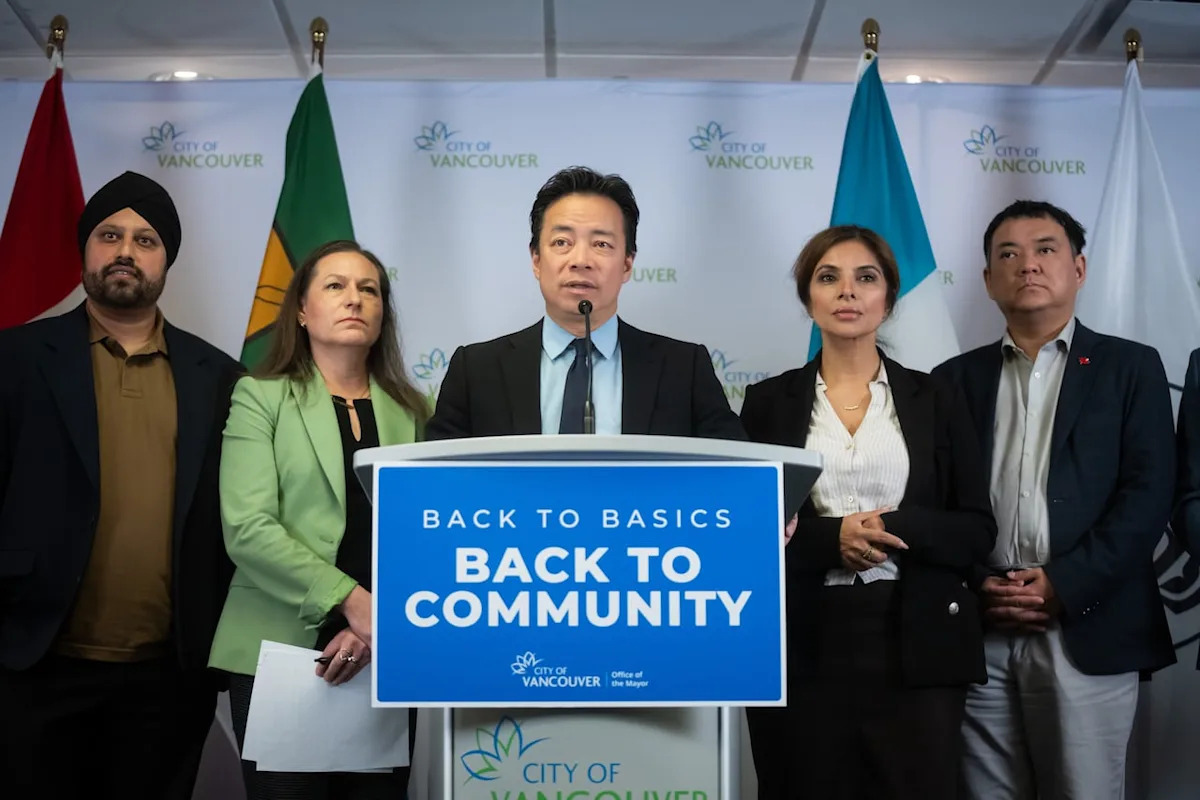
Vancouver Mayor Ken Sim and his ABC majority on council announced Wednesday that a motion next week will list its priorities for the upcoming 2027-30 capital plan — which includes $400 million in investments for the city’s aging community centres.
The motion follows a funding request from the Vancouver Park Board last week that sought over $1.43 billion in investments for the city’s parks and recreation facilities, which included $400 million for community centre renewal and maintenance.
Sim’s announcement Wednesday included some of the projects in that funding request, but also a proposal to explore a Vietnamese Cultural Centre and a new Collingwood branch for the Vancouver Public Library.
The mayor also pointedly said that some of the proposals would direct investments towards South Vancouver in particular, with a proposal to build a 25-metre swimming pool at Sunset Community Centre.
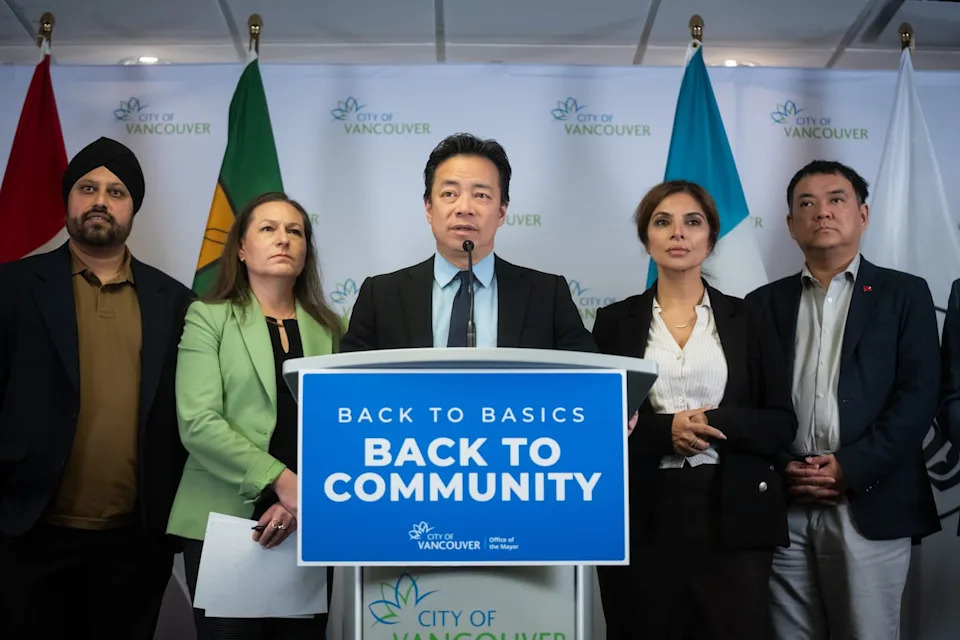
Vancouver Mayor Ken Sim, centre, argued that decades of underinvestment had left community centres in a precarious state. (Ben Nelms/CBC)
“This capital plan will be the single largest investment in South Vancouver’s history,” the mayor said.
In a report released last year, Vancouver’s auditor general said that 72 per cent of the city’s 24 community centres, 14 pools and eight indoor rinks were in “poor or very poor condition,” with an infrastructure deficit of $33 million per year.
Sim echoed park board commissioners who said last week that decades of underinvestment had left facilities in unacceptable states, and the 2027-30 capital plan would be the “first opportunity to reprioritize and fix the challenges that we inherited.”
The mayor also said the motion, which hasn’t yet been released to the public, would look at the idea of delivering projects through partnerships with other bodies.
During Sim’s tenure, the city has passed policies that sought to raise corporate funds through offering naming rights, among other things.
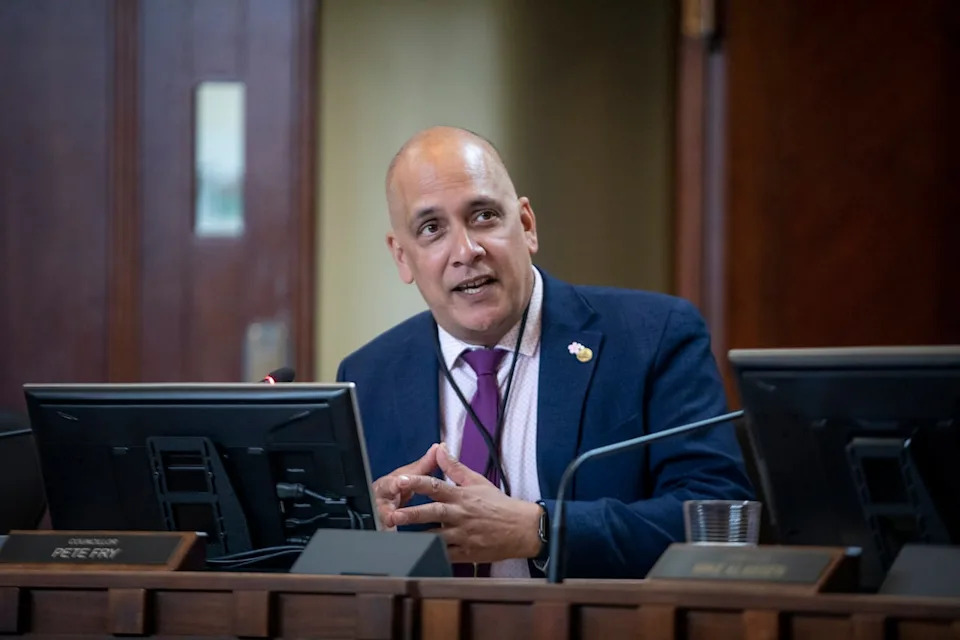
Green Party Coun. Pete Fry, who is running for mayor in the upcoming fall election, says more details would be needed on how the investments would be funded. (Ben Nelms/CBC)
Pete Fry, a Green Party councillor who is running against Sim in October’s municipal election, said the “devil’s in the details” when it comes to what partnerships the mayor is referring to.
He said that, traditionally, capital plans have been funded in part by partnership contributions, like community amenity contributions raised from developments.
“We’re in a different territory now. We’re not generating that kind of revenue,” he said.
“So when I hear partnerships? It does raise some questions what kind of partnerships we’re talking about.”
Typically, capital plans are made by council to set priorities for a four-year period, and any borrowing to fund the plan would be approved by voters in that fall’s municipal election.
Fry argued that Sim’s commitment to zero per cent property tax increases would limit the city’s flexibility in paying off any debt it incurs.
A former park board commissioner said the mayor’s list of priorities seemed to be at odds with what commissioners were requesting. (Ben Nelms/CBC)
Aaron Jasper, a former park board commissioner, said that Sim’s list of priorities seemed to go against what commissioners requested last week — a list of priorities that came after hearing from over 60 different speakers.
He also said that $400 million did not seem to cover the number of projects that Sim would want prioritized.
“It’s unfortunate that they’ve gone ahead and put the cart before the horse in terms of announcing their priorities,” he said.
“We think that they should have done the other way around. Listen to the public, hear from the stakeholders … and then from there, prioritize the list.”