
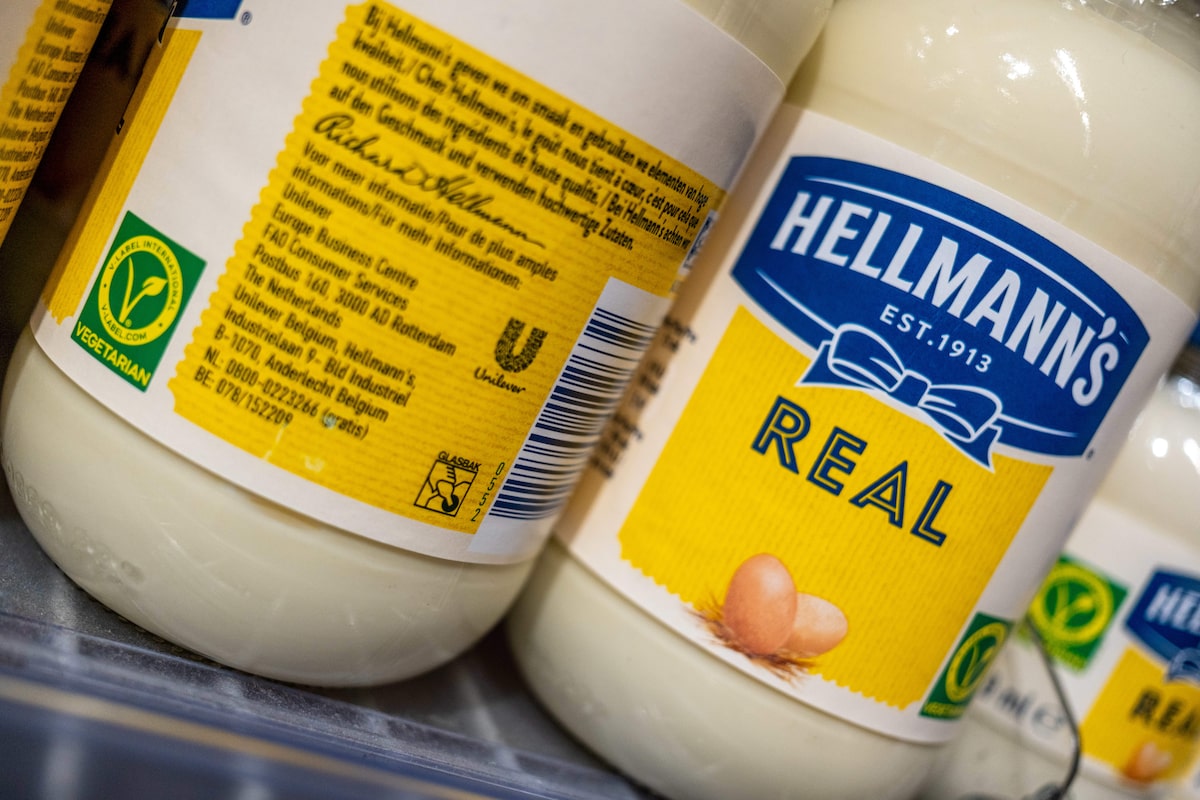
Unilever is applying a 9-per-cent increase in the price it charges retailers for its Hellmann’s mayonnaise.Storm Groenendijk/Reuters
Multinational food and packaged-goods conglomerate Unilever PLC UL-N is applying a 9-per-cent increase in the price it charges retailers for its Hellmann’s mayonnaise – another signal that soaring fuel costs are putting pressure on grocery prices.
The Anglo-Dutch company sent a notice to retailers late last week, saying the price hike – which will take effect in early July – reflects a “significant increase” in its costs. The notice, and those from other companies, was obtained by The Globe and Mail.
The Globe was first to report last week that Maple Leaf Foods Inc. and other suppliers have been informing retailers of a new surcharge on their deliveries. Those food and beverage vendors have explained that the moves are linked to rising transportation costs, as the United States and Israel’s war with Iran has upended global energy supply chains.
Middle East conflict creates disproportionate inflationary pressures in Canada’s North
Unilever’s notice is slightly different from those other communications, because it comes in the form of a standard cost increase, with a much longer lead time than such temporary surcharges.
The company also did not refer specifically to fuel prices, but noted that “Unilever reserves the right to consider further costing action to more fully reflect product cost inflation,” according to the letter signed by Bruce Findlay, Unilever Canada’s head of customer business development in foods.
These conversations between suppliers and grocers are not just happening in Canada, said Henry Chambers, senior vice-president with Sentinel Management Consultants, a strategic advisory and commercial capability training firm that works with food suppliers around the world. “This is everywhere,” he said, as rising fuel costs have global effects, “… all the manufacturers have been hit.”
More suppliers in Canada have communicated price hikes recently to retailers. Also last week, Canadian Linen & Uniform Service, a Toronto-based supplier of employee uniforms and other items, sent a notice to stores of a 3-per-cent “temporary energy surcharge,” effective immediately. The letter cited rising costs for the diesel and gasoline used for deliveries, as well as other energy needs.
The Editorial Board: Leave public grocery stores on the shelf
Allmart Distributing, a Vaughan, Ont.-based beverage distributor, informed customers last week of a 0.5-per-cent increase to its delivery charges, and it included a chart showing the increase in diesel prices since the U.S. and Israeli strikes on Iran in late February. “This adjustment will be reversed as soon as fuel prices return to levels before the attack,” the note stated.
Brandt Meats, a Mississauga-based manufacturer and distributor, opted not to adjust its prices, but told retailers in late March that it would be increasing its minimum order volumes, and would require customers to order at least $1,000 for all deliveries, starting May 4.
“Rising fuel and labour costs have significantly increased transportation expenses across our industry,” its letter stated.
The federal government on Tuesday announced a temporary tax break on gasoline, diesel and aviation fuel, which takes effect next week. But the measure provides only partial relief from broader increases in fuel costs.
Unilever and all the other suppliers in this story did not respond to requests for comment from The Globe. Unilever recently agreed on a deal to combine its food business with U.S. spice and sauce maker McCormick & Co.
Mr. Chambers has been advising clients that surcharges are the best mechanism to use, both because they can be applied more quickly than typical cost-price increases – which usually require weeks of advance notice – and because they are designed to be lifted when circumstances change and costs normalize.
“A surcharge is a temporary measure, which is the right thing to do,” he said. Surcharges were also applied by some suppliers last year when countertariffs that were put in place in response to U.S. President Donald Trump’s tariffs on Canadian goods made a number of imports from the U.S. more expensive.
Opinion: Government-run grocery stores: A leftist idea coming from the heart, not the head
But the situation is raising concerns that smaller, independent retailers may be disproportionately shouldering the burden of these types of price hikes – as some major grocers have confirmed that they are refusing such measures.
Sobeys parent Empire Co. Ltd. EMP-A-T has declined “a few requests” for fuel surcharges, spokesperson Karen White-Boswell wrote in an e-mail to The Globe.
“We believe the fuel market is too unpredictable to take any decisions that could adversely impact the value we provide to our customers,” she wrote.
Scott Bonikowsky, a spokesperson for Loblaw Cos. Ltd. L-T, declined to comment on dealings with specific suppliers, but said in an e-mail that “we continue to push back on unjustified cost increases that would cause inflationary pressures for Canadians and that includes for fuel surcharges, which we have now seen a few come through.”
Metro Inc. MRU-T spokesperson Marie-Claude Bacon wrote in an e-mail that the company negotiates such requests from suppliers “to ensure they are justified and to limit the impact on our customers,” but she declined to comment on any specific notices that have come in recently.
Spokespeople for Walmart Canada and Costco Canada did not respond to questions from The Globe for this story.
“When we get the notices of price increases, we don’t get to negotiate,” said Gary Sands, vice-president of government relations at the Canadian Federation of Independent Grocers. “If you’re an independent and you want to challenge a price change from a major company … I’ll take you there, but I’ll keep the car running in the parking lot. Because it’s not going to be a long meeting.”
Peter Chapman, founder of consulting firm SKUFood, said the impact of rising fuel costs might already be showing up in some grocery prices. Fresh produce, for example, operates under a pricing model in which increases in input costs such as fuel are incorporated almost immediately into prices, rather than being negotiated separately.
“It’s not $25 plus a fuel surcharge … it’s just broccoli this week costs $27,” he said. “The fresher it is, the sooner you’re going to see the change.”