
Stay up to speed with stories written by drivers, for drivers.
Get automotive news, DIY tips, market trends, in-depth car profiles, and more right in your email inbox.
There are multiple hurdles to clear when performing a restoration or mechanical refresh on a car. To restore a popular vehicle that has lots of parts and support available may not be the LEGO kit some want or expect, but it is indeed on the easier end of the spectrum.
At the opposite end are one-off prototypes and rare race cars, often built with ultra-rare bits and pieces. One such car would be the four-rotor Mazda 787, one of which took the overall win in the 1991 24 Hours of Le Mans. Though spiritually kin to the Mazda RX-7, the race car was basically built from one-off parts. Mazda recently tore down one of its 787 race cars for a refresh and didn’t hide the details that made its engine extra special.
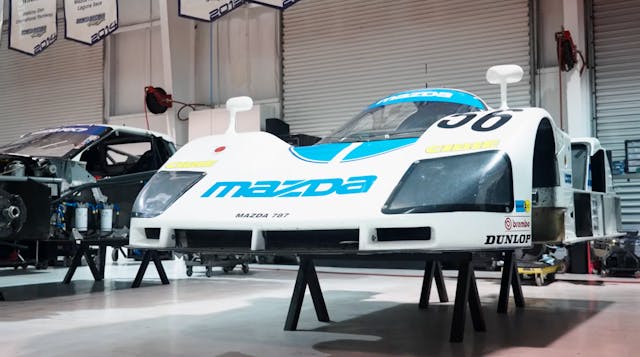 One of the 787 chassis that raced in the 1991 24 Hours of Le Mans.Mazda Motorsports
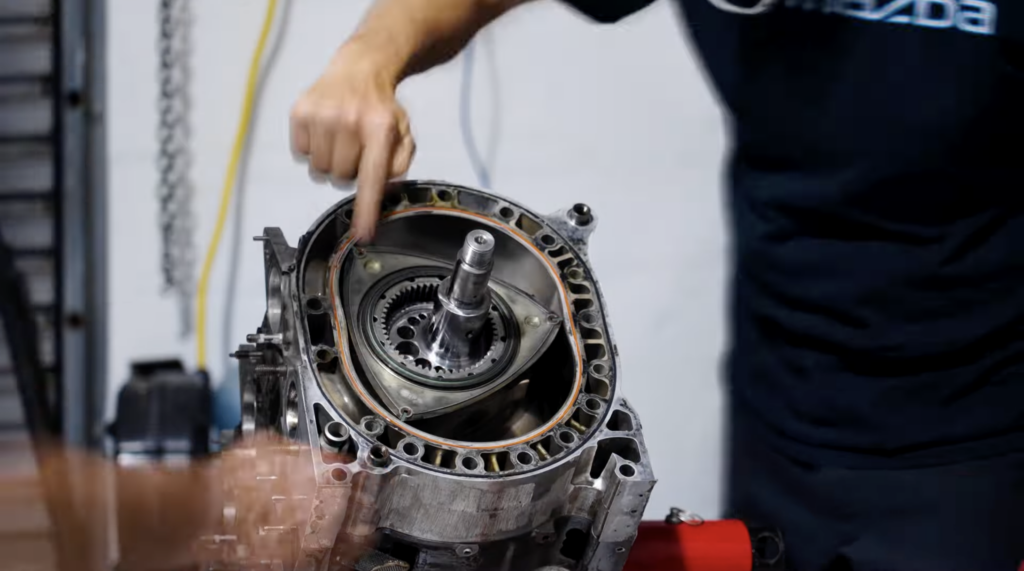
The concept of a rotary engine is a little strange in and of itself, as most gearheads are far more familiar with engines that translate reciprocating motion into rotational motion rather than a rotary that eschews pistons. Instead, there are triangular rotors with seals at the points, and as the rotor turns inside the housing, the design of the crankshaft enables an intake, compression, combustion, and exhaust cycle in a single revolution. It creates sounds unlike any other engine and is power-dense like few other designs. Stack four of these rotors on a common crankshaft and the potential for race wins is clear.
Of course, most anything this awesome has drawbacks, and the modifications done to the Le Mans-spec engine highlight a few of the ones inherent to the rotary design. Most Mazda rotary engines feature two spark plugs per rotor housing but the way the rotary cycles is relatively inefficient, leading the Le Mans motor to have three spark plugs per rotor. This likely ensured a more complete burn of the air and fuel mixture, helping with fuel economy, which can be so critical at endurance races.
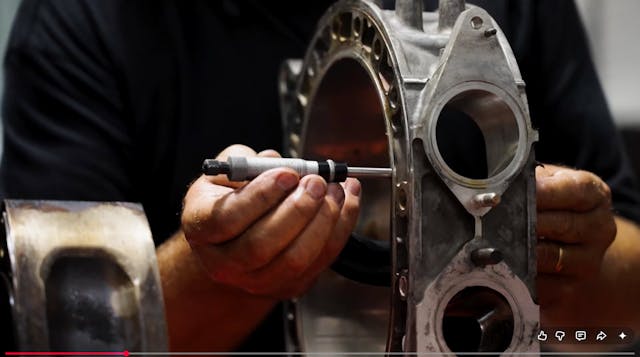 Checking the width of the rotor housings with a micrometer.Mazda Motorsports
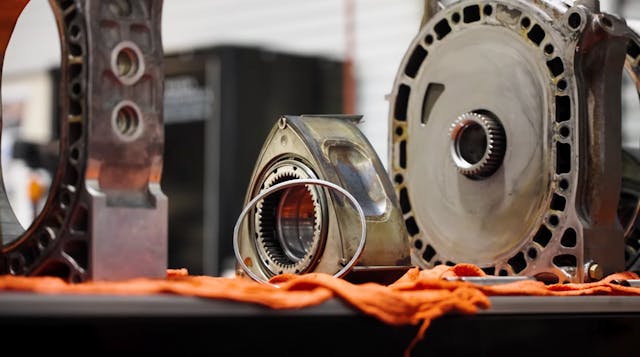 The rotors are actually the same between other race engines.Mazda Motorsports
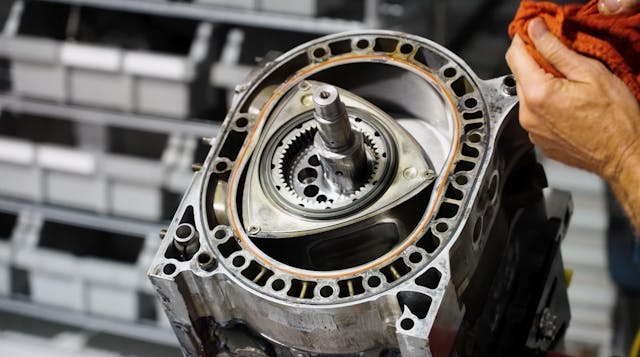 The assembly is simple, but effective.Mazda Motorsports
Another interesting item highlighted is the ceramic apex seals. If you’ve heard one criticism of rotaries, it’s likely about their propensity to eat apex seals and lose compression. The seals in this race engine are ceramic, which is lighter and also more durable. Combine the lighter seals with stronger springs, keeping them pressed to the housing, and this engine is likely more stable through extended heat cycles and wear.
It’s a rare look inside a particularly rare engine. To see what makes this specific one special is fun and also serves as a good reminder that plenty of rotary racers are still running and track-prepared. The simplicity of the engine design might be one reason for that.