
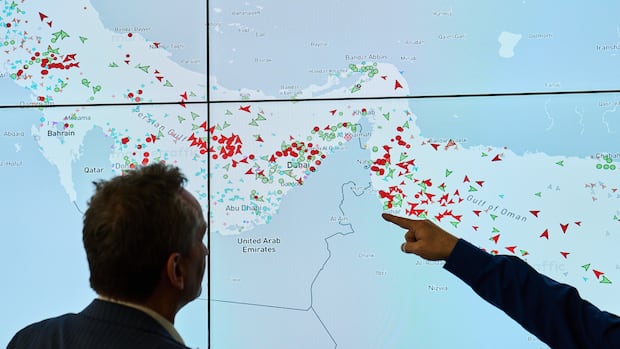
Iran’s foreign minister announced Friday that passage for all commercial vessels through the Strait of Hormuz is completely open following a ceasefire agreement reached in Lebanon yesterday, but President Donald Trump said the U.S. naval blockade on Iran will remain in place until a deal with Tehran is struck.
“The Strait of Hormuz is completely open and ready for business and full passage,” Trump wrote on Truth Social. “But the naval blockade will remain in full force and effect as it pertains to Iran, only, until such time as our transaction with Iran is 100% complete.”
Iran responded sharply, with Foreign Ministry spokesperson Esmaeil Baghaei warning that Tehran would take “necessary reciprocal measures” if a maritime blockade continued, saying it was in violation of the ceasefire.
Israel and Lebanon on Thursday announced a 10-day pause in fighting, which is separate from the ceasefire in the U.S. and Israeli war against Iran that’s due to expire next week.
The war on Iran, which started on Feb. 28, has killed thousands of people and destabilized the Middle East.
WATCH | Iran reopens Strait of Hormuz: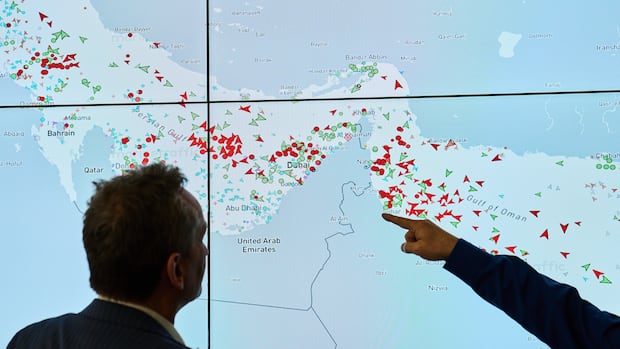
Strait of Hormuz open during U.S.-Iran ceasefire, Trump and Iran’s foreign minister say
U.S. President Donald Trump and Iran’s foreign affairs minister say the Strait of Hormuz is open during the ceasefire between their countries, as they negotiate a peace deal. Trump also said the U.S. naval blockade is still in place, but only for Iranian vessels.
The conflict led Iran to effectively close the Strait of Hormuz, through which a fifth of the world’s oil and liquefied natural gas transits, threatening the worst oil shock in history. The U.S. military blockade of Iran’s ports followed after talks last weekend in Pakistan ended without agreement.
Lebanon was dragged into the war when Hezbollah began firing rockets into northern Israel on March 2 in solidarity with its ally.
Iranian Foreign Minister Abbas Araghchi said on X on Friday the strait will be open for all commercial vessels for the remainder of the Israel-Lebanon ceasefire.
Araghchi said the passage of ships would need to be along the route that Iran’s Ports and Maritime Organization had announced.
Trump has said he believed a deal to end the Iran war would come “soon,” although the timing remains unclear. He told Reuters on Friday there could probably be more talks this weekend, though diplomats said that was unlikely given the logistics of gathering in the Pakistani capital, Islamabad, where the talks are expected to take place.
Despite Trump’s optimism, Iranian sources told Reuters that “gaps remained to be resolved” before a preliminary deal could be reached, while senior clerics struck a defiant tone during Friday prayers.
“Our people do not negotiate while being humiliated,” cleric Ahmad Khatami said.
Trump also said Iran, with the help of the U.S., has removed or is in the process of removing all sea mines it placed in the strait.
Adm. Brad Cooper, the top U.S. commander in the Middle East, confirmed that the U.S. military will be working to clear mines from the Strait of Hormuz but would offer no details on the scope of the task.
Ships test Hormuz exit
A group of ships made an unsuccessful attempt to exit the Gulf on Friday evening, ship-tracking data showed, as shipping companies cautiously welcomed Iran’s announcement that the Strait of Hormuz was open.
Around 20 vessels began sailing toward the Strait of Hormuz on Friday evening but soon halted, with some turning back, MarineTraffic data showed. It was the largest group of vessels to attempt the transit since Iran effectively closed the strait in response to U.S.-Israeli strikes that began on Feb. 28.
It was not immediately clear why the ships stopped. The group included three container ships operated by French shipping group CMA CGM, which declined to comment.
As of 5 p.m. ET, most vessels in the group had turned back, but tracking data showed several new ships, mainly tankers, heading toward the strait.
The head of the Norwegian Shipowners’ Association, Knut Arild Hareide, said the reopening is a welcome development. But key issues remain unresolved, including the presence of mines, Iranian conditions and how the measures would be implemented in practice, he said.
“These aspects will need to be clarified before any transit can be assessed,” he said.
Nils Haupt, senior director of communications of German shipping giant Hapag-Lloyd, echoed those concerns, adding that there is no clarity around the order of ships allowed to enter the strait.
“There are roughly a thousand ships in the gulf at the moment. Who is leaving first? Will it be like a chain? How is the procedure? This is all information we would need to know and because priority number one is safety and security of the seafarers,” Haupt said.
Countries ready to join
British Prime Minister Keir Starmer said on Friday that more than a dozen countries were ready to contribute assets to a defensive mission aimed at restoring the freedom of navigation of the Strait of Hormuz.
France and Britain chaired a meeting in Paris of 49 countries to discuss preparations for a possible multinational defensive mission to protect shipping in the Strait of Hormuz once conditions allow.
“We will take this forward with a military plan conference in London next week where we will announce more detail on the composition of the mission, and over a dozen countries have already offered to contribute assets,” Starmer told reporters alongside the leaders of France, Germany and Italy.
“Reopening the strait is a global necessity and a global responsibility,” he said.
WATCH | Europe warns of jet fuel shortages:
Europe has ‘maybe 6 weeks’ of jet fuel due to Iran war, IEA chief warns
The head of the International Energy Agency is warning some European planes may be grounded as the continent faces jet fuel shortages because of the U.S.-Israel war against Iran. Industry experts told CBC News that Canadians planning to travel abroad should expect costs to go up.
German Chancellor Friedrich Merz said on Friday that his country was also prepared to contribute.
“I require a decision by the federal government, a mandate from the German Bundestag and a sound military concept,” Merz said in Paris alongside his counterparts, adding that this could include reconnaissance and mine clearing.
“We will therefore take part in the further military planning discussions that are taking place and would also like to see the United States of America participate, if possible. We believe this would be desirable,” he added.