
How to
Be Cultured Menu Art
Corinne, Utah
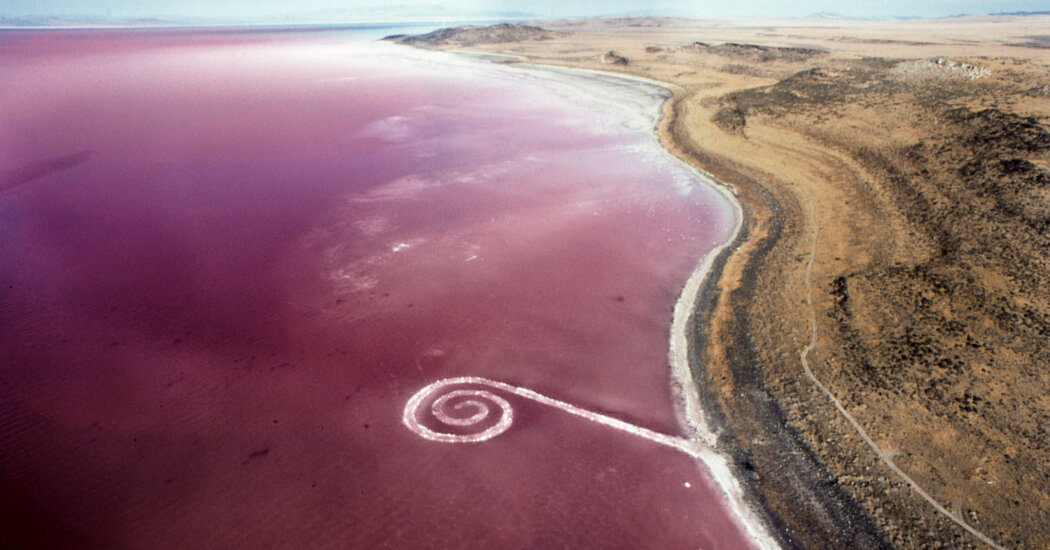
‘Spiral Jetty’ (1970) by Robert Smithson
“Spiral Jetty” is what Kevin Beasley, 40, a New York-based artist who’s heavily influenced by land art, calls “the poster child” for the movement. Located on the northeast shore of Utah’s Great Salt Lake, the work is a coil made from roughly 6,000 tons of earth and basalt rock that stretches 1,500 feet long and 15 feet wide. Its creator, Robert Smithson, who died in a plane crash in 1973, was one of a handful of American artists who began creating large-scale outdoor works, mainly in the Southwest, in the 1960s and ’70s. For Beasley, “Spiral Jetty” epitomizes the unpredictability of land art. A couple of years after its debut, it was submerged in the lake, and it largely remained so until 2002, when, as the lake receded because of drought, the sculpture re-emerged. Since then, it has become, essentially, a beached artwork. Land art thrives in “the impossibility of control,” Beasley says. “It’s like seeing an animal in the wild.”
Quemado, N.M.
‘The Lightning Field’ (1977) by Walter De Maria
Sometimes, light is an even more important element for land art than dirt, says Michael Govan, the director of the Los Angeles County Museum of Art, who’s worked with many of the artists associated with the movement. For “The Lightning Field,” Walter De Maria arranged 400 stainless steel poles in a one-mile-by-one-kilometer grid on a remote expanse in New Mexico. Only six people — who must stay overnight at a cabin adjacent to the property — are allowed to visit at any time. While the poles are designed to attract lightning, it’s rare for it to actually strike them. “The more ordinary, extraordinary events are sunrise and sunset,” Govan says. “It’s like God flipped a switch.”
Garden Valley, Nev.
‘City’ (1970-2022) by Michael Heizer
By the time “City” opened in 2022, it had been under construction for 50 years and achieved near-mythological status. Critics likened aspects of Michael Heizer’s nearly mile-and-a-half-long, half-mile-wide complex of concrete and dirt mounds, plazas and geometric constructions to Teotihuacán and Luxor. (Heizer’s father, Robert, was an archaeologist who worked in Mexico and Egypt.) While many artists are concerned with scale, “Michael Heizer taught me that it’s about distance and size,” Govan says. There’s nothing metaphorical about walking a mile and a half in the harsh desert sun.
Various locations, including Oaxaca, Mexico, and Iowa City
‘Silueta Series’ (1973-80) by Ana Mendieta
If many land artists worked big, the Cuban American artist Ana Mendieta proved the power of working at the scale of the human body. For her “Silueta Series,” created across the Americas and Europe, she lay down in nature and left behind imprints, mounds or outlines of her form on the land. Rather than transforming the landscape with dump trucks and construction crews, Mendieta made “Siluetas” “about connecting with the earth in a foundational way,” Beasley says. “A lot of land art doesn’t do that.”
Brunswick, Ga.
‘Marsh Ruins’ (1981) by Beverly Buchanan
Near the Georgia coast, Beverly Buchanan created a sculpture that most people walk by without noticing. “Marsh Ruins” consists of three concrete mounds covered with tabby, a mixture of oyster shells, sand and water. She placed the work near Igbo Landing, where, in 1803, an estimated 75 people died by suicide rather than submit to enslavement. “It’s emotionally and spiritually extremely charged, but it’s a monument that refuses to announce itself,” says the French sculptor Marguerite Humeau, 39, who makes art in and about nature. The project, she adds, invites questions that aren’t always explored in conventional land art, such as “Who is given a voice through monuments and who isn’t?”
Joshua Tree, Calif.
Noah Purifoy Outdoor Desert Museum of Assemblage Art (1989-2004)
Artists are often drawn to land art because their visions can’t be contained by “the antiseptic, climate-controlled, never-changing white box of the gallery,” says Govan. The artist Noah Purifoy made his name in the mid-1960s with sculptures he created from materials burned in the Watts Rebellion. As he got older, “he couldn’t make the scale of work he wanted in the studio or museum,” Govan says. Priced out of Los Angeles, he found a creative home in the Mojave Desert, where he spent his final 15 years building an open-air museum filled with fun-house sculptures made of repurposed materials like toilet seats, chain-link fencing and tires.
St. Paul, Minn.
‘Revival Field’ (1991-93) by Mel Chin
“Revival Field” showed how land art could help heal the planet. In 1991, the artist Mel Chin teamed up with Rufus Chaney, a researcher at the U.S. Department of Agriculture, to build an experiment-cum-artwork at a Superfund site in St. Paul, Minn., where they created a garden of plants with high tolerance to heavy metals, along with a few that could absorb those metals from the soil in a process known as hyperaccumulation. It worked. “Revival Field,” says Beasley, “gets to the core of what art can do.”
Various locations in the American Southwest
‘Field Recordings’ (1999) by Raven Chacon
By the onset of the 21st century, a growing backlash to the land art movement, much of which had been made by white artists on Indigenous lands, led some to challenge its monumentality by creating work that doesn’t change the landscape at all. In 1999, the Diné artist Raven Chacon visited quiet, remote sites across the American Southwest, recorded the sounds there and later amplified them. “There is often this idea that in the desert, there is nothing,” Humeau says. Chacon’s recordings — which sound like fuzzy audio feedback with the occasional clang or chirping bird — remind us that “actually, there’s so much,” even though “it might not be [apparent] at first.”
These interviews have been edited and condensed.
Essential Museum Works
Is It Surreal?
Masks
Innovations in Painting
Postwar Art
Conceptual Art Explained
Essential Pottery
Painting Movements
Intangible Art
What Is Performance Art?
Notorious Controversies