
Midland’s wastewater treatment plant experienced four ‘overflow events’ in less than a week; mayor allays fears about potential impact
Since Sunday, more than 6.5 million litres (6,500 cubic metres) of partially treated wastewater has “overflowed” into Georgian Bay, the result of four overflow events at the Midland wastewater treatment centre. That’s the equivalent of more than 60 full swimming pools.
According to a community advisory that was posted to the town’s website yesterday, “significant rainfall and ground saturation” combined with “challenges associated with legacy combined sewer infrastructure” caused the overflow events, which occurred on the following dates:
Start: April 12 at 11:13 p.m.
End: April 13 at approximately 3:30 a.m.
Total Volume Released: 1,656 cubic metres
Start: April 13 at 8:08 a.m.
End: April 13 at approximately 3:08 p.m.
Total Volume Released: 1,260 cubic metres
Start: April 14 at 9:05 a.m.
End: April 14 at approximately 4:15 p.m.
Total Volume Released: 1,983 cubic metres
Start: April 15 at 7:35 a.m.
End: April 15 at approximately 3:30 p.m.
Total Volume Released: 1655.5 cubic metres
The advisory noted that the town has, as required under provincial regulations, notified the Ministry of the Environment, Conservation and Parks, the Medical Officer of Health and completed all mandatory reporting procedures.
According to Karen Kivalahti, manager of the Safe Water, Smoke-Free Ontario Act & Enforcement Program, who responded to questions MidlandToday sent to the Simcoe Muskoka District Health Unit, overflow water “should be considered unsafe for drinking or recreation for at least 48 hours” following an overflow or heavy rain to prevent secondary infections of the eyes, ears or skin.
She said natural processes like UV exposure from sunlight, water dilution, and sedimentation typically need a couple of days to reduce bacteria to safer levels.
According to Midland Mayor Bill Gordon, the overflow that ended up in the bay is “heavily diluted” and, while it’s not pure potable water, “it’s a whole lot better than what came in.”
He created an “educational” video to allay resident fears, to ensure them that the impact of the overflow events was minimal to both humans and the environment.
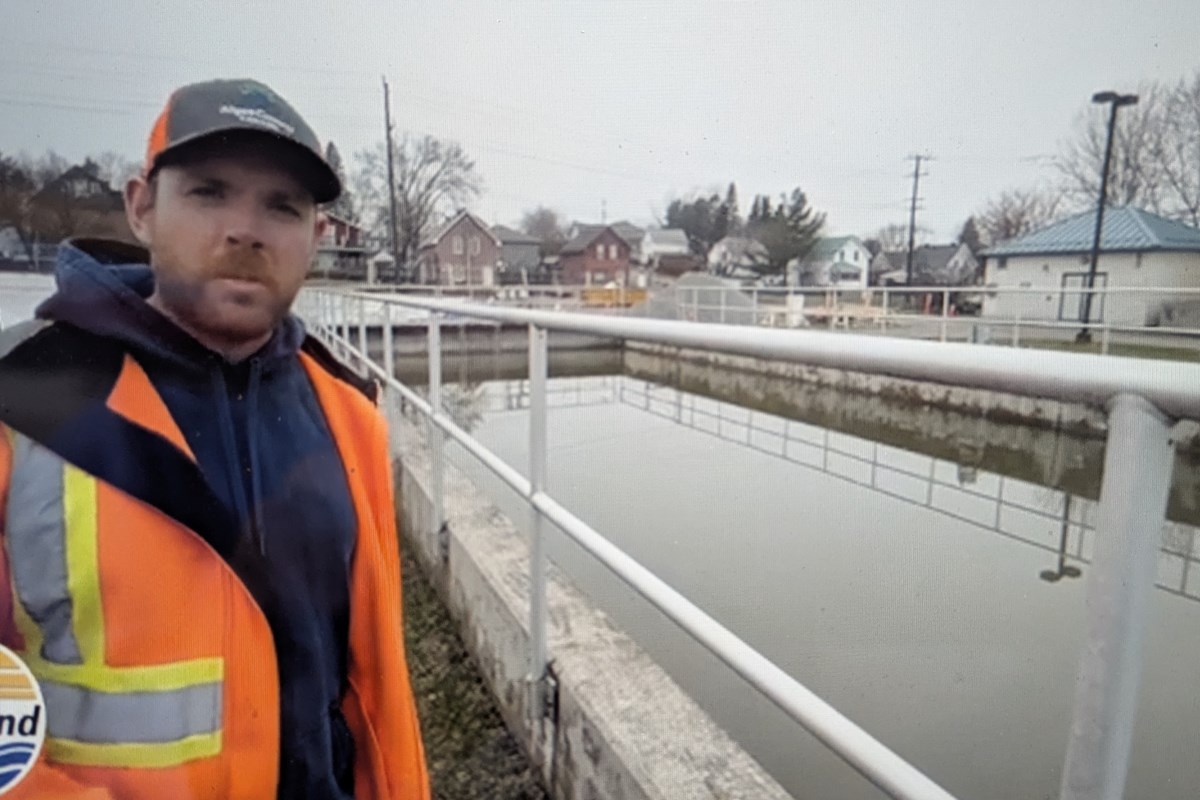
In the video, he talks with an employee at the wastewater treatment centre, who walks him through how the treatment centre works and explains what causes overflow events.
After taking viewers on a tour of the plant and its inner workings, the employee is seen standing outside, beside what is called a storm equalization tank, a massive concrete holding tank that is “several metres” deep that acts as a buffer, holding excess sewage and stormwater runoff during high-flow events.
“The flow comes into this tank where we will add aluminum sulfate to act as a coagulant to help the solids stick together and settle down,” the staffer said. “As the tank level rises and rises and rises, we add chlorine as a disinfectant to kill off any e. Coli bacteria and viruses.”
He noted that the water in the equalization tank is treated with calcium thiosulfate, a safe, non-hazardous liquid dechlorinating agent that removes the chlorine that was added earlier, to ensure the overflow water entering the bay is free of chemicals.
According to Gordon, the overflow pipe discharges about 30 metres offshore where the water depth is about eight metres.
He said this week’s overflow events can be attributed to inflow and infiltration — stormwater and groundwater that enters sanitary sewer systems through cracked pipes, leaky joints, or improper connections like downspouts and sump pumps.
He doubts water is getting in through cracked pipes, leaky joints or improper connections because the town uses a predictive artificial intelligence (AI) tool that staff developed to predict pipe failures.
“They’re aggregating all of the information they get from other sonar readings and they can predict which pipes are more likely to fail than not and we’re attacking those first,” Gordon said.
“We know these overflow events are not caused by incursion from pipes.”
Gordon said the major cause of inflow and infiltration in Midland, and probably everywhere else, is folks that have sump pumps and gutter leaders connected to the sanitary system.
He said that was the standard many, many years ago because many communities only had one sewer system.
“That’s how they were originally built, but today it’s illegal and there are some heavy fines around it,” he noted.
According to Gordon, the expensive solution is to replace the single sewer system with two new sewer systems — one for stormwater, the other for waste.
The less expensive option, he added, is for residents with sump pumps and gutter leaders to check to see where they are discharging.
If they’re discharging into the sanitary sewers, Gordon recommends homeowners disconnect them and employ alternative discharge solutions.
“This is a serious problem and if it continues, we’re going to have to institute a program to deal with it,” Gordon said. “That could include serious penalties.”