
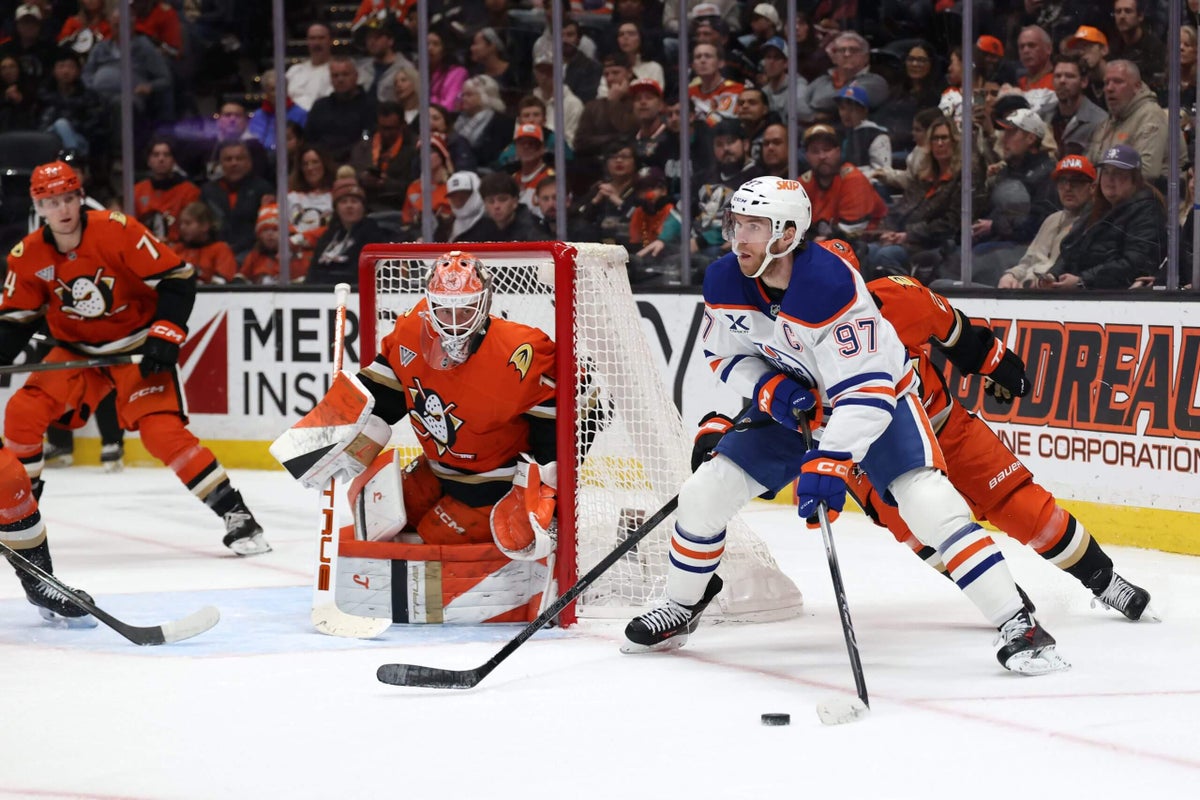
At long last, Connor McDavid and Co. get a new dance partner in the opening round. Same travel itinerary to Southern California, but a different and far more exciting matchup with the emerging Anaheim Ducks.
Instead of the grinding defensive machine known as the Los Angeles Kings attempting to thwart Edmonton’s stars, it’ll be a true track meet between two of the league’s highest octane teams.
May the best offense win.
The Odds

As expected, the team that has gone to back-to-back Stanley Cup finals is the heavy favorite over the team that’s making its first playoff appearance in eight years.
Two things that make that an easy call: Edmonton’s track record (duh) and the fact that its goal differential was actually 40 goals better.
You are what your record says you are, and Anaheim finished only one point back of Edmonton. But in hockey, it’s outscoring opponents that generally matters more; the rest is sequencing luck. In the Ducks’ case, it’s an 8-0 record in shootouts that obfuscates that the team’s real goal differential was actually worse than the Kings’ — and any other playoff team.
The playoffs don’t have a shootout for the Ducks to exploit. What Anaheim does have is an opponent on the other side who is starting to click at just the right time.
The Numbers

An Oilers-Ducks matchup has the potential for chaos because of both teams’ offensive strengths and weak points are on the backend.
Neither team has sparkling five-on-five numbers across 82 games. The Ducks generated more quality chances than Edmonton, with the third-best xG rate in the league, but the gap in actual scoring was slim.
Anaheim has only amped up its shot volume and scoring chances since the Olympics. The Ducks create offense in different ways, with a lot of rush threats and cyclers to lean on. The Oilers’ top-six, at least, can; it just doesn’t trickle down the lineup as well.
For all the Ducks create, especially down the stretch, it hasn’t always tracked on the scoresheet. And that’s a problem for a team that struggles in its own zone.
The Ducks’ defense has been abysmal at times this season, leaving their goaltenders extremely vulnerable. The Oilers have had their own defensive lapses, but have improved since Paul Coffey returned behind the bench in late February. The wild card is whether the goaltending can stand tall behind that reduced workload.
Those improvements haven’t extended to short-handed situations. The Oilers have given up a lot of chances since the break, but have had more reliable goaltending there. The Ducks are far from stout on the PK, but have been even shakier in net.
That could prove costly against a power play force like the Oilers, who led the league in expected and actual scoring in the regular season. The Ducks get their looks on the power play, but don’t convert consistently enough.
The Big Question
Can Anaheim’s defensive structure stop Connor McDavid?
This season was a step forward for the Ducks. No rational person would argue that; they’re in the playoffs, they’re basking in the continued development of some of the league’s most interesting young players, and the future is bright.
However, they are most decidedly not in this spot because of their defensive game. They’re actually here despite it. Under Greg Cronin, the Ducks were a year-over-year disaster in their own end, and under Joel Quenneville, the results have been far too similar. In 2024-25, they had the worst expected goals against in the league (3.05), a number prettied up by Lukáš Dostál and John Gibson. This season, they actually allowed fewer (2.81), but avoided another last-place finish only due to the ongoing messes in Vancouver and Chicago. Dostál has again partially bailed them out, as did their improvement on the offensive end.
Still, the numbers are ugly. On a per-60 basis at five-on-five, the Ducks allow the ninth-most shots in the league (27.4), the eighth-most attempts (59.2), and, most crucially, the fourth-most actual goals (2.93). If that’s the sort of game they bring into this series, McDavid is going to feast — and the meal might already have started. In three games this season against Anaheim, McDavid has two goals and five assists, all at even strength.
The hope for the Ducks, as is the hope for any team facing the Oilers, is to accept the fact that McDavid is going to get his and hope the rest of the lineup doesn’t follow suit. The problem for the Ducks, as is the problem for any team facing the Oilers, is that McDavid’s share of the production might be enough to sink them. If that’s how it goes down, we’re willing to give Anaheim a pass; for them, simply making the playoffs is a real achievement. Still, they don’t need to look far to find a team that either couldn’t or wouldn’t take the lesson — one was a hell of a lot more capable defensively, too. And look what that got them.
The X-Factor
Is Matt Savoie the answer to Edmonton’s depth woes?
We know the Oilers beating the Kings had become a rite of spring. So, too, did real questions about their lack of depth scoring. In the 2025 postseason, McDavid and Leon Draisaitl each had 33 points in 22 games. Ryan Nugent-Hopkins had 22. Next up among forwards was Corey Perry with 14 points. Distribution like that will work in the first round, but probably not the Stanley Cup Final. Edmonton learned that the hard way.
Savoie, though, has spent the last few months emerging as an interesting fix. The 22-year-old former No. 9 pick has done well in his first protracted NHL action, spent largely on McDavid’s wing. McDavid himself has seen his production tick upward when he’s on the ice with Savoie; there, he’s scoring 3.03 points per 60 minutes of play, more than he’s managed with any other teammate (2.73 with typical linemate Hyman, 2.27 with Draisaitl). Savoie is holding up his end of the bargain as well, with 2.14 points per 60.
Overall, Edmonton is winning the McDavid/Savoie minutes 21-16 with an expected goal share of about 53 percent. They’ve been even better since the Olympic break, with Savoie scoring 19 points in his last 24 games, including a hat trick in Edmonton’s Game 82 win over the Vancouver Canucks.
That game, somehow, carried actual stakes. Perhaps that bodes well for Savoie and the rest of the Oilers; ideally, they would have more players capable of succeeding away from McDavid and Draisaitl, but after the last few years, they should take what they can get. Savoie, as a skilled, productive player at every stop thus far in his career, seems capable of quite a bit.
The Rosters

McDavid continues to prove he is the best player in the world, but this year’s second-half efforts have been especially impressive.
In 24 post-Olympic Games, McDavid put up 24 points, bringing his season-wide totals up to 138 points. That scoring was clutch both while Draisaitl was out and because the team legitimately couldn’t win without it. The Oilers did not win a single game where McDavid was held scoreless.
McDavid’s play down the stretch elevated him to the top of the Hart Trophy race. And the best may still be yet to come, considering his usual playoff dominance.
Draisaitl and Zach Hyman’s returns punch up the Oilers’ offense even more.
Draisaitl’s scoring rate was consistent from last year; he just got there differently. He was still a dangerous goal scorer, but his passing was even stronger; Draisaitl’s primary shot assist rate led the league, according to AllThreeZones’ tracking.
Ideally, the Oilers can keep those two split across the top-six as an elite one-two punch, and only reunite them in case of rare emergencies.
It depends on who else can step up.
Savoie’s breakout helps. So does Hyman’s rebound, with his scoring rate and offensive impact jumping closer to expectations after last year’s struggles. With those two on McDavid’s line, Draisaitl can drive a line with Kasperi Kapanen and Vasily Podkolzin, who earned a 12-3 scoring edge this year and had chemistry last spring.
Nugent-Hopkins leads a pretty weak bottom-six. Below him, the lineup is thin offensively — and no one has enough shutdown talent (besides Jason Dickinson, who is still out) to make up for it.
What helps is how much the defense has stabilized since Coffey returned.
Evan Bouchard’s offense has been next-level this season and leads all defensemen. And that generally gets cranked even higher in the playoffs. The problem is that his turnovers can prove costly, especially with the Oilers’ goalie woes, and he can get hemmed in his own zone.
But with Coffey’s influence, his pair with Mattias Ekholm has settled on both ends of the ice; they have a 64 percent xG rate since the Olympics and have outscored opponents 23-13.
A new-look second pair of Connor Murphy and Darnell Nurse has been pretty solid, too. The team doesn’t generate a ton of looks in their minutes, but Edmonton has limited opponents to just 2.28 xGA/60 and has a plus-two goal differential. Jake Walman and Ty Emberson, similarly, haven’t moved the needle offensively, but have calmed down play in their own end to give the goaltenders more support.
Connor Ingram improved since being named starter on March 15; he has seven quality starts in 12 outings since. But his body of work this season doesn’t scream Stanley Cup-caliber starter. And there isn’t another viable option to lean on. The Tristan Jarry trade has been an outright disaster, and his playoff history instills even less confidence.

The Ducks, at least, have that part figured out: Dostál is a true No.1 who can be trusted in any situation. He comes into this series with a plus-11.1 Net Rating, despite some ups and downs this year.
Dostál still gave his team a chance to win with 31 quality starts in 56 appearances this year. The problem was his ever-growing workload, which was filled with rush chances against and shots set up by dangerous passes. It’s up to him to give this team a chance with quality saves, no matter how poorly this team defends — and the team in front of him has to try to outscore its problems on top of that.
The talent is there to, at least, try and do that. On defense, it starts with Jackson LaCombe and John Carlson.
LaCombe is an all three zone threat, thanks to his puck retrievals and transition game. His scoring hasn’t taken a leap this year, but he is still a positive on both ends in tough usage.
Carlson may not be perfect defensively, but he is still an offensive ace, which helps the Ducks play to their strengths. Despite moving the puck less this year, he still helps his team generate more chances and goals once in the zone. That pairs well with an up-and-coming forward group filled with talent.
Leo Carlsson is the cornerstone of that. While his play cooled down after a fantastic start, he still comes into this series with a projected plus-5.1 Net Rating. That isn’t contender-level yet for a franchise forward, but he has shown flashes of that potential this year.
Carlsson’s growth has taken a lot off Troy Terry’s shoulders; he was leaned on as The Guy up front in Anaheim for years, when he is better suited as one of the guys in the top-six. His line, with Carlsson and Chris Kreider, has been one of the Ducks’ best, with a 57 percent xG rate, fueled by their overwhelming offensive attack.
Cutter Gauthier’s shoot-first approach and rookie Beckett Sennecke’s high-danger passing add even more oomph to the top-nine. So does veteran Mikael Granlund, whose utility has been a real plus this season.
Lower in the lineup, the weaknesses start to pile up on both ends of the ice, and there may not be enough upside in the top six to withstand that. It’s something to build on in the long run, but maybe not in Round 1 against this opponent.
The Key Matchup
Ingram vs. Dostál
We discussed Anaheim’s defensive issues earlier, and down the stretch, Dostál — who’d bailed them out frequently over the last few years — finally had the look of a guy who was starting to crack. In April, ironically while facing fewer shots than he typically does, he allowed 23 goals on 140 shots for an .836 save percentage, putting him at .888 overall, eight points below this season’s average.
Ingram, meanwhile, took control of Edmonton’s net almost by default and has acquitted himself well, playing in 22 of Edmonton’s last 27 games and, after the Olympic break, putting up a .901 save percentage. He’s played significantly fewer games this season than Dostál, but has also spent a few months facing a starter’s workload for just the second time in his career. Edmonton doesn’t need him to be great. They also won’t get away with him playing poorly, unless a Tristan Jarry resurgence is in the cards.
The Bottom Line
The Ducks can build on what they’ve done this season, and the Oilers are far from perfect, but Anaheim’s defensive issues, combined with the mere presence of McDavid and Draisaitl, are likely to make this series as short as it is entertaining.
References
Understanding projection uncertainty
Resources