
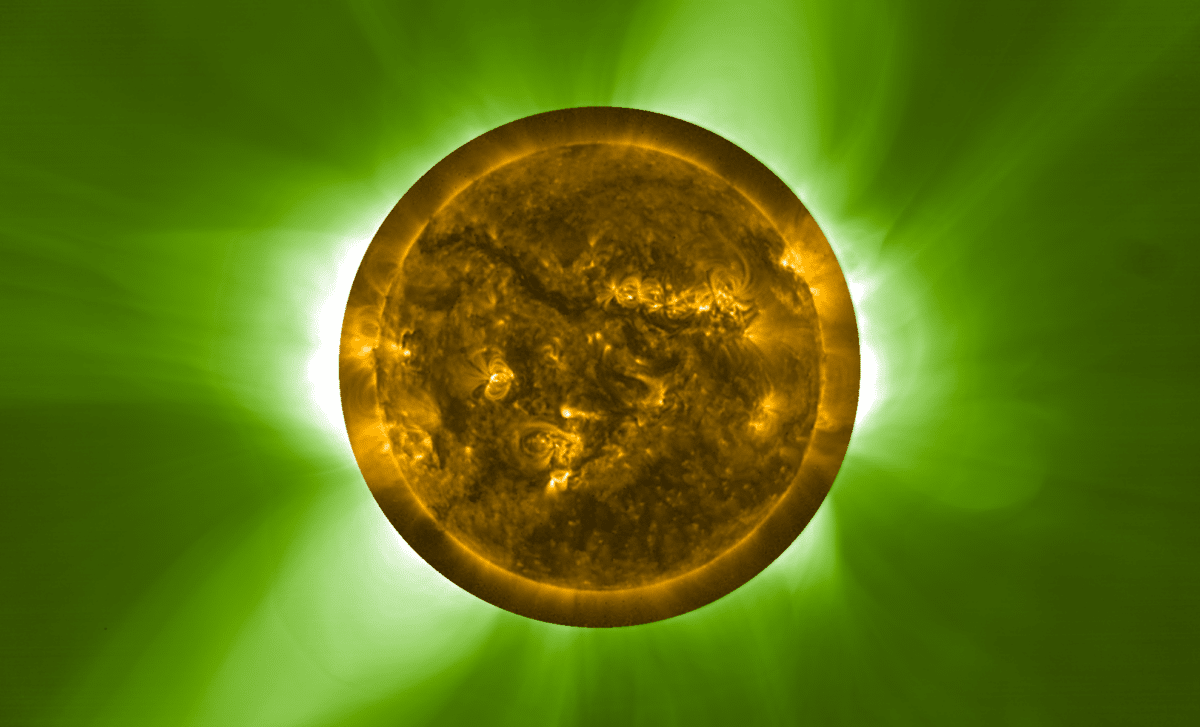
New observations from the European Space Agency’s Proba-3 mission have revealed that solar wind, a stream of charged particles continuously emanating from the Sun, moves much faster than scientists had previously understood. For years, it was believed that slow solar wind near the Sun’s surface traveled at speeds around 60 miles per second. However, fresh data has shown that these winds can reach speeds as high as 300 miles per second, up to four times faster than expected. This surprising discovery could drastically shift how we approach space weather and our understanding of the Sun’s behavior.
A New Chapter in Solar Wind Research
For decades, solar wind has been a key subject of research, but much of its behavior, especially near the Sun’s surface, has remained a mystery. Solar wind is a stream of charged particles constantly emitted by the Sun, affecting everything from space weather to geomagnetic storms on Earth. Scientists have long understood that solar wind can be divided into two categories: fast wind, which flows from coronal holes at speeds of about 480 miles per second, and slow wind, which was thought to move at more modest speeds of 60 miles per second.
However, the recent findings from Proba-3, published in The Astrophysical Journal Letters, challenge this understanding. Using a unique method to simulate solar eclipses, Proba-3 captured high-resolution images of the Sun’s corona, an area notoriously difficult to study due to the intense brightness of the Sun itself. This new method allowed scientists to track the movement of slow solar wind much closer to the Sun’s surface than ever before.
“In the inner corona, a region very difficult to observe, we saw slow solar wind gusts moving three to four times faster than expected,” Andrei Zhukov, lead author of the study and a solar physicist at the Royal Observatory of Belgium, said in a statement. These revelations not only answer questions about the Sun’s atmosphere but also raise new ones about the mechanisms driving solar wind.
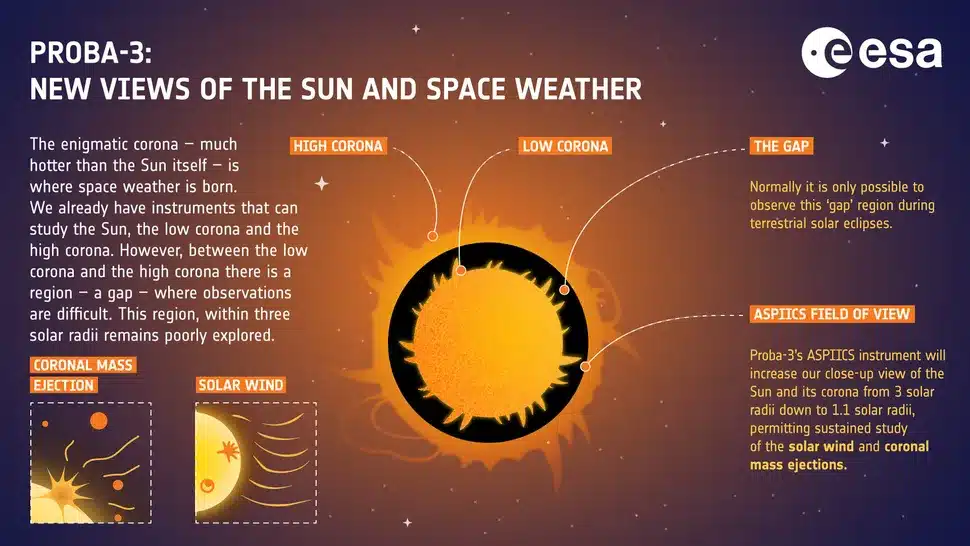 Proba-3 gives us new views of the sun and space weather. (Image credit: ESA-F. Zonno)
Proba-3 Mission: A New Window Into the Sun’s Atmosphere
The Proba-3 mission represents a significant leap forward in solar observation technology. Unlike traditional telescopes, which struggle to capture images of the corona due to the overwhelming light from the Sun’s surface, Proba-3 uses a pair of satellites to simulate a solar eclipse. One satellite acts as a giant occulter, blocking out the Sun’s light, while the other observes the faint corona. This innovative setup has allowed the mission to capture a wealth of data on the Sun’s outer atmosphere, revealing previously hidden phenomena.
Since its launch in December 2024, the Proba-3 spacecraft has recreated 57 artificial solar eclipses, collecting over 250 hours of high-resolution video. This data offers an unprecedented view of the Sun’s corona, a region critical to understanding solar wind formation. The spacecraft’s ability to track how solar wind accelerates near the Sun’s surface provides fresh insights into how these solar gusts are generated and how they interact with the Sun’s magnetic fields.
Joe Zander, Proba-3 project scientist at ESA, expressed excitement about the mission’s initial findings:
“We can track how solar wind speeds up close to the Sun, we see it all over Proba-3’s field of view, and we have already seen speeds and accelerations that surprised us.” These early discoveries, Zander emphasizes, are just the beginning: “This first dataset is just the beginning of the much longer journey to fully understand what’s happening.”
The Significance of the Discovery for Space Weather
The acceleration of slow solar wind, as revealed by Proba-3’s findings, could have profound implications for understanding space weather. Solar wind influences geomagnetic storms, which can disrupt satellites, communication systems, and even power grids on Earth. Understanding how solar wind accelerates near the Sun could lead to better space weather predictions, giving Earth’s technological infrastructure more time to prepare for potentially damaging solar events.
The fact that solar wind can speed up so dramatically near the Sun also invites further questions about the processes occurring in the corona. Researchers suspect that this acceleration is linked to the Sun’s complex magnetic fields, which may interact with the solar wind in ways previously not understood. “This first dataset is just the beginning of the much longer journey to fully understand what’s happening,” Zander noted, hinting at many more discoveries to come as Proba-3 continues its mission.