
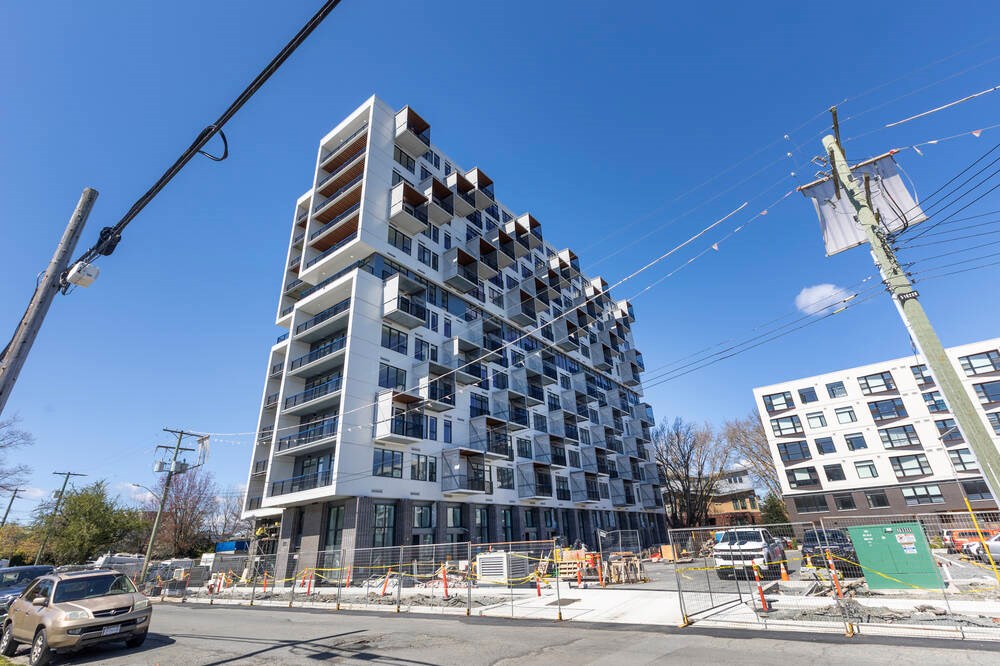
The funding will go to a society set up to purchase a newly completed 179-unit multi-family building near Mayfair, to be operated by the non-profit Tresah West Housing Co-operative
The first co-operative housing project in Victoria in recent memory will get a helping hand from the city, after council approved a $677,500 grant to the newly formed group behind the initiative.
The funding, from the city’s $4.5 million Housing Reserve Fund, will go to the Midtown Affordable Housing Society, which was established last year in order to purchase a newly completed 179-unit multi-family building at 611 Speed Ave., near Mayfair shopping centre.
According to city staff, the society intends to own the building, using a $20-million forgivable loan from the federal government’s Build Canada Homes program as its down payment.
Ross Soward, the city’s housing manager, said the capital cost to purchase is likely in the neighbourhood of $85 million.
The city’s contribution would help reduce the cost for those living there, as well as indicating to Ottawa that there is local support for the project.
The non-profit Tresah West Housing Co-operative, which was also established last year, will operate the housing.
Under the co-op model at this project, residents pay an initiation fee — or member share purchase — and then monthly charges. Those one-time fees are expected to be about $20,000.
According to the city, Community Savings Credit Union has agreed to provide private loans to members of the co-operative to help finance the initial share purchases.
And while residents do not build equity in the building, they do have security of tenure and the monthly charges can be lower than market rent.
Soward noted the Midtown Affordable Housing Society is anticipating financial support through the Canada Mortgage and Housing Corporation MLI Select Program that will reduce borrowing costs and provide a long-term mortgage that will support lower debt servicing.
The federal funding is expected to reduce monthly housing charges to 20% below market rates.
“Everything that I see here is is a win for the city and a win for affordability,” said Coun. Matt Dell.
“What I’m seeing right here is a fairly unique arrangement where the federal government is stepping in, we have two new not-for-profits that have been set up to take advantage of the funding situation right now and we have what I think is a really beautiful building in Tresah that hasn’t worked out as a rental or a condo for a variety of reasons.”
The Speed Avenue building was initially intended to be a strata condominium. But in 2024, developer Mike Geric Construction told would-be buyers who had put down deposits that the company had determined it could only complete construction by converting Tresah West to a purpose-built rental building. The company cited rising labour and material costs, delays, supply chain issues and high interest rates.
The building was put up for sale in the spring of 2025.
Shannon Kowalko, spokeswoman for Mike Geric Construction, confirmed there has been a conditional agreement to buy the property since October.
She noted one of the conditions was an occupancy permit from the city, which came earlier this week.
Soward said the project is an opportunity to support an innovative approach that would rapidly expand the non-market housing supply and would be the “first new housing co-operative in decades.”
Council added an amendment to the motion Thursday that will require the proponents to secure non-refundable financing from Build Canada Homes that guarantees the project’s affordability and sustainability.
With that in place, some councillors said they felt better about backing the project.
“I want to make sure that we’re protecting our investment and looking out for the public’s money, but fundamentally supportive of what this project is,” said Coun, Jeremy Caradonna. “It’s unique. We haven’t seen this before.”
Coun. Krista Loughton said the project is exactly what the Housing Reserve Fund was created for: supporting long-term stable housing for people who are being squeezed out of the private market.
In co-op housing, residents aren’t just tenants, she said. “This model gives people peace of mind because they don’t have to worry about renovictions or the building being sold out from underneath them.”
Coun. Marg Gardiner said she could support the project because of the amendment, even though it isn’t a true co-op, since the building will be owned not by the co-op but by another nonprofit.
“I wish this was a co-op but the only aspect I see of this as being a co-op is that there’s a group of people that can select who lives in the building,” she said.