
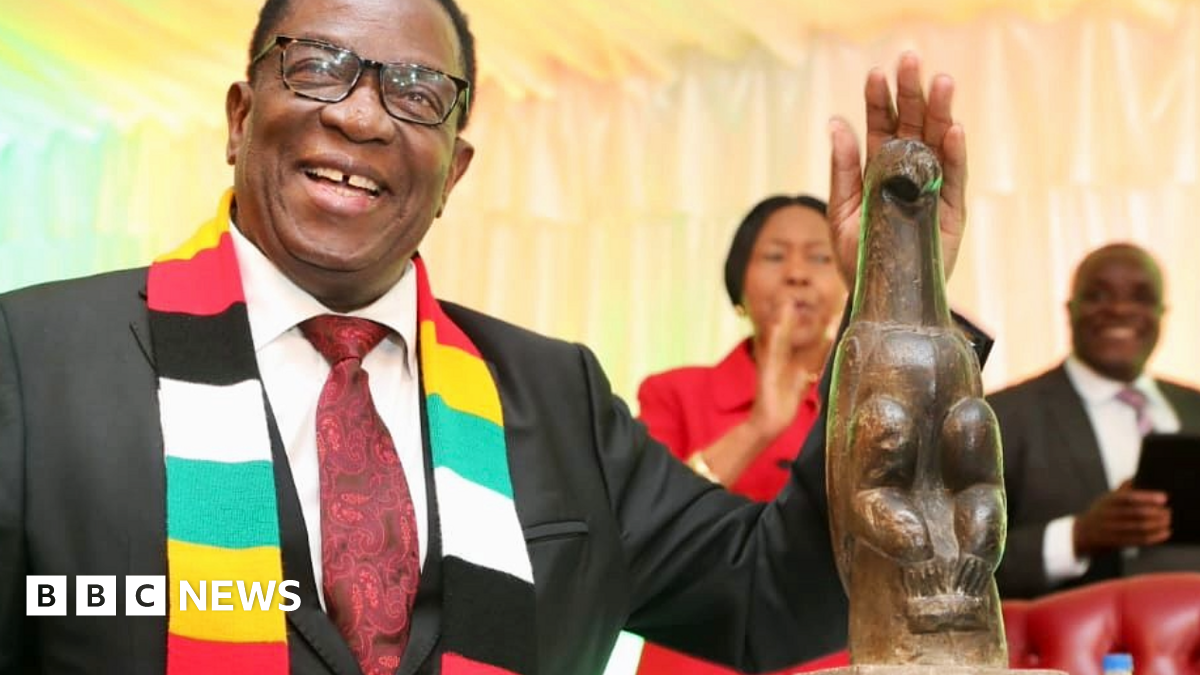
Posselt sold the bird to Cecil Rhodes, a powerful imperialist who headed the British South Africa Company and spearheaded the colonisation of modern-day Zimbabwe and Zambia.
Rhodes used the bird as décor for his grand Cape Town estate and two years later, the British South Africa Company commissioned archaeologist Theodore Bent to return to Great Zimbabwe.
Bent found the sculptures that Posselt had stored away and transported four of the prized birds to a museum in South Africa.
A fragment of one other bird ended up further afield – its pedestal was taken by a German missionary and sold to Berlin’s Ethnological Museum in 1907.
But after Zimbabwe became independent in 1980, its authorities launched a campaign to recoup the missing birds, with only two remaining in the country.
Robert Mugabe, Zimbabwe’s independence leader and long-time president, described their loss as a “ruthless cultural plunder”.
In a peculiar trade, South Africa’s apartheid government agreed in 1981 to release the four birds it held in a museum in exchange for a huge collection of bees, wasps and ants. The trove, belonging to Zimbabwe’s Natural History Museum, comprised around 1,000 kinds of insects.
Then, in 2003, another win. Germany returned the soapstone pedestal that, in Mugabe’s words, had “spent almost 100 years in exile”.
Getting the last bird back was more of a challenge. When Rhodes died in 1902, his Cape Town home and all its contents were vested to South Africa’s governor-general – a role which was later transformed into the national president.
In 1910, a law named the Rhodes Will Act stated that these possessions should not be sold, let or transferred.
“Every time Zimbabwe asked, the 1910 Act was cited,” McKenzie explained in his speech.