
(Credits: Far Out / Bent Rej / Herr Sharif)
Sun 19 April 2026 20:30, UK
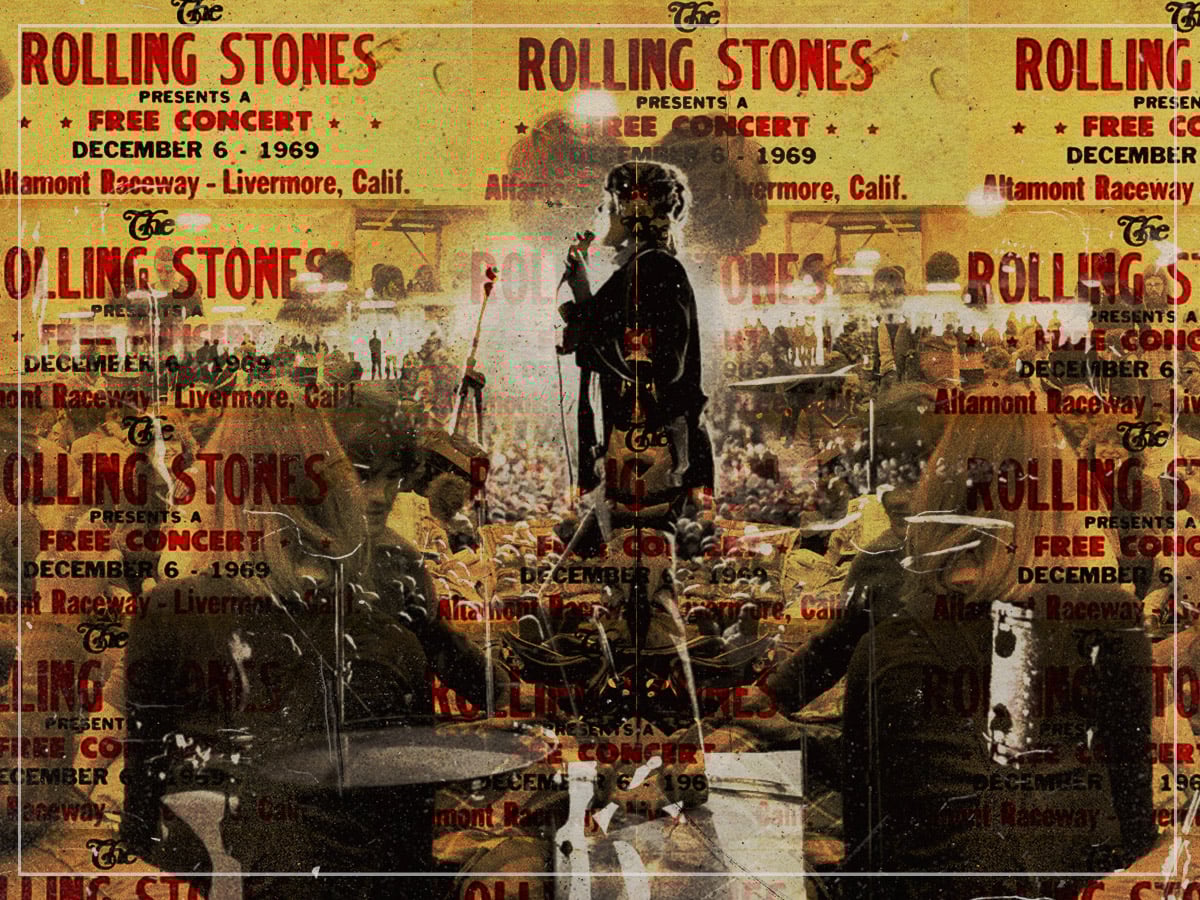
The Altamont Speedway Free Concert has long served as a very convenient, poetic coda for any historian or documentarian trying to tell the tale of the 1960s.
Taking place just a few months after Woodstock and intended as its West Coast complement, the event infamously spiralled into total chaos, with any semblance of ‘peace and love’ beaten into submission thanks to the ill-advised decision to put the Hells Angels on festival security.
Looking back on the entirety of the ‘60s as a steady progression from youthful rebellion into idealism into cynicism, it’s easy to understand why Altamont (which took place in December of ’69) became the decade’s full stop: the so-called ‘the day the ‘60s died‘. This macro view does obscure the experience on the ground, though, when Altamont was seen by many as the sudden derailment of a special moment, rather than the inevitable final crash of a sputtering rocket.
At the centre of the whole narrative, of course, were The Rolling Stones, the headliners at Altamont and, due to the recent breakup of The Beatles, the undisputed biggest band on the planet. This was their show, and as captured in the legendary rock documentary Gimme Shelter, it was their decision to hire a notorious biker gang to be the muscle at the event.
At the risk of oversimplifying the story, the Stones were young and cocky and feeling foolishly invincible. The Altamont show was the last stop on what had so far been a triumphant and exhilarating tour of America, the band’s first visit in three years. It was also their first tour since the tragic death of Brian Jones, a horrific blow earlier that summer that seemed to draw the rest of the band closer together, guilt-ridden to a degree, but also newly unified in the absence of their often antagonistic fallen comrade, who’d already been fired from the group a month before his death.
From the Stones’ perspective, the end of 1969 was actually swinging in an upward trajectory, as the months after Jones’ death had seen the hopeful promise of Woodstock, the arrival of Mick Taylor as the band’s new guitarist, and the release of a critically and commercially successful new album, Let It Bleed, which went to number one in the UK and number three in America. What really lifted the band’s spirits, though, was that American tour in the late autumn of ‘69, as they found a wildly different sort of audience from the screaming teenagers they’d endured back in ‘66. With several of their heroes, including BB King and Chuck Berry accompanying them as opening acts on the month-long jaunt, the Stones finally felt like a fully realised live rock ‘n’ roll band.
 (Credits: Far Out / Picryl / Larry Rogers)
“Musically and performance-wise, the energy was just like ka-boom!” Mick Jagger told the Times-Transcript newspaper in 1987, recalling the New York gigs on the tour that were later released as the live album Get Yer Ya-Ya’s Out!, “The band played really, really together at that point. It was actually the best tour of America the Stones have ever done.”
“I remember going to see John Lennon after that and explaining to him what it was like,” Jagger continued, “The Beatles always said, ‘Well, we don’t tour because we can’t hear ourselves’. I said, ‘It’s not like that anymore! You can go out there and play, people will listen and applaud at the end. But for them, it was already too late.”
Because the Stones arrived in California on such a high at the end of their tour, they seemed somewhat oblivious to the glaring problems surrounding the somewhat hastily thrown-together free concert at the Altamont Speedway outside San Francisco. One of the reasons the band agreed to be part of it in the first place, aside from the fact that Woodstock had unintentionally turned into a free festival a few months earlier, was that they’d taken a lot of the heat in the press for the high prices of their tickets on the ‘69 tour. This last gig would be their nod to the cheapskate hippie ethos, and a final bow to wind up their re-conquering of America.
As was the case with Woodstock, though, Altamont was somewhat of a last-minute venue selection, as concert organisers frantically scurried for an option after two earlier plans fell through. The Altamont Speedway had the space and capacity to hold a big crowd, but it was severely lacking in other facilities, and its geographical layout posed considerable problems, as the pre-built stage, which had been intended for positioning on a sloped hill, would now have to be set up on a relatively flat ground, with very little separation between the bands and the audience.
Each issue became part of a domino effect that ultimately led to the rushed decision to bring in the local chapter of the Hells Angels motorcycle gang as makeshift stage security on December 6th, 1969, a concert date that would live in infamy. Long before the Stones took the stage, the event had already turned into a clear, unmitigated disaster. A crowd full of mostly stoned attendees in the range of 5,000 to 6,000 were being herded by mostly drunk bikers looking for any excuse to wield the power they’d been given.
“The vibes were bad,” Jefferson Airplane frontwoman Grace Slick later wrote in her autobiography. The Airplane was the second band on stage that day, after Santana and followed by the Flying Burrito Brothers and Crosby, Stills, Nash & Young.
“Something was very peculiar, not particularly bad, just real peculiar. It was that kind of hazy, abrasive and unsure day”.
Grace Slick
Slick added, “I had expected the loving vibes of Woodstock but that wasn’t coming at me. This was a whole different thing”.
Speaking to Rolling Stone magazine two years after Altamont, Keith Richards made no bones about the mistakes that had been made, although the buck was mostly passed to the local promoters from the Grateful Dead’s camp, who’d vouched for the Hells Angels (the Dead had been booked to play Altamont but bailed once they saw the scene that was developing).
“The Angels shouldn’t have been asked to do the [security],” Richards said, “I think the Dead should have known. [Grateful Dead manager] Rock Scully should have known, I think. We all spoke to him, and he trusted those cats, man, to do just a good job of keeping the stage clear… Somewhere along they flipped.”
The increasingly post-apocalyptic scene in the crowd at Altamont, where dozens of fights were breaking out, combined with the swagger and hubris of the people who’d put it together, made for a glaringly obvious statement on the state of the hippie dream: an anarchic utopia, clearly, was not anywhere near becoming a reality.
 (Credits: Far Out / Alamy)
The Stones, as the closing act, ultimately chose to play their set after ample delays, largely out of fear that things would get considerably worse if they didn’t. It was a train wreck from the outset, as the band had to repeatedly stop so Jagger could attempt to reason with the crowd to calm down. It was an awful look for a frontman best known for strutting across the stage, putting maximum bravado into dangerous characters like the ‘Street Fighting Man’, ‘The Midnight Rambler’, or the devil himself. Now, he was practically whimpering, begging his own fans to ‘cool out’.
In the middle of the seventh song of the set, ‘Under My Thumb’, a young African-American man in the crowd, Meredith Hunter, was stabbed repeatedly by a Hells Angel on the security team after allegedly drawing a pistol, later dying from his wounds. It would come to light that three other people had also died during the event; one from drowning in a nearby irrigation canal, and two from a hit-and-run incident with a car. From their vantage point on stage, the Stones just saw a sea of chaos. “All you see is lights out there,” Richards said, “If someone strikes one or shines one. The only time we were aware of trouble was when suddenly a hundred cats would leap in front of us, and everybody would start yelling.”
The Stones, unaware of Hunter’s death, played eight more songs, then fled the venue on a helicopter, a scene now oddly reminiscent of the last American choppers leaving Saigon at the end of the Vietnam War six years later.
“Altamont changed us,” Jagger told the Palm Beach Daily News in 1983, “We became more professional after that in our tours. We learned we couldn’t simply perform anywhere, that our concerts have to be more professionally planned.”
“At Altamont it was the dark side of human nature,” Richards wrote in his 2013 memoir Life, “what could happen in the heart of darkness, a descent to caveman level within a few hours, thanks to Sonny Barger and his lot, the Angels. And bad red wine. It was Thunderbird and Ripple, the worst fucking rotgut wines there are, and bad acid. It was the end of the dream as far as I was concerned.”
