

Why more people in the North are starting to look beyond traditional mental health care
We get asked all the time what we’re doing in our psychedelic-assisted therapy clinic at Bay and Elgin.
After nearly two and a half years in Sault Ste. Marie, the short answer is this: we’re helping people who have already tried everything.
In the Soo, strength and pushing through are part of the culture. But over time, that can turn into carrying everything alone, long after it’s become too heavy.
When “just coping” becomes the norm
Mental health struggles rarely show up all at once. More often, they build gradually:
Poor sleep
Constant stress
Feeling stuck, numb, or overwhelmed
Strain in relationships and daily life
So people adapt.
For some, that looks like a drink at the end of the day.
For others, cannabis to take the edge off.
Or staying busy enough to avoid slowing down.
From the outside, things look manageable. Underneath, many feel exhausted, disconnected, or stuck.
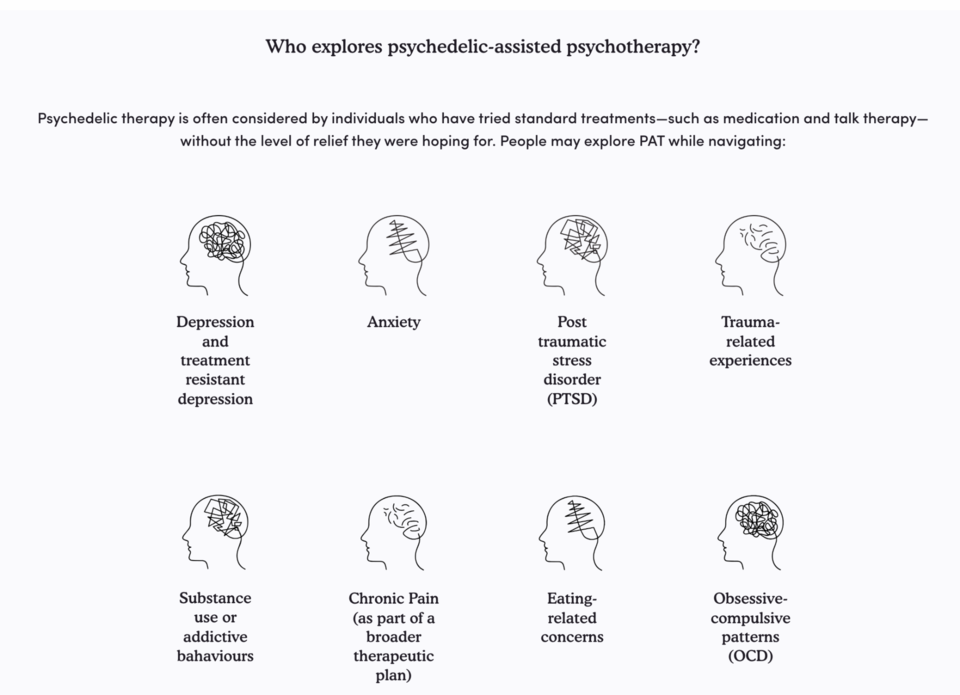
And by the time people reach out, most have already tried the standard options:
But something still feels unresolved.
What we’re seeing locally
At our clinic in Sault Ste. Marie, we regularly meet people working in healthcare, trades, education, and first responder roles.
Many have been navigating the system for years before finding us.
It’s common for people here to wait longer than they should before seeking additional support, not because they don’t care, but because pushing through is what they’ve always done.
And when they do reach out, it’s rarely because they haven’t tried.
It’s because they have.
The gap no one really explains
Traditional approaches can be effective for many people. But for others, they don’t go deep enough to address long-standing stress patterns, trauma responses, or negative thought loops that won’t shift.
So what happens?
People keep functioning, but they don’t actually feel better.
What most are looking for at that point isn’t a quick fix.
It’s movement.
A different kind of approach
If there’s one thing we wish more people in the Soo knew, it’s this:
You don’t need to reach a breaking point before exploring other options.
In recent years, psychedelic-assisted therapy, offered through structured programs that combine psychotherapy with carefully supervised, short-acting medications, has started to become more available in Northern Ontario.
At our clinic, this approach is always delivered within a therapeutic framework, never as a standalone experience.
The goal isn’t to escape symptoms, but to create the right conditions for deeper therapeutic work.
How it works (in simple terms)
Biologically, this approach can:
Help the brain form new connections instead of repeating the same patterns
Increase the brain’s ability to adapt and reset (often referred to as neuroplasticity)
Interrupt cycles like constant worry, negative thinking, or trauma responses
Psychologically, people often experience:
A sense of distance from overwhelming thoughts
The ability to reflect from a new perspective
Feeling more open and less stuck
For many, this makes it easier to engage in therapy in a meaningful way, especially when previous approaches have stalled.
Is it safe?
This type of care is delivered in a structured clinical setting with licensed healthcare professionals, including nurses and therapists.
Every person goes through a thorough screening process to determine whether it’s appropriate for them.
Sessions are supervised from start to finish, with support throughout.
It’s also important to be clear: this approach isn’t for everyone, and responsible providers are selective about who they treat.
What progress actually looks like
Change doesn’t usually happen all at once.
For many people, it starts with small shifts:
Over time, those moments begin to build.
People often notice they respond differently to stress.
They feel more connected to themselves and to others.
They have more space between how they feel and how they react.
Life doesn’t suddenly become easy, but it can start to feel more manageable.
What we wish people knew earlier
Feeling stuck does not mean you’ve failed.
More often, it means the strategies that once helped you get through are no longer enough.
Real change rarely comes from forcing yourself to endure more.
It comes from learning to relate differently, to stress, to past experiences, and to yourself.
No single approach is a cure. But for some people, structured and integrative models of care offer a path forward when the usual options haven’t been enough.
Wondering if this approach could be a fit for you?
If you’re curious whether this type of care could be right for you, the best next step is simply to ask questions.
Our team is available to talk through your situation and help you understand your options.
Field Trip Health
📞 1-888-838-6004
🌐 fieldtriphealth.ca