
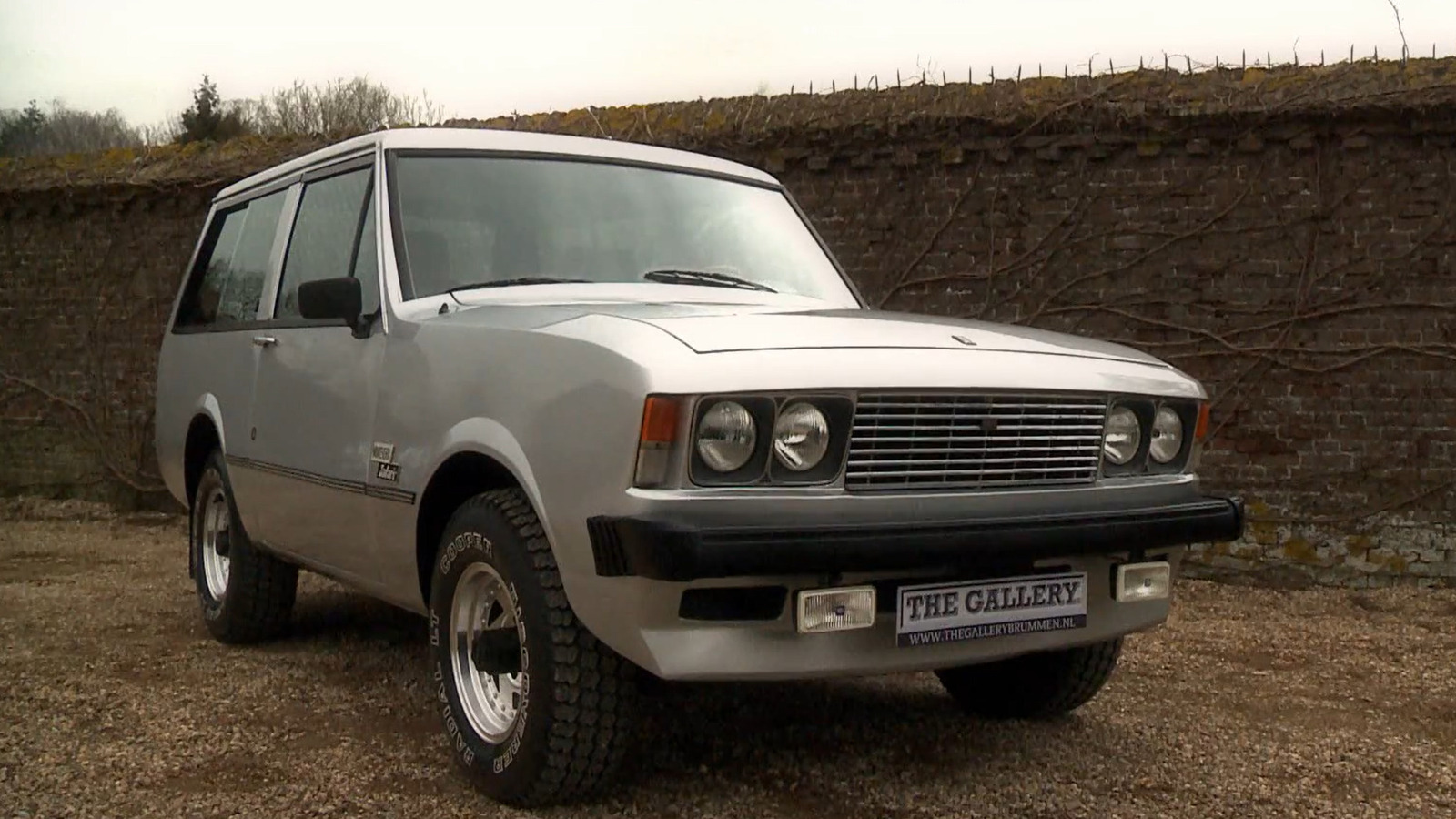
The luxury SUV market is crowded and hotly contested today, although it wasn’t always that way. Wind the clock back half a century, and the segment was reserved for the highest flyers, with your only choices being Range Rover or the Jeep Super Wagoneer. Unlike today, in the 1970s this wasn’t a segment for mainstream brands to try cracking — it would be decades before the likes of Volvo and BMW tried to make an entrance.
Still, this didn’t stop smaller brands from giving it a go, with notable entries being the Lamborghini LM002 and Monteverdi’s Safari. The Safari is our vehicle under the spotlight today, and though the optional leather-clad interior and 300-horse V8 distracted from the fact, this Swiss slice of excellence was really just an International Scout in disguise. A utilitarian vehicle more at home on the farm than gallivanting across Europe, its original design brief was to “replace the horse,” per Southern Scouts, clearly depicting its purpose as a hard worker more than anything else.
Monteverdi took the rugged Scout’s underpinnings and body, left them largely alone, and went to town on the power train and interior. A 150-horse 318-cubic-inch V8 was standard, although options such as Chrysler’s 440ci big block and even Nissan’s diesel SD33 were available, while paint colors and interior finishes were entirely customizable. Buyers could choose manual or automatic transmission, and while the Scout upon which these were based would be considered luxurious if it had so much as carpets fitted, the jet-set Monteverdi boasted features such as air conditioning, electric windows, power locks, fridges, and even TVs.
The man behind the brand
Taking on the established greats of luxury off-roading during the late 1970s and early 1980s was no walk in the park, which is probably why the comfortable mainstream brands weren’t interested in paving the way. That task would be left to bold individuals such as F1 racer and constructor Peter Monteverdi.
Monteverdi’s life was fueled from Day One by premium gasoline. He began as a mechanic before venturing into the world of motorsport at the helm of everything from a cheap Alfa Romeo to a self-modifed Porsche to a Ferrari 1953 Mille Miglia coupé. Of course, the journey wound up with him entering Formula 1. His stint as a driver was brief, but he entered the F1 world again as an owner in later years, while in the meantime he kept himself busy with his production dreams.
See, Monteverdi used to import Ferraris into his home country of Switzerland, but after a disagreement with Enzo Ferrari, he opted to instead produce his own high-end luxury and sports cars. But early efforts, such as the High Speed 375 S and slightly later Hai 450SS, did little to impress the paying public.
It wasn’t until Monteverdi took a leap of faith and crafted his Scout-based Safari SUV, and the later Sahara, that success finally found a home in the Monteverdi Automotive factory. The Safari was still no mass-produced vehicle — just a few hundred are known to have been made — but nonetheless Monteverdi managed to find a gap in the market and fill it.
Buying and owning a Monteverdi in 2026
Of course, the story had to end at some point, and for Peter Monteverdi, the fun stopped when International Harvester stopped producing trucks. Specifically, production of both the Sahara and the Safari stopped in 1982, meaning the mighty Monteverdi enjoyed just six years of production. As you might imagine, with just a few hundred Safaris made, just a handful of Saharas, plus small numbers of the High Sport 375 S and Hai 450SS, getting hold of a Monteverdi in 2026 is tricky. And it requires a decent bank balance.
Scarcely do Monteverdis crop up for sale at all, although one fine Safari appeared in recent years, with an estimate sitting roughly in the $115,000 to $140,000 range. And an example of the scarcer but lower-end Sahara traded hands for roughly a third of this. Only 30 or so were made, though, so nabbing a “bargain” Monteverdi will require a sizable helping of patience.
The good news is that, should you be able to A) find one and then B) afford it, since both the Safari and Sahara share much in common with the International Harvester Scout, and the engines are less exotic than the brand name may lead you to believe, getting hold of routine maintenance items should be easier than you’d first think. Not a bonus of classic Range Rover or Lambo LM002 ownership, we’re quite sure.