
 (Turner Construction Company)
The Metro Vancouver Regional District secured $357.01 million in revenue from development cost charges (DCCs) in 2025, a significant increase from the $176.81 million secured in 2024, according to an MVRD staff report.
There is plenty more than meets the eye with those numbers, however.
On January 1, 2025, DCC rates increased as part of a three-year phased increase. That resulted in many developers rushing to secure building permits during the early months of 2025 to take advantage of in-stream protection and 2024 DCC rates, as I’ve previously reported.
As such, Metro Vancouver secured $276.89 million of the $357.01 million in DCC revenue — 77.6% — in the first half of 2025 and just $80.12 million — 22.4% — in the second half of the year.
The $80.12 million in H2 2025 was lower than both H1 2024 and H2 2024, which totaled $86.20 million and $90.61 million, respectively, despite the rate increase from 2024 to 2025.
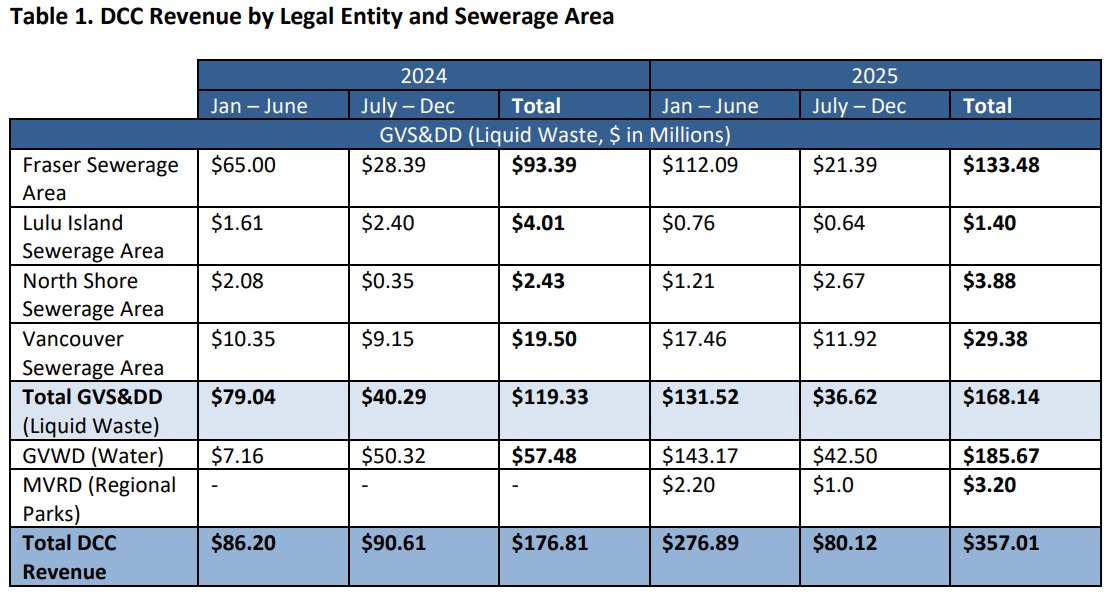
I’m using the word “secured” because, according to the MVRD staff report, only $210.76 million of the $357.01 million (59.0%) was provided in cash, while the remaining $146.25 million (40.9%) remains owing because of deferrals.
These deferrals occurred under the previous regulations where developers were required to pay a minimum of one-third of the total DCC charge upon subdivision or building permit approval. Last July, the Province announced legislative changes that allowed developers to pay just 25% upon permit approval and the remaining 75% upon occupancy or within four years (up from two years), but that change only came into effect on January 1, 2026.
All of this is to stay that despite a substantial increase in DCC revenue for Metro Vancouver from 2024 to 2025, it’s hard to say where 2026 DCC revenue will land.
“Looking forward, DCC revenues are expected to become more volatile given current development market uncertainty, continued effects of provincial legislative changes, and upcoming policy decisions,” said staff. “The challenging development environment is also potentially affecting 2025 revenues but will likely impact 2026 revenues further.”
“While DCCs are a critical funding source for growth‑related capital infrastructure in Liquid Waste, Water, and Regional Parks, they are not a stable revenue stream,” staff added. “Collections are sensitive to development market conditions, legislative frameworks, and the timing of construction activity. As a result, year‑to‑year revenues can fluctuate, and higher collections in any given year should not be interpreted as a sustained or ongoing trend.”
According to the report, residential development (as opposed to commercial development) still represents the largest share of DCC revenues, accounting for about 63% of total building permit values.
Last week, Metro Vancouver held a special board meeting where they voted in favour of rolling back 2026 DCC rates and reducing 2027 DCC rates.
That doesn’t neccessarily mean 2026 DCC revenue will be lower, however. As seen in H1 2025, developers could choose to accelerate their plans to lock in lower rates. This has long been the argument developers have made: Raise DCC rates too high, we won’t be able to move forward with projects, and you won’t have anything to collect. It looks like things are changing.