
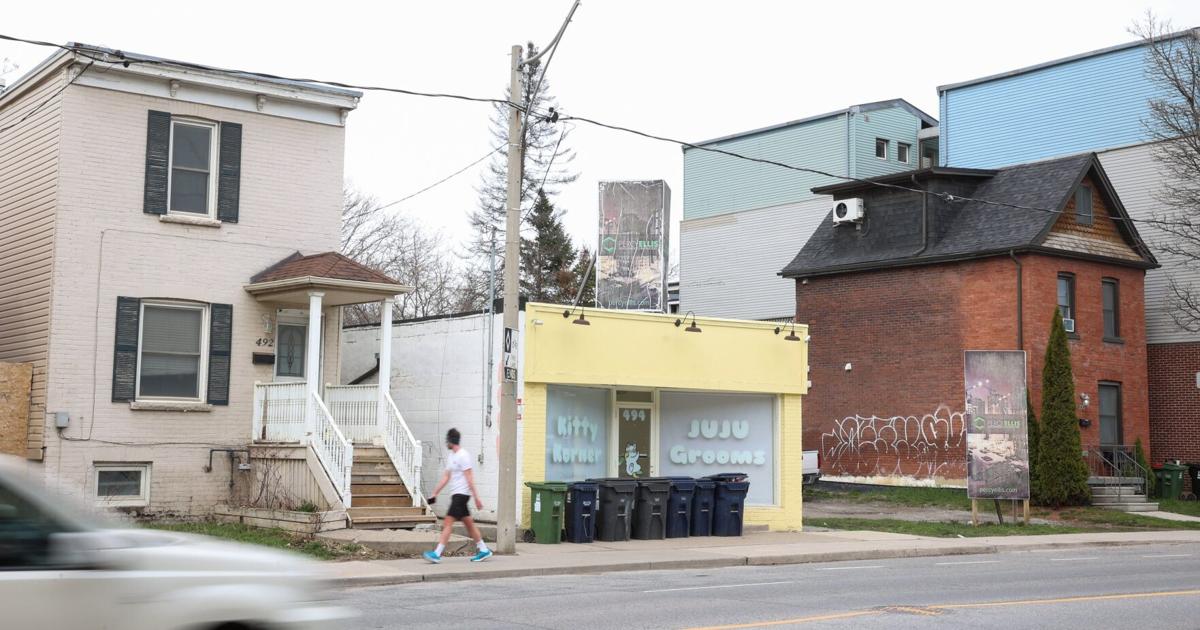
There’s an empty lot at 498 Eastern Ave. in South Riverdale, the site where the downtown chapter of the Hells Angels Motorcycle Club once stood.
This was Canada’s largest outlaw biker gathering spot in the early 2000s: a two-storey cinder block, bunkerlike, members-only fortress, with a thick solid steel front door, secured with multiple deadbolts.
Nowadays, it’s a patch of vacant muddy land owned by the federal government, next to the Kitty Korner cat-grooming salon, a decidedly non-criminal enterprise with pink, yellow and blue frolicking kittens painted on the exterior wall facing the empty lot where the fortified biker bunker once stood.
The Hells Angels remain the world’s largest outlaw motorcycle club and are still a top tier organized crime threat inside Canada, with more than 500 members spread across the country in 34 chapters, 160 of whom are in Ontario, according to the RCMP.
But with many criminal enterprises shifting online and becoming more global in scale, the idea of a bricks-and-mortar clubhouse is emblematic of a version of the Hells Angels that no longer exists in southern Ontario. And, over the years, as the Hells Angels themselves or law enforcement dismantled their clubhouses, they were never replaced.

A 2015 photo shows the Hells Angels clubhouse in South Riverdale. While the Toronto clubhouses aren’t visible any longer, there are still Canadian Hells Angels spread across chapters in Central America, South America, Europe and Southeast Asia, the RCMP said.
Carlos Osorio Toronto Star
Taking care of business
There are 39 full-patch Hells Angels members in Toronto, police spokesperson Stephanie Sayer says.
While those aren’t huge numbers, they remain a significant force in cyberspace, says Declan Hill, an Oxford educated Ph.D. who is an associate professor of investigations at Henry C. Lees College of Criminal Justice and Forensic Science, University of New Haven, Conn.
“The HA understood globalization long before most Fortune 500 companies did,” Hill said. “They moved their bookmaking operations offshore, and closed down the clubhouses — which always drew too much attention from law enforcement — to an online, ‘Taking Care of Business’” lifestyle.
While the Toronto clubhouses aren’t visible any longer, there are still Canadian Hells Angels spread across chapters in Central America, South America, Europe and Southeast Asia, the RCMP said.
Publicity blitz
In its heyday, back in the early 2000s, the Eastern Avenue clubhouse had almost three dozen full patch members, which was tops for the country.
It thrived amidst a publicity blitz that even included a billboard over the northbound Don Valley Parkway and an “open letter” in the Globe and Mail, both of which compared the outlaw bikers to freedom-loving Allied fighter pilots in the Second World War.
The billboard boasted, “Still Fighting for Democracy & Freedom.”
A billboard over the Don Valley Parkway commissioned by the Toronto Hells Angels in 2004 likened them to freedom-loving Allied fighter pilots in World War II.
R.J. Johnston Toronto Star
The open letter complained, “We ask only to be treated fairly.”
There was a strict, “no murders, no wives policy” at Eastern Avenue, as in all the other clubhouses, Quebec biker-hit-man-turned-informer Gilles (Kid) Lalonde told The Star.
It was strictly a members-only club and those members were carefully vetted to ensure they were not police officers or former police officers.
Those members remain barred from going to the police and are bound by a no rip-off rule in drug deals.
Back in the day, the entire Eastern Avenue property was gated and fenced, with several cement posts blocking the front entrance and a cement wall just inside the front door.
A series of security cameras ringed the building’s perimeter, allowing members inside to see everyone who was coming and going.
Even the mailbox was high-security: see-through Plexiglas, so its contents could be easily identified.
The insides of the building were surprisingly clean, scrubbed down by aspiring wannabe bikers who hoped to someday gain membership, Lalonde said.
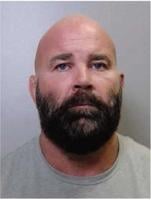
Craig McIlquham was one of many Hells Angels who learned that there’s money to be made if you’re low-key, skilled on the computer — and feared.
Craig McIlquham was one of many Hells Angels who learned that there’s money to be made if you’re low-key, skilled on the computer — and feared.
Compulsory gatherings were called “church meetings,” and held once a week.
In person attendance was mandatory.
There was no zoom option.
A whiteboard allowed key messages to be written and then erased forever, rather than spoken and possibly secretly recorded.
The Eastern Avenue property had been outlaw biker turf since 1978, when it was purchased by the now-defunct Para-Dice Riders Motorcycle Club, who folded into the Hells Angels in December 2000, according to an affidavit filed by the late Robert (Donny) Petersen, the club’s former spokesperson.
East Toronto Hells Angels chapter
A five-minute drive away, at on Kintyre Avenue in South Riverdale, is the site where the East Toronto Hells Angels chapter also held court.
It too has undergone a dramatic transformation in the 2000s.
Just north of Queen and Broadview, it was originally the Toronto home of the old Satan’s Choice Motorcycle Club, before Satan’s Choice were absorbed into the Hells Angels, police say.
A lot on Kintyre Avenue that was formerly occupied by the Hells Angels before the building was seized by the government and torn down.
Sophie Bouquillon Toronto Star
It weathered bombing and a rocket-launcher attack during hostilities with the rival Loners Motorcycle Club in the 1990s and was eventually seized by the government and destroyed as proceeds of crime.
After the property was resold, it was replaced by a triplex of high-end semis, marketed by realtors as “one-of-a-kind,” impeccably-maintained,” “primo, “charming” and “stunning.”
Hells Angels Niagara chapter
A couple of hours down the QEW, at 855 Darby Rd. outside Welland, another once mighty symbol of the Hells Angels has vanished.
There’s a now empty patch of land on an isolated road outside Welland, where the powerful Hells Angels Niagara chapter once met.
Surrounded by farmers’ fields, it was built out of a former machine shop.
A site in Niagara where the Hells Angels had their clubhouse, which was leveled by authorities after being undermined by an informer.
Peter Edwards Toronto Star
Bikers replaced the first-floor windows with concrete blocks, installed a cement-filled steel door and put up lots of security cameras.
There was the standard winged “death head,” featuring a winged skull on a sign, alongside the letters “AFFA” for “Angels Forever, Forever Angels.”
The Darby Road clubhouse was levelled by authorities in 2020, but police warned at the time that it didn’t mean the bikers were extinct.
“They’re basically embedded in every level of society,” then OPP Det. Sgt. Scott Wade cautioned.
“Outlaw motorcycle gangs are involved in all levels of crime, from drug trafficking, stolen property, human trafficking as well as white-collar crime,” Wade said.
Enemies within
The demise of the fortified Ontario clubhouses was sped up by enemies from within.
Dave (Shaky) Atwell acted as a high-ranking Hells Angels officer at the Eastern Avenue clubhouse while wearing a wire for police for 18 months between 2005 and 2007.
Atwell, had been the chapter’s sergeant at arms, in charge of security at the same time as he was selling secrets to police.
In Niagara, full-patch Hells Angel Steven Gault was the star Crown witness in a string of trials that put fellow members in jail and allowed the government to seize and destroy the clubhouse.
Today, meetings can always be held in cyberspace or hotel rooms, rented at the last minute under the names of third parties, retired Montreal police organized crime investigator Pietro Poletti said.
Interior of Hells Angels Montreal south clubhouse.
Surete du Quebec
If there’s something really big, like a national run, there’s always the option of bumping shoulders at a sprawling Montreal South property in Saint-Charles-sur-Richelieu, Que.
There’s plenty of parking space for dozens of Harleys at the Montreal South property, where the buildings are red and white, the club’s colours.
It’s a compound rather than just a clubhouse, with buildings arranged in a square with a large courtyard inside.
The property includes a massive meeting room with an extensive table, with executive-style chairs around it. By the wall is a bar with stools and plaques from other Hells Angels chapters are on the walls.
There was another Hells Angels gathering spot in Sorel-Tracy, Que., a small town northeast of Montreal. It was destroyed on Oct. 18, 2008, when a stolen tanker truck was driven into it at high speed, causing a fire that burned for a day and forced 50 neighbours from their homes.
The two-storey bunker was a writeoff.