
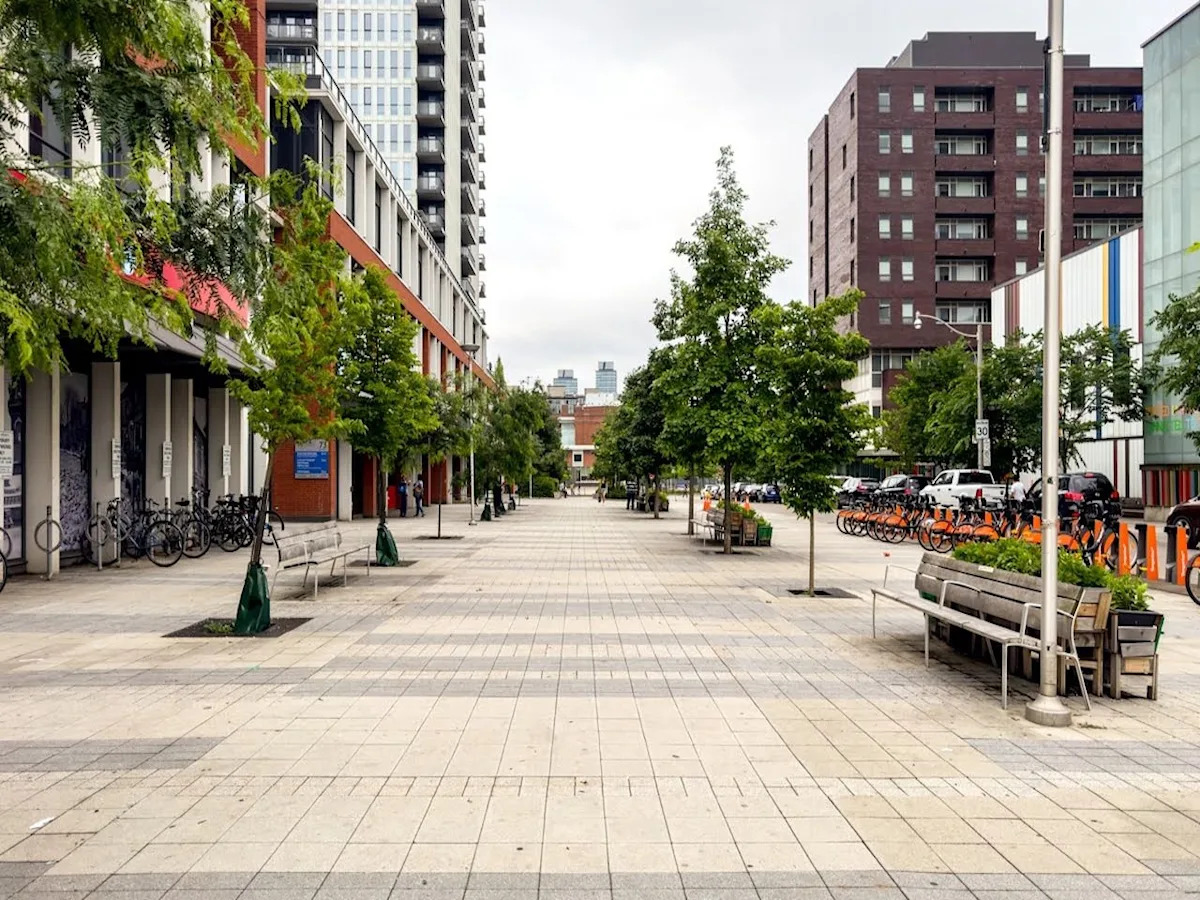
Standing outside the recently completed Don Summerville complex, it’s hard to tell where the affordable units end and the market condos begin. And that’s the point.
Led by Context Development and RioCan Living in partnership with Toronto Community Housing Corporation (TCHC) and the City of Toronto, the eye-catching redevelopment one block west of Queen Street East and Coxwell Avenue replaces two aging social-housing blocks with 770 new homes, along with retail space and a public green square. Roughly one-third of the units are affordable, with another 120 reserved for subsidized tenants. The rest are market rentals and condos, including 50 units set aside for women and families, and a portion for artists.
In a city grappling with affordability, this project offers a glimpse of how income diversity can be built into a project’s design and governance.
According to TCHC CEO Sean Baird, the logic behind mixed-income housing is both financial and social. “A development that combines affordable, market-rate and ownership housing is simply more sustainable,” he explains. “It spreads costs, attracts better financing and allows for long-term reinvestment.”
“When households with different incomes live side-by-side, you avoid stacking vulnerabilities on top of one another,” Bard adds, explaining that this results in safer, more stable neighbourhoods where residents are more likely to participate in local programs, attend community events and look out for one another.
Baird points to lessons learned from earlier redevelopments such as Regent Park and Alexandra Park, where replacing isolated social-housing blocks with mixed-tenure communities dramatically improved health, safety and employment outcomes. “The old model simply wasn’t sustainable,” he says. “This one is.”
For Context Development principal Howard Cohen, the economics of Don Summerville required careful choreography. “We built the new TCHC building instead of paying for the land,” he says, describing the deal structure that allowed public land to stay in public ownership while still leveraging its value. “It’s an integrated model that can absolutely work elsewhere as long as the city remains an active partner.”
The project’s management teams also prioritize collaboration by organizing joint programming and encouraging retail tenants to hire locally. “If a TCHC resident ends up working at the café or grocery store downstairs, that’s real integration,” Cohen says.
Don Summerville’s incorporation of affordable rental and co-op units into its main “market” building means residents share the same lobby, gym and community rooms. This provides a prime example of the community integration that Torontonians uniquely embrace, Cohen adds. “We’ve never seen resistance to people buying condos next to public housing. That social acceptance makes the model possible.”
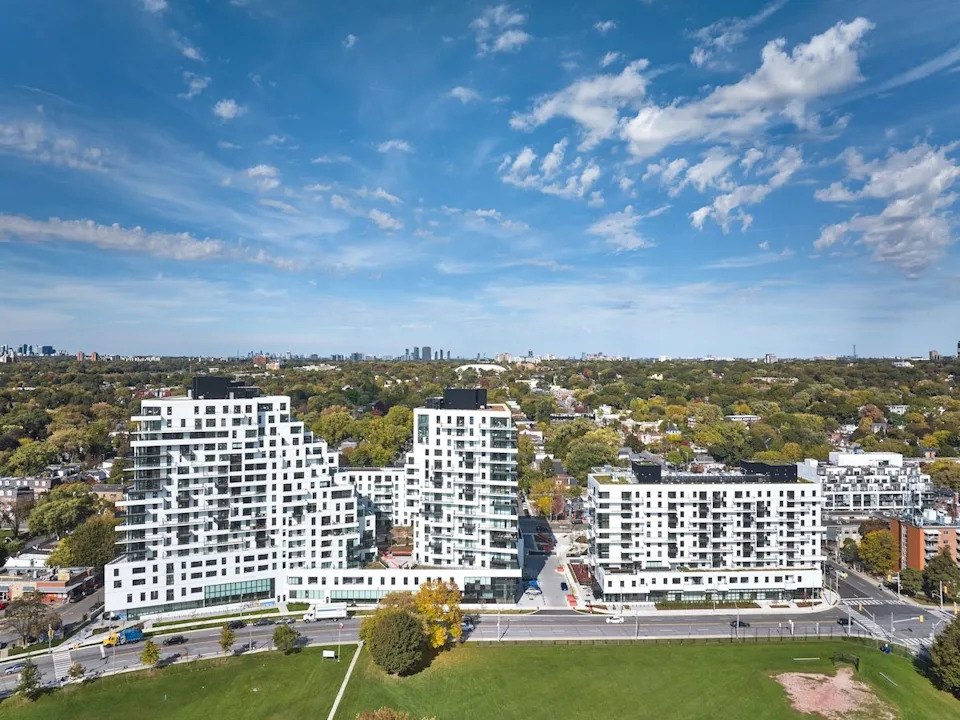
Roughly a third of the units at Don Summerville will be affordable, with another 120 reserved for subsidized tenants. The rest are market rentals and condos, including 50 units set aside for women and families, and a portion for artists.
Urban-planning professor Matti Siemiatycki of the University of Toronto likens projects like Don Summerville to “solving a Rubik’s Cube” of public and private interests. Each side — landowners, developers, government, residents — has its own priorities and aligning them takes time and effort.
But when it works, the results can redefine a neighbourhood. “What stands out here is the design sensitivity,” he says. “There are no ‘poor doors,’ no hidden entrances, no visual cues that separate one group from another.”
Attention to aesthetics matters just as much as the balance sheet, he adds. “We’re in a housing crisis, so it’s easy to dismiss those details as superficial. But the look and feel of a building communicate value. They tell residents that this is a place that matters.”
Indeed, Don Summerville’s beach-inspired palette blends naturally with the Queen East streetscape and nearby Lake Ontario waterfront. The architecture doesn’t advertise affordability; it normalizes it.
Mixed-income projects also bring vitality to surrounding areas. By adding density in established neighbourhoods close to schools, shops and transit, they help sustain local businesses and public amenities that rely on steady visitation and usage. “Cities thrive when people of different backgrounds share public space,” Siemiatycki says. “These developments contribute to that by keeping main streets busy, playgrounds full and libraries well used.”
At Don Summerville, residents are steps from the Martin Goodman Trail and a short streetcar ride from downtown. “When affordable housing is built in desirable areas instead of pushed to the margins, you’re creating complete communities,” he adds.
With the condo market struggling, developers are increasingly open to partnerships that combine public funding and private expertise. “A few years ago, developers didn’t need to collaborate because everything they built sold instantly,” Siemiatycki notes. “Now, mixed-income projects help keep crews working and sites active.”
Baird sees it as a rare alignment of market conditions and political will. “For the first time in a long time, all three levels of government recognize that they can’t solve the housing crisis alone. Projects like Don Summerville show that collaboration works and that it can be replicated.”
Similar redevelopments are planned or underway in Lawrence Heights, Alexandra Park and Eglinton West, with dozens more in pre-planning. Many involve replacing under-used midrise sites with denser, energy-efficient buildings that blend rent-geared-to-income, affordable and market units.
Cohen believes the model’s long-term success hinges on maintaining that balance. “If the mix is right, these communities flourish. They become places people want to live regardless of tenure or income.”
For Baird, every completed project adds momentum. “Each one that opens and works — that feels like a real part of the city — makes the next easier to achieve.”
“Ultimately,” Siemiatycki says, “this isn’t just about housing. It’s about reimagining what a neighbourhood can be.”