
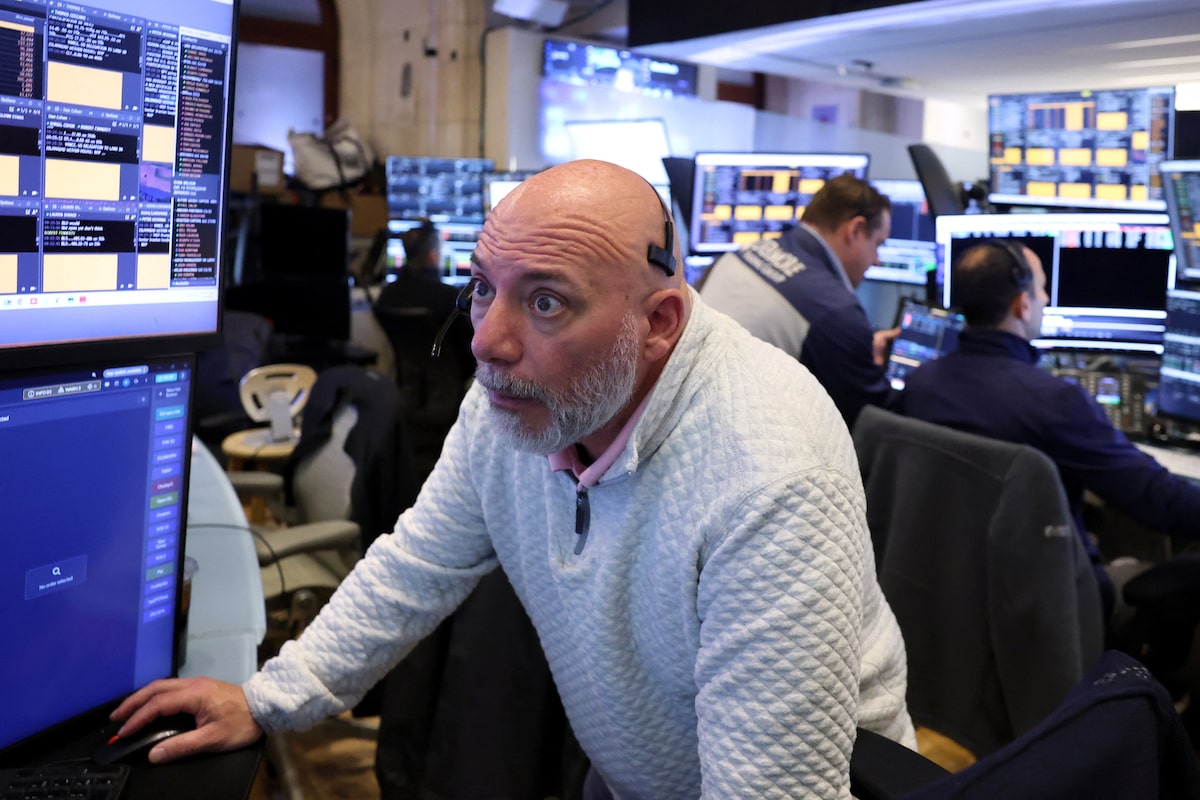
Traders work on the floor at the New York Stock Exchange (NYSE) in New York City, U.S., April 17.Brendan McDermid/Reuters
Canada’s main stock index dipped on Tuesday as uncertainty over U.S.–Iran peace talks ahead of the ceasefire deadline kept investors cautious, with miners being the biggest drag on the index.
At 10:57 a.m. ET, the Toronto Stock Exchange’s S&P/TSX Composite Index was down 296.51 points, or 0.86 per cent, at 34,063.52.
President Donald Trump said on Tuesday that he did not want to extend a rapidly expiring ceasefire in the U.S.-Israeli war on Iran and that the U.S. military was “raring to go” if negotiations were not successful.
The materials subindex, which includes Canadian metal miners, led the losses, dropping 2.2 per cent as gold and silver fell more than 0.8 per cent and 1.4 per cent, respectively.
Miners including NovaGold Resources and Equinox Gold corp were among the top losers.
Six out of 11 TSX sectors were trading in the red.
On the other hand, the tech subindex rose 0.8 per cent, tracking gains on Wall Street as renewed optimism around artificial intelligence and strong corporate earnings lifted sentiment.
TSX’s energy subindex rose 0.9 per cent, tracking gains in oil futures as shipping traffic through the Strait of Hormuz remained largely halted.
Focus next week will be on a Bank of Canada policy meeting in which the central bank is expected to hold rates steady at 2.25 per cent. Data this week showed Canada’s annual inflation rate rose less than analysts expected in March, further weakening the case of more rate hikes.
“With a weak beginning of the year, a negative output gap and a soft labor market, we see arguments against potential hikes,” said Bank of America economist Carlos Capistran.
U.S. stocks are ticking higher Tuesday after UnitedHealth Group and other big companies showed they’re making even bigger profits than analysts expected. Oil prices, meanwhile, remained relatively stable as optimism seems to be sticking in financial markets that the United States and Iran will avoid a worst-case scenario for the economy, even with their war ongoing.
The S&P 500 added 0.3 per cent, coming off just its second drop in 14 days, and is close to another all-time high. The Dow Jones Industrial Average was up 309 points, or 0.6 per cent, and the Nasdaq composite was 0.4 per cent higher.
UnitedHealth helped lead the market with a jump of 9.4 per cent after reporting stronger profit and revenue for the beginning of the year than analysts expected. It also raised its forecast for profit over the full year of 2026.
That’s big because stock prices tend to follow the path of corporate profits over the long term. It’s a double-plus for investors when companies not only top earnings estimates but also forecast even better growth ahead.
Quest Diagnostics rose 5.9 per cent after it likewise joined the fattening list of companies topping expectations for profit and revenue during the latest quarter. It also raised its forecast for profit for the full year.
They helped offset an 8.7 per cent drop for Tractor Supply, whose profit and revenue for the latest quarter fell short of expectations.
Other signals are also indicating the U.S. economy may be doing OK despite sharp up-and-down swings for oil prices because of the war with Iran. A report on Tuesday morning showed that U.S. retailers made more money in March, the first full month of the war, than analysts expected.
Growth was even relatively stable for retail sales when not including those from gasoline stations.
“It’s become cliched to say that the economic hit will depend on the duration of the Middle East conflict, but that cliche does ring true,” according to Brian Jacobsen, chief economic strategist at Annex Wealth Management.
The price for a barrel of Brent crude oil, the international standard, dipped 0.5 per cent to US$95.05 ahead of Wednesday’s scheduled expiration for a U.S.-Iran ceasefire agreement. Both sides are continuing to talk tough, but hope remains after both have signaled they will hold a new round of ceasefire talks in Pakistan.
Much of the tension in financial markets has focused on what will happen to the Strait of Hormuz, a narrow waterway off Iran’s coast that oil tankers use to exit the Persian Gulf. A long-term closure would keep crude oil pent up in the gulf and away from customers worldwide.
The price for a barrel of Brent oil has gone from roughly US$70 before the war to US$119 at times as worries have risen and fallen about a long-term closure for the strait.
On Wall Street, Apple slipped 0.8 per cent after Tim Cook said he’ll step down as CEO on Sept. 1 and become the iPhone maker’s executive chairman. He’s handing control over to John Ternus, a company veteran who rose through Apple’s hardware engineering ranks.
Amazon rose 1.9 per cent after Anthropic said it signed a new agreement and is committing more than US$100 billion over the next 10 years to AWS technologies to train and run its Claude chatbot.
In stock markets abroad, indexes were mixed in Europe following a stronger finish in Asia. South Korea’s Kospi rose 2.7 per cent for one of the world’s biggest moves.
In the bond market, Treasury yields edged higher. The yield on the 10-year Treasury rose to 4.27 per cent from 4.26 per cent late Monday.
Kevin Warsh, President Donald Trump’s nominee to chair the Federal Reserve, will be speaking on Capitol Hill later Tuesday. He’ll face a tightrope walk, as investors want to see if he would maintain the Fed’s independence from political meddling even though Trump has been pushing hard for lower interest rates.
Reuters and The Associated Press