

Listen to this article
Estimated 4 minutes
The audio version of this article is generated by AI-based technology. Mispronunciations can occur. We are working with our partners to continually review and improve the results.
From your smartphone to algorithms on platforms like Netflix and Amazon, artificial intelligence is increasingly becoming part of daily life.
And now AI is becoming incorporated into your daily weather forecasts.
Environment and Climate Change Canada (ECCC) recently announced it will use artificial intelligence in its weather forecasts beginning this spring.
The department is launching a new hybrid model that will make its six-day forecast as accurate as its five-day forecast, according to Stephane Beauregard, manager, design and integration of numerical forecast systems and AI at ECCC.
This improvement is significant because they’ve only been using the hybrid model experimentally for about one year.
“We’ve been running traditional models for 50 years and historically it takes about 10 years to gain one day of predictability, so this kind of improvement is essentially 10 years of research,” Beauregard said.
ECCC says its hybrid model will better predict major systems like winter storms, heat waves and atmospheric rivers.
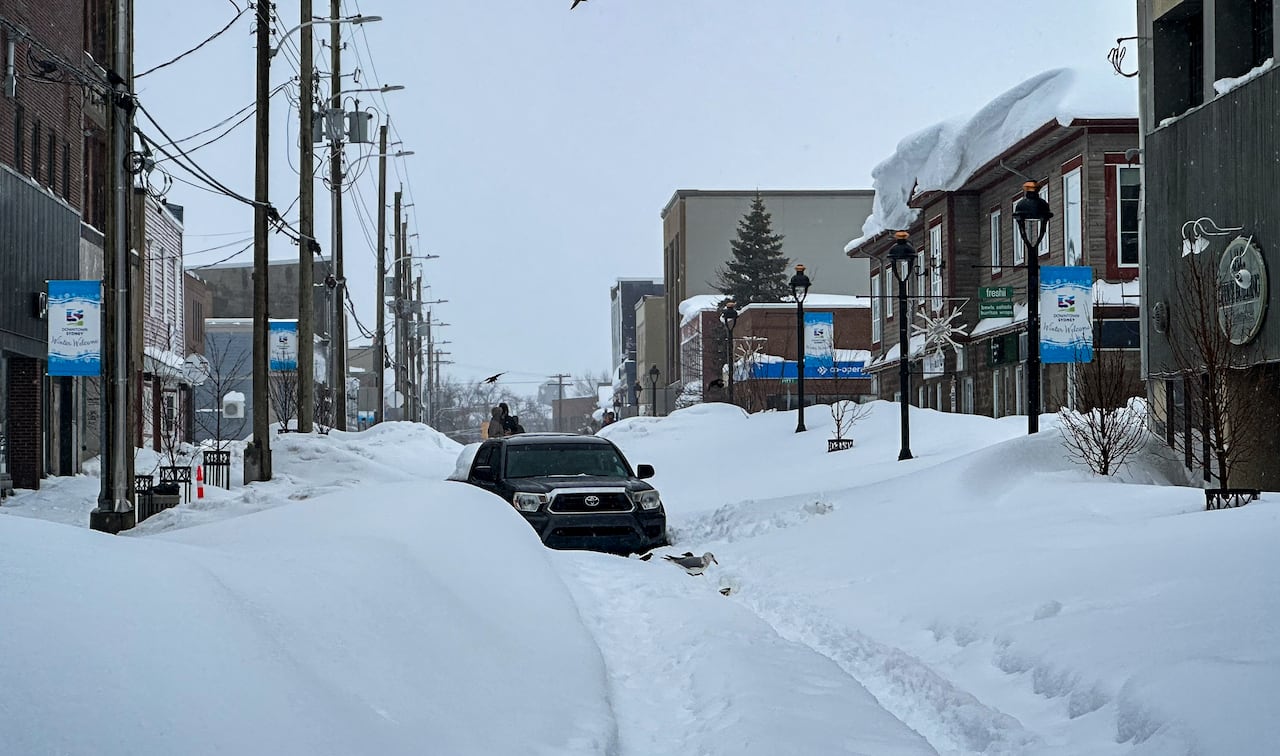 The aftermath of the infamous 2024 winter storm that dropped 150 centimetres of snow on Sydney, Cape Breton. (Tom Ayers/CBC)
The new model is focused on the four- to 10-day time frame, however Beauregard said in the coming years there will be efforts to incorporate AI into shorter-range forecast modelling as well.
While ECCC is using the hybrid approach, other government weather agencies and private companies have jumped in with their own dedicated AI models.
The European Centre for Medium-Range Weather Forecasts officially launched its artificial intelligence forecasting system (AIFS) in early 2025 and it’s already become a central part of their forecasting suite.
For some variables, such as near-surface temperatures and mid-level atmospheric conditions, the AIFS is outperforming traditional physics-based models by up to 20 per cent in terms of error reduction.
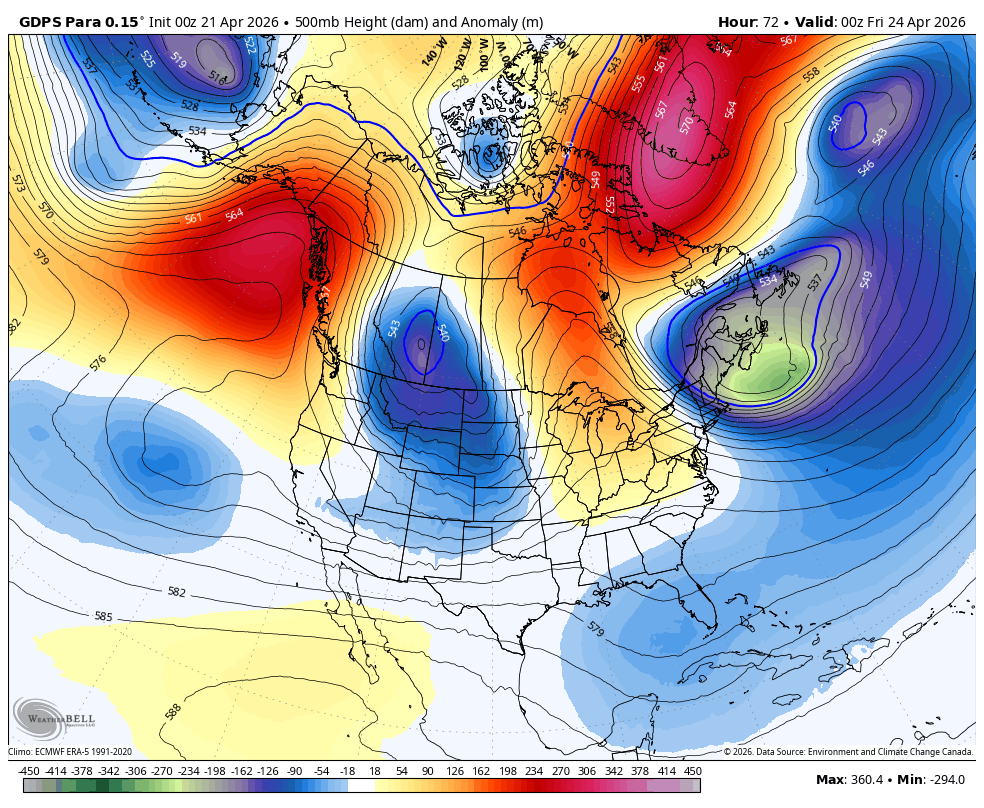 A forecast snapshot from Environment and Climate Change Canada’s new AI hybrid model. (WeatherBell Analytics and Environment and Climate Change Canada)
Meanwhile, Google’s GraphCast can generate a highly accurate 10-day global forecast in under one minute. This allows scientists to run thousands of different versions of the same forecast to reduce the level of uncertainty. This is a real game changer given that traditional physics-based models take hours to complete on supercomputers.
Beauregard said by incorporating decades of historical reanalysis, these AI-driven models can make huge improvements to the forecast, but they do have their limits, especially with local variables like wind speeds near specific mountain ranges.
“The challenge is, we don’t have as much data as we would like … at a high enough resolution, to train the AI models at these scales. So these are more challenging, but I’m expecting those to be improved in the future … because a lot of research is being done in that direction.”
I’m often asked if I’m worried about AI taking over my job, but I believe we will continue to need meteorologists to interpret all of this data that’s produced from these forecast models, whether it’s coming from a traditional physics-based model, AI or a hybrid.
And there is certainly no shortage of forecast models to look at when producing a daily weather forecast.
Personally, I analyze at least a dozen different forecast models throughout the course of the week, including traditional models, AI models and now the new Canadian hybrid model.
With the speed at which an AI model can be produced, there will likely be many more coming online over the next few years and I’m expecting the number I use to only increase.
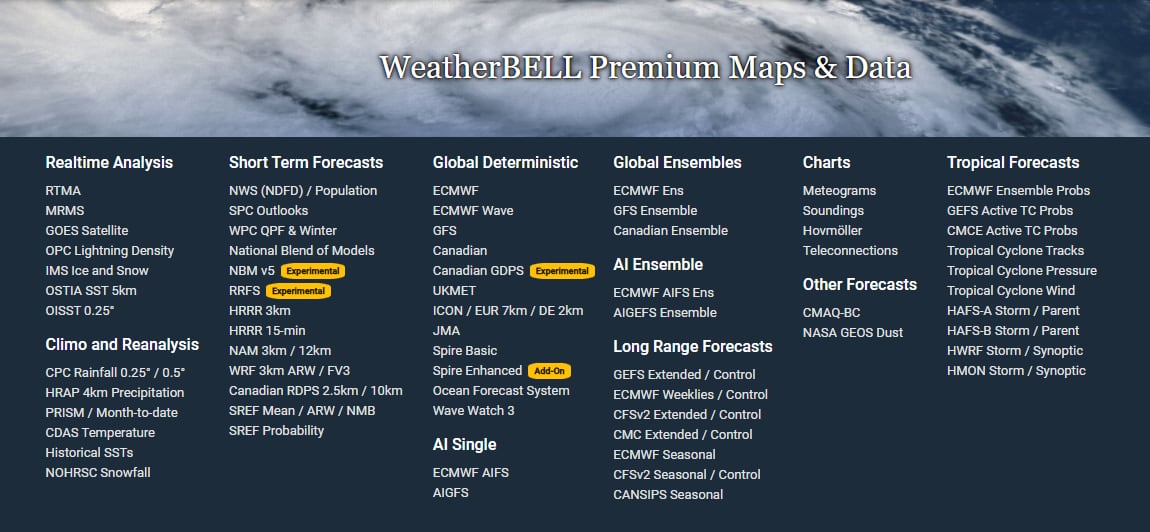 This is just a sample of the numerous forecast models available to meteorologists. (WeatherBell Analytics)
While the advancements in forecast accuracy are a great step, we will still have a long way to go.
I see on a daily basis just how different the projections of forecast models can be, whether it’s predicting the track of an incoming storm, or timing how quickly the low-level clouds and fog will retreat back to the coastline in the early summer.
At the end of the day, predicting the future is tough when you have as many variables as the atmosphere does, especially here in the Maritimes.
MORE TOP STORIES