

While nearly half of violent crimes now go unsolved nationally, with the weighted clearance rate dropping from 63 percent to 55 percent in 2024, reactions from four major police services in Toronto, Winnipeg, Calgary, and Montreal provided to The Hub tell the story behind the numbers at a local level.
An analysis of Statistics Canada data published in The Hub by Dave Snow, University of Guelph associate professor and Macdonald-Laurier Institute senior fellow, tracked the steady decline in solving the most violent crimes committed in Canada.
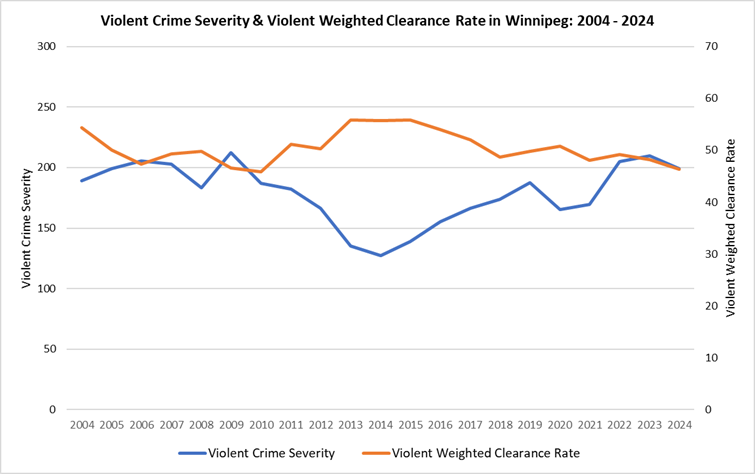
In the latest data from city police services, Winnipeg shows a pronounced inverse trend: as violent-crime severity rose, its weighted clearance rates have fallen.
Statistics Canada’s weighted clearance rates adjust for crime severity using a standard index. A first- or second-degree murder carries almost 300 times the statistical weight of a common assault. And it carries more than 12 times the weight of a robbery.
This weighting ensures that a handful of homicides or attempted murders can swing the overall rate dramatically. High-volume offences such as assaults may remain stable. The metric reflects both investigative effort and the changing offence mix (types of crimes being committed) in a jurisdiction.
Toronto reports violent incidents up 37 percent since 2015, and clearance rates have dropped to 57 percent from 63 percent, a modest overall decline compared to some other parts of the country. Similarly, in Montreal, the violent crime severity index went up 22 percentage points from 2020 to 2024, while the weighted violence clearance rate dropped from 7 percentage points in the same time period.
Meanwhile, Calgary stands out: its weighted violent-crime clearance has recovered and hit its highest levels in 2022-24, even after earlier rises in crime severity. This means it has a lower rate of unsolved violent crimes compared with the national trend.
These city-level details, highlighting specific drags in three cities and recovery in the fourth, reveal that some of Canada’s major centres are contributing to the national decline in clearance rates more than others.

Declining rates of solving severe violent crimes a national trend
Snow’s analysis showed an inverse relationship between rising violent-crime severity and falling violent weighted clearance rates as a trend over the last two decades, with an uptick in violent crime-severity between 2018 and 2024 throughout most regions in Canada.
Population growth from 35 million to 40 million coincided with a roughly 10-percent national decline in officers per 100,000 people. The ratio fell from 202 officers per 100,000 people in 2012 to 181 per 100,000 people by 2023 (the most recent available data). Court backlogs, strained bail practices, and rising stayed or withdrawn cases have added downstream pressure.
“Police are being asked to do more with less…More people, more violence, more demanding cases, and fewer crimes solved,” Snow concluded.
Police clearance rates measure the proportion of “founded” criminal incidents that police resolve. Resolution occurs by identifying a suspect and either laying a charge or clearing the file through other recognized means.

i
Winnipeg Police Service Chief Danny Smyth speaks during a press conference regarding a search for a male suspect in the fatal stabbing of a teenaged girl near a busy corner of the city’s downtown. Aaron Vincent Elkaim/The Canadian Press.
Winnipeg Police Service reports pronounced inverse relationship driven by robberies and extortion
Winnipeg Police Service (WPS) reports a clearer alignment with national trends. After declining sharply between 2007 and 2014 and more pronounced than the rest of the national average, total crime severity rose through 2022. It then eased in 2023 and again in 2024. Weighted clearance rates followed an inverse trend of more weighted crimes being solved, as total crime severity waned.
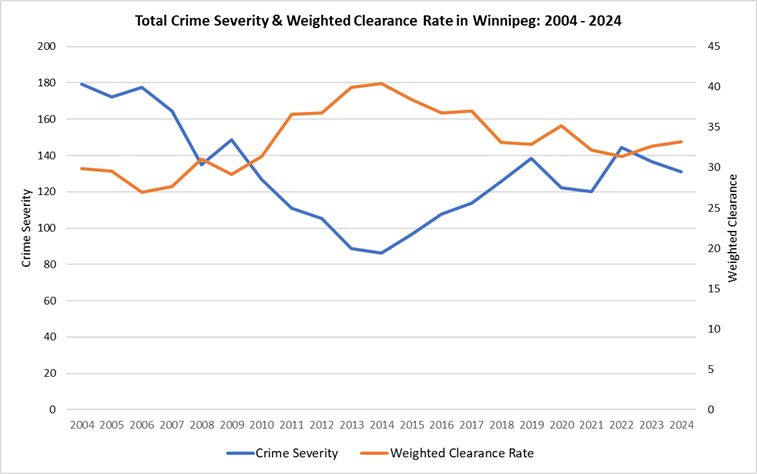
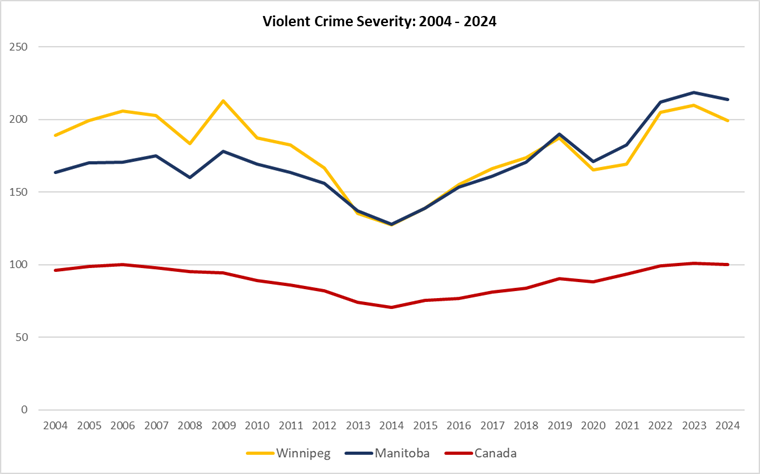
Violent-crime severity followed a similar path in Winnipeg. It peaked in 2023, when it had climbed well above double the national average for crime severity, at its highest level since 2009. It then fell 5 percent in 2024—a steeper drop than the national 1 percent decline.
Winnipeg’s increases in severity since 2014 have been more pronounced than the Canadian average. Violent crime rose 56.2 percent versus 41.2 percent nationally.
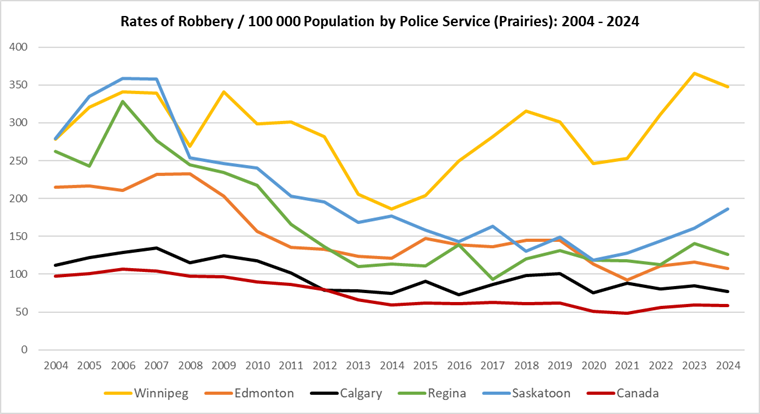
The WPS confirmed an inverse relationship between crime severity and weighted clearance rates since 2004. As violent-crime severity has increased, weighted clearance rates declined. A key driver is the sharp rise in robberies. WPS recorded 348 robberies per 100,000 in 2024. This rate far exceeds other prairie cities and the national average of 58.
Robberies carry a low clearance rate of 29.9 percent in 2024. Extortion is even lower at 3.3 percent.
By contrast, homicide clearance remained strong. Thirty-eight of 41 homicides (92.7 percent) were cleared in 2024. Winnipeg has consistently exceeded the national average since 2011.
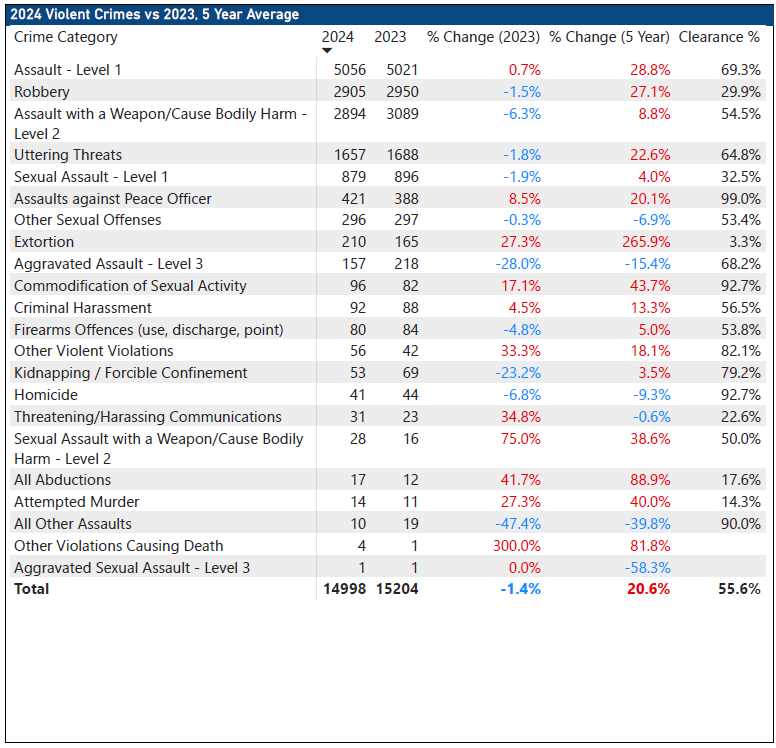
Staffing issues with WPS mirror national pressures. Winnipeg’s population grew 20 percent over the past decade while the number of police meant to serve them lagged, resulting in falling per capita.
“In 2024, the Winnipeg Police Service had an authorized complement of 1,390 police officers, an increase of 24 officers from the previous year. Winnipeg’s population has grown by 20 percent over the past 10 years; during the same timeframe, the number of police officers in the city has decreased,” explained WPS public information officer Pat Saydak to The Hub.
“Despite the addition of new officers in each of the past three years (2022–2024), the WPS has not kept pace with population growth. As a result, the officer-to-population ratio has been shrinking since 2013. The addition of new officers in 2025 and 2026 will flatten this downward trend, matching the Service’s growth with that of the City of Winnipeg’s,” Saydak added.

i
Toronto Police Chief Myron Demkiw speaks during a press conference. Spencer Colby/The Canadian Press.
Toronto Police Service: Detailed data shows rising complexity
Toronto Police Service (TPS) supplied comprehensive annual figures from 2015 to 2025 to The Hub that illustrate persistent increased pressure on authorities and rising crime.
Violent incidents rose approximately 37 percent, from 26,867 in 2015 to 31,414 in 2025. But clearance rates declined about 9 percentage points overall, from 63 percent in 2015 to 57.4 percent in 2025, with year-to-year fluctuation. 2025 is the lowest clearance rate for violent crimes in Toronto since at least 2015.
TPS, like many police services across the country, has faced challenges recruiting new officers and with the growth in population and crime that comes along with increased population.
“TPS experienced a 12.6 percent decline in police officers per 100,000 population since 2012 (from 197 to 172), even as Toronto’s population grew from 2.7 million to 3.2 million,” a TPS respondent from the analytics and innovation team told The Hub.
Non-violent incidents increased 57 percent. Non-violent crime offences include crimes like theft under or over $5,000, breaking and entering, identity theft, trafficking in stolen property, and fraud. TPS’s clearance rates for non-violent crimes fell dramatically from 44.2 percent to 25.1 percent, a 43-percent relative drop.
Recruitment has rebounded for TPS, however. The service received 5,787 distinct applications in 2025, a 16-percent increase year-over-year. A multi-year plan targets 360 hires annually. The service has also expanded its recruiting team.
TPS says its investigations have grown more resource-intensive. This is especially true for cases involving firearms, organized crime, and digital evidence.
“A significant driver of complexity is the increasing use of technology in criminal activity. We’re seeing offenders rely on encrypted platforms and other digital tools to coordinate and conceal serious offences, including drug trafficking, extortion, child exploitation, hate-motivated crime, and violent extremism,” explained a TPS media officer. “That creates real investigative challenges when critical evidence is difficult or time-consuming to lawfully access.”
TPS Police Chief Myron Demkiw and other Canadian police chiefs advocate for lawful-access reforms, such as Bill C-22, which is federal legislation aimed at modernizing police access to digital subscriber information and other data held by telecom and tech companies through clearer court-authorized processes. This, they claim, would modernize authorities for timely digital evidence.
Extortion cases are rising in Toronto as well. TPS noted the problem is more acute across the broader Greater Toronto Area.

i
Chief of SPVM and Minister of Finance and National Revenue Francois-Philippe Champagne answer questions on a new National Anti-Fraud Strategy to combat surging financial crimes. Christinne Muschi/The Canadian Press.
Montreal Police also faced lack of new police officers for rapidly growing population and increased violent crime
The Service de police de la Ville de Montréal (SPVM) also saw an inverse relationship of its weighted violent crime clearance rate dropping as the violent crime severity index increased from a rating of 92.4 in 2020 to 112.51 in 2024. The weighted clearance rate dipped from 55.11 percent in 2020 to 48.1 percent in 2024.
“At this stage, there is no single or definitive explanation for why crime severity may increase while clearance rates decline. The SPVM cannot, on its own, provide a comprehensive explanation for a phenomenon that is this complex and that extends well beyond policing,” SPVM media relations officer Samantha Velandia explained to The Hub.
However, Valendia said the SPVM has observed, alongside with its institutional and community partners, that there are many factors at play, including social, economic, and individual dynamics.
“Several plausible contributing factors may help explain why higher crime severity can coincide with lower clearance rates: the investigative landscape has become markedly more demanding, driven by more sophisticated criminal activity, expanding volumes of digital and physical evidence, and heightened judicial expectations for documentation and disclosure,” Valendia added. “At the same time, broader social pressures, such as community tensions and mental‑health‑related factors, further complicate case progression, resulting in longer, more resource‑intensive investigations and increased operational strain on investigative teams.”
To make matters worse for the strain on resources, Montreal’s agglomeration population jumped 12 percent between 2012 and 2024, while SPVM’s police personnel only increased by about 1 percent. The number of SPVM officers per 100,000 Montreal residents dropped 10 percent from 2012 to 2024. As of 2024, there’s a ratio of 210.9 officers per 100,000 residents across Montreal.
The SPVM has faced surges in certain categories of violent crime in Montreal in recent years.
“Several categories of violent crime in Montréal have become significantly more resource‑intensive, particularly violence targeting businesses and business owners, including intimidation, mischief, arson, threats, and firearm‑related incidents. Many of these offences are initiated or facilitated online, which increases investigative complexity and requires specialized technological capabilities, cyber‑investigative expertise, and sustained inter‑unit coordination,” Valendia told The Hub.
From 2023 to 2025, the SPVM opened more than 1,700 extortion files. In 2024, the SPVM started investigating 923 extortion cases. Last year, SPVM saw a drop of 12 percent in extortion cases, opening 812 files.
In response to the increase in organized crime gangs targeting Montreal businesses with violent crimes and threats, the SPVM launched several coordinated initiatives to curb the alarming trend.
The SPVM created Project ENSEMBLE in 2025: a collaboration among several SPVM units, municipal and provincial partners, and merchant associations and business owners. So far, Project ENSEMBLE has led to 41 investigation files opened, 30 arrests, 38 search warrants, and 51 files submitted for charges.
The SPVM also created Project AURORA, which is a digital crime monitoring platform.
“AURORA has revealed that suspects come from diverse backgrounds, including youth aged 14 to 17 who are often manipulated and receive little or none of the promised payment,” Valendia explained. “The project reinforces a clear message: social media no longer provides anonymity for those who solicit or accept criminal contracts.”

i
Calgary mounted patrol officers, after a press conference in Calgary, Alta., Monday, June 2, 2025. Dave Chidley/The Canadian Press.
Calgary Police Service finds stability and recovery after decline in clearance rates
Calgary Police Services (CPS) told The Hub it has not experienced the same sustained national trend of clearance rates declining as weighted violent crime rises.
Between 2016 and 2019, violent-crime severity rose. But it has since fluctuated within a stable range.
Weighted violent-crime clearance recovered and reached its highest levels in 2022-24. Year-to-year data show only a “loose” and “weak” inverse link.
On staffing, CPS acknowledges an overall downward shift in authorized officers per capita amid population growth.
Investigative outcomes, the service argues, are shaped by many factors. These include offence mix, case complexity, specialized investigative capacity, workflow prioritization, and severity weighting.
“At a year‑to‑year level, Calgary does show a loose inverse relationship between violent‑crime severity and weighted violent‑crime clearance, with clearance tending to decline in years when severity increases,” a CPS spokesperson explained to The Hub. “However, this relationship is weak and not stable over time.”
“This pattern suggests that year‑to‑year changes in [types of offences committed] combined with a small number of extremely serious cases that carry disproportionate statistical weight, exert a strong influence on weighted clearance outcomes,” the CPS spokesperson added.
Regarding resource-intensive crimes, CPS reports concrete action on the extortion wave now affecting multiple provinces. As of April 15, 2026, Calgary recorded 41 extortion-related occurrences since Jan. 1, 2025. Seventeen involved shootings and 24 were non-shootings. The service is collaborating with the Alberta Law Enforcement Response Team (ALERT). It has launched two parallel enforcement-and-suppression operations.

Expert perspectives and implications of the lower clearance rates
Canadian Police Association president Tom Stamatakis stressed to The Hub that the clearance-rate decline is fundamentally a capacity issue.
“Canada has historically had a lower ‘cop-to-pop’ ratio than the U.S. or any other Commonwealth or European peer countries, and that has gotten even worse more recently as Canada’s population has increased,” he said.
Stamatakis points to additional aggravating factors, including legal decisions in the courts that have made serious criminal investigations increasingly complex, which have added significant administrative obligations and more resources. He also highlighted how an increase in people suffering from mental health problems and drug addiction is adding further strain on police services across the country, especially in major cities.
“Serious challenges across Canada involving unsupported persons struggling with serious substance use challenges (including related consequences that affect behaviour, impulse control, rage, etc) and the same for those struggling with serious mental health challenges, who often fall into crisis.”
University of Ottawa and Carleton University criminologist Jeffrey Bradley points to the “erosion of police legitimacy, particularly among marginalized communities,” which, he says, has reduced witness co-operation, hurting the clearance rate on violent crimes in certain regions. He also highlights resource reallocation toward order-maintenance functions such as managing protests, homelessness and mental-health crises as reasons why clearance rates of violent crimes have declined in recent years.
University of Toronto law professor Kent Roach highlights prosecution challenges in organized-crime cases like extortion, citing “broad constitutional disclosure obligations and problems transitioning from secret intelligence to public evidence.”
View reader comments (0)
Collectively, the three police services and the expert commentary paint a picture more complex than national declines suggest. CPS demonstrates that the types of violent crimes committed year-to-year and investigative prioritization can produce fluctuating weighted violent crime clearance rates even amid staffing shortage pressures.
Winnipeg police officers’ isolated robberies and extortion as the main drags on its clearance rate, although staffing shortages amidst a population boom also undoubtedly played a major role in violent crimes being solved.
Meanwhile, TPS faced a significant drop in clearance rates in the last decade, dropping 5.6 percentage points, which was tied to rising case volume and technological complexity while officers per capita declined during the population boom of 2018 to 2023.
In Montreal, SPVM saw a similar drop in its weighted violent crime clearance rates, as extortion and attacks on local businesses shot up, coinciding with major population growth but a steady number of police officers.
Whether these city-level efforts can reverse the broader trend will depend on sustained political commitment to resourcing, legislative reform, and prevention. The recent curtailing of immigration, lowering population to a standstill, will also give the police services some breathing room.
For victims and communities, the stakes are clear: when nearly one in two violent offences remains unsolved, deterrence weakens, and public trust erodes. The fresh data from Calgary, Winnipeg, Montreal, and Toronto underscore that solutions must be both local and national if Canadians are to regain confidence that serious crimes will be investigated and resolved effectively.
Fault Lines examines the pressures pulling Canadian society apart and the principles that can hold it together. We look beyond headlines to understand how institutions, communities, and democratic norms are fraying. Our mission is to show how better choices can repair what is broken.

Graeme Gordon is The Hub’s Senior Editor and Podcast Producer. He has worked as a journalist contributing to a variety of publications, including CBC,…
Read more