

Robert KlemkoApr 22, 2026, 07:00 AM ET
CloseRobert Klemko is a senior writer focused on investigative reporting.
Multiple Authors
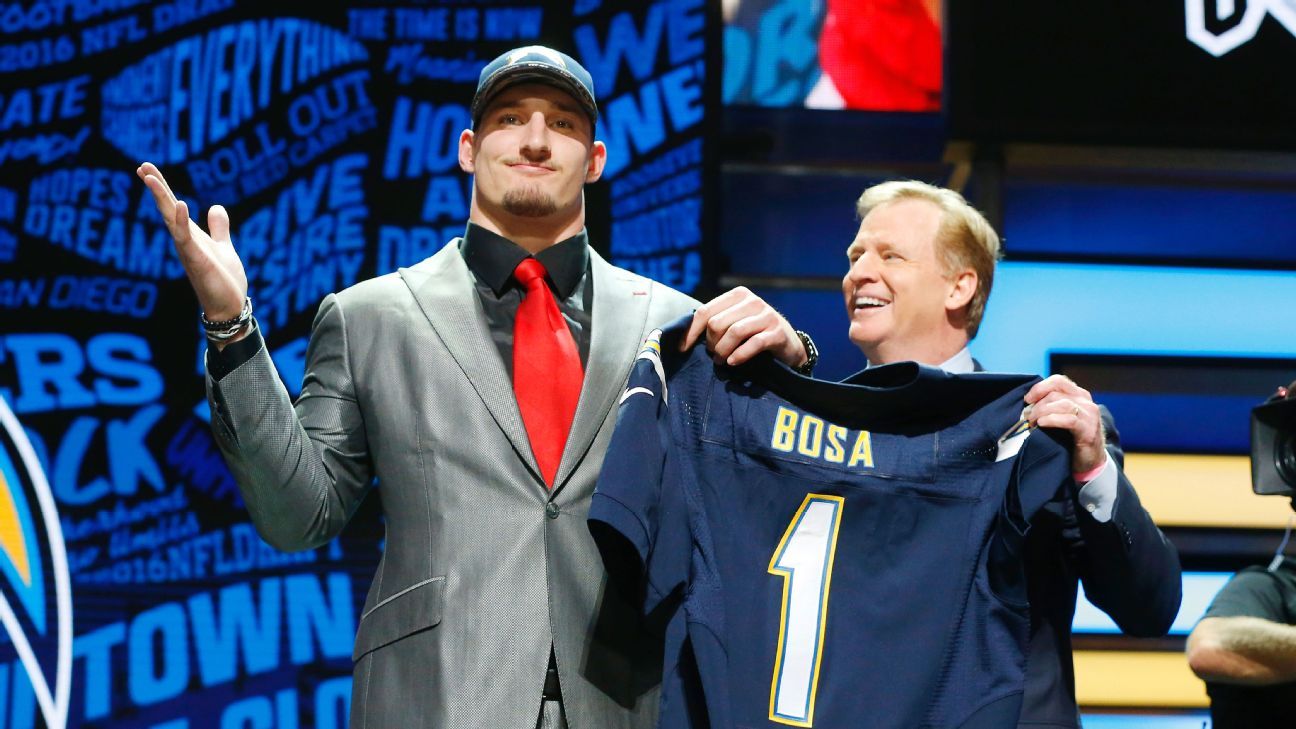
In 2016, the San Diego Chargers’ front office and coaching staff were enthusiastic about Ohio State edge rusher Joey Bosa, but the rest of the league was unconvinced. Bosa had been out of the top-three conversation for months, and most of the prominent media mock drafts sent other players to San Diego at No. 3.
Tom Telesco, the former NFL general manager who led the Chargers front office from 2013 to ’23, figures between 20 to 30 people would have known who the Chargers pick would likely be 24 hours before draft day, based on meetings with ownership, scouting meetings where prospects are discussed at length and the team’s draft board is built, and internal whispering.
Editor’s Picks
Back then, an insider with that knowledge would likely have needed to place the bet illegally, or with an offshore sports betting outfit. A decade later, someone armed with a similar sure-thing wager need only visit a prediction market website, sign up for an account and bet the farm, confident in their anonymity.
“This scares the s— out of me,” Telesco said. “It’s something I never would have considered a possibility.”
Nowadays, Telesco said, there’s not much a GM can do but tighten the circle of people within an organization with insider knowledge and hope scandal doesn’t hit.
“When I was a scout, we treated this information like state secrets,” Telesco said. “The only thing you can really do is scare people and tell them that heads will roll. At the end of the day, if you don’t trust your employees, you’ve got the wrong employees.”
The NFL has flagged prediction markets as being particularly susceptible to insider abuse in the wake of multiple high-profile trades that accurately predicted the onset of U.S. military action in Iran and Venezuela, leading to congressional inquiries into insider trading potentially stemming from the Department of War or the White House. Donald Trump Jr., the president’s son, works with both companies as an adviser, and he is an investor in Polymarket.
Prediction markets such as Kalshi and Polymarket are federally regulated (unlike traditional sports betting sites, which are regulated by states), and under the second Trump administration, they’ve expanded options for trading on sports propositions, including who is picked where in the NFL draft. Kalshi’s users have bought some $2 million in stakes on the identity of the No. 2 overall choice.
Last month, the NFL sent letters to several prediction markets asking them to cease options for trades on outcomes that can be determined in advance or easily manipulated.
The NFL said it wanted to protect game participants from “unfair and unwanted allegations” tied to gambling and prediction markets and objected to four types of offerings: those that can be easily manipulated by a single person (such as missed field goals), those that are knowable in advance (such as draft picks, player signings and coach firings), anything related to officiating, and “inherently objectionable” topics (such as player injuries and fan safety).
The sites have declined to make changes, and users can make trades on a variety of props, including who will be the 13th pick in the draft this week, or the identity of the third wide receiver off the board. More than 100 draft-related propositions are available for investing on Kalshi.
The NFL has asked prediction markets not to offer propositions that would be knowable in advance — such as draft picks — but they are anyway. Kalshi is offering roughly 100 draft-related propositions. Getty Images
Kalshi declined to comment for this story. Polymarket did not respond to an emailed request for comment.
And while sportsbooks such as DraftKings, ESPN’s official sportsbook and odds provider, maintain strict surveillance of betting patterns and have historically pounced on suspected insider-informed betting by banning accounts and alerting law enforcement when applicable, prediction markets have not raised those concerns over controversial winning trades. Instead, the odds move with the action, and large bets swing markets in real time.
Both Polymarket and Kalshi have partnerships with integrity monitors such as IC360 (formerly U.S. Integrity), and Kalshi says it screens and bans professional athletes, coaches, trainers and others from trading on any sport they’re connected to.
Until the Supreme Court struck down barriers to legalized sports gambling in a 2018 decision, the NFL took a hard-line stance against any connection with gambling. Since legalization and its subsequent partnerships with sportsbooks, the NFL had its share of players disciplined for gambling-related incidents — as have Major League Baseball, the NBA and NCAA basketball.
The NFL says it educates teams on the dangers and penalties associated with sports gambling yearly.
“Before each Draft, the league reiterates to all NFL personnel — including owners, presidents, general managers, head coaches, player personnel directors and IT directors — the importance of maintaining the integrity of the Draft selection process through adherence with the NFL Gambling Policy and Draft-related security measures,” a league spokesperson said in a statement.
The league suspended standout Falcons wide receiver Calvin Ridley for the entire 2022 season after it found he had bet on NFL games while on the non-football illness list.
Ridley was one of several players suspended for entire seasons in 2022 and 2023. Another player, Titans offensive lineman Nicholas Petit-Frere, was among a handful of players suspended for fewer games for simply betting on non-NFL sports while they were inside NFL facilities (Sports betting apps, in cooperation with the NFL, share flagged geolocation data when bets are made inside team facilities).
The Titans’ general manager at the time, Ran Carthon, told ESPN it was the first and only time he’d dealt with a gambling issue as an NFL employee. He hadn’t considered that an employee might use inside information to profit off the draft.
“I’ve been a scout, and I made $35,000 a year, so I know how tempting making a quick five grand could be,” Carthon said. “Because of the era we’re in, you have to put your foot down and say it’s a fireable offense. It’s not a ‘Hey buddy, I know you made a mistake.’ No, if you get caught, you’re fired, and you run the prospects of your whole career being over. It’s a conversation, for sure.”
Said former Steelers general manager Kevin Colbert: “It’s worrisome as a purist. On draft day itself, the draft room was open. We weren’t very secretive. Anyone could walk in and out, because there was a degree of trust. Naively, you want to believe that everyone is in it for the right reasons.”
If recent scandals in the NBA are any indication, leaks can come from anywhere, and for any reason. In 2024, Toronto Raptors guard Jontay Porter was implicated in a gambling scheme in which he fed inside information to a bettor whom he owed a significant amount of money. Porter received a lifetime ban from the NBA. He pleaded guilty in federal court and is awaiting sentencing.
Martin Mayhew, former NFL player, Georgetown-educated lawyer and former general manager of the Lions and Commanders, said the draft is especially vulnerable to insider trading at the top of the first round on the occasion a team’s staff knows it values a prospect more than most other teams.
That was the case in 2013, when the Lions held the fifth overall pick and were in the market for an edge rusher. The coaching staff spent a week with BYU’s Ezekiel Ansah at the Senior Bowl in Mobile, Alabama.
“His college career probably didn’t merit being taken that high,” Mayhew said. “But our coaching staff was very confident — and correct — they would get it out of him relatively quickly based on how quickly he improved that week. It wasn’t a super small circle of people in the building who knew that.”
Mayhew said he believes disaster is likely. Someone associated with a team — through coercion or ambition, from the owners’ suite to the locker room — will probably take the plunge, he said. The question is whether they get caught.
“The league really found a way to maximize profits when they embraced gambling,” Mayhew said. “Franchise value has skyrocketed. But as people get more comfortable with it, I will not be surprised when someone crosses the line. In a sense, the NFL is playing with fire.”
ESPN’s David Purdum and John Mastroberardino contributed to this report.