
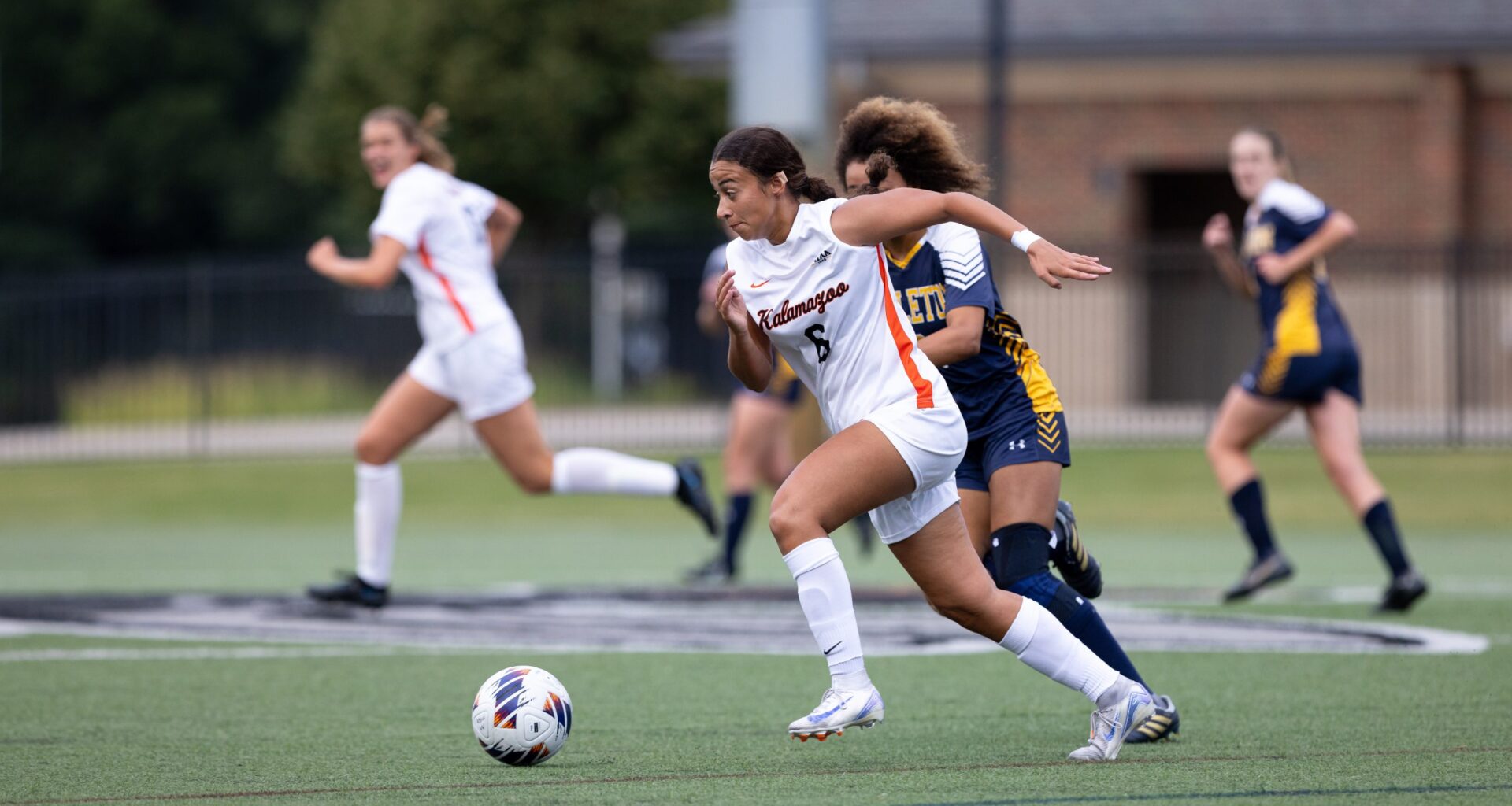
In soccer, chemistry might outweigh star power.
A new study from Kalamazoo College, published in Football Studies, found that a soccer player’s individual ability accounts for only about 11% of performance variation in small-sided games. Their combination with teammates? Roughly double that.
In the study, Associate Professor Santiago Salinas, soccer alumnus Shun Yonehara ’24 and student-athlete Miyani Sonera ’27 ran 78 small-sided matches—three-on-three, men and women, rotating teammates through ever-changing combinations. Because each athlete played with many different teammates, the researchers were able to separate the influence of individual ability from the impact of specific teammate combinations.
The research drew inspiration from an unlikely source in quantitative genetics. “In biology, we often separate the effects of genes and environment to understand why organisms differ,” Salinas said. “We realized we could apply the same idea to soccer. Players are like genotypes, teammates are the environment, and performance is the resulting phenotype.”
What they found surprised even the researchers. Individual player effects accounted for only about 11% to 12% of the variation in performance, while teammate combinations explained 20% to 23%. The rest, nearly two-thirds, remained unpredictable, likely influenced by opponent dynamics, moment-to-moment decisions, and the inherent randomness of low-scoring games.
“When you actually see the numbers, it’s eye-opening,” Yonehara said. “I expected teamwork to matter, but I didn’t expect individual impact to be that small.”
For Yonehara, the research question was personal. A biology major who played soccer throughout his life, he had long felt that games are won in moments that often miss the highlight reels.
“People talk about great teams like they’re just a collection of great individuals,” he said. “But from playing, you know that without cohesion, without players doing the unseen work, the whole thing falls apart.”
The study also compared match performance with traditional skill assessments including passing accuracy, dribbling speed, shooting precision and ball control. Those measures, commonly used in evaluations and tryouts, did not strongly predict how much a player helped their team in games.
“That was a big takeaway for me,” Sonera said. “Being great in isolated drills doesn’t necessarily translate to being effective in real gameplay.”
Sonera, who has loved soccer since childhood, was drawn to the project because it merged science with a sport built on collaboration.
“Soccer demands understanding your teammates,” she said. “That’s part of what makes it beautiful. This research puts numbers behind that idea.”