
More than 3 million Australians aged over 65 will have to pay hundreds of dollars more for their private health insurance per year, in a move the federal government argues will re-establish fairness between generations.
In a major pre-budget speech at the National Press Club on Wednesday, Health Minister Mark Butler announced sweeping changes to the National Disability Insurance Scheme and aged care.
As part of this, he revealed older Australians would no longer be given special treatment and would now have to pay the same amount for health insurance as younger Australians.
“I understand this won’t be a welcome decision for many, but it’s the right thing to do,” he said.
The rebate you receive depends on your income, but currently some older people are recouping eight per cent more than younger people on the same income.
Mr Butler said the current policy was “not fair between generations” and not the best use of taxpayer money, with the decision set to save the government $3 billion over four years, which will be spent on aged care elsewhere.
The government said about 3.2 million older people would now have to pay, on average, between $226 and $255 more a year, with 44,000 older Australians expected to ditch their private health insurance as a result.
Shadow Aged Care Minister Anne Ruston said the government was “targeting” older Australians who were already struggling to hang onto their private health insurance during a cost-of-living crisis.
“They’re going into a time where they’re scrimping and saving to keep their private health insurance because they know, in the later years of their life, they’re more likely to draw on the health system,” she said.
“And these are the people the government is targeting to pay for the mess that they’ve made of the aged care system.”
She said her biggest concern was that it would force people to give up their private health, which went against the purpose of the Coalition-era initiative, which was to act as an encouragement for older Australians to have cover to avoid adding to the pressures on the public system.
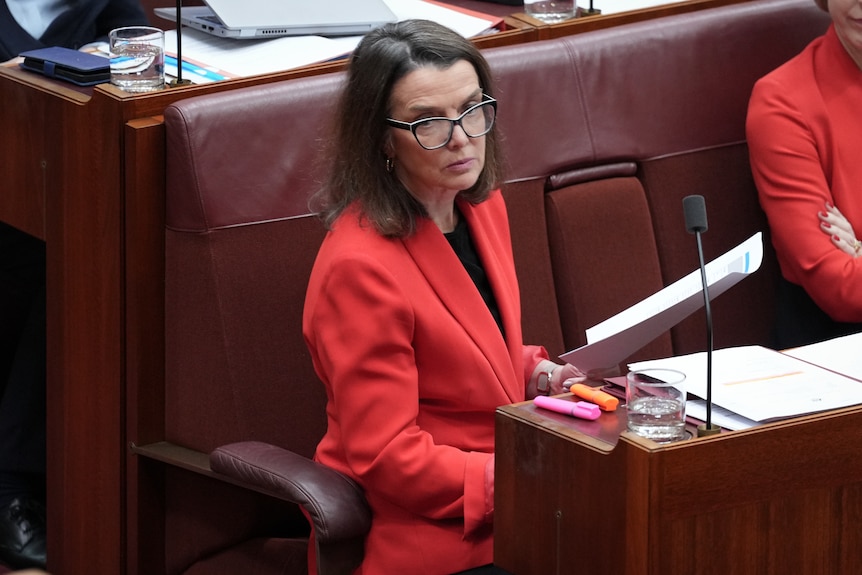
Anne Ruston says the government is targeting older Australians. (ABC News: Matt Roberts)
The change will require legislation to pass parliament, meaning the opposition’s concerns could become a hurdle for Labor.
Private Healthcare Australia (PHA) chief executive Rachel David said the decision would disappoint older Australians, but she was somewhat subdued in her criticism, acknowledging it would mostly affect wealthier people who were unlikely to stop their cover.
“It will hurt consumers, impact the viability of private hospitals, and limit health funds’ ability to deliver better patient experiences,” Dr David said.
“[But] health funds recognise this group receives significant benefits that could be better targeted elsewhere.
“PHA has previously recommended reducing the rebate for this cohort and redistributing it to lower-income Australians who rely on private health insurance.”
The difference in rebates between generations dates back to 2004 when then-prime minister John Howard made the change while Mr Butler said “government coffers [were] reaping the benefits of the China boom”.
“In 2026, it’s a policy that’s harder to defend,” he added.
Government to pay for showers for at-home aged care recipients
The policy shift came alongside Mr Butler announcing the government would spend $1 billion to fully cover the cost of showering assistance for someone on an aged care Support at Home package.
Only six months ago, the government introduced a co-payment for package recipients, but its decision to include showering and continence care as part of that proved highly controversial, with some calling it a “human rights” issue because it was costing some people $50 out-of-pocket per hour.
Elsewhere in aged care, insufficient beds across the country has had major flow-on effects to bed block in hospitals, with states demanding the federal government do more to help.
To assist, Mr Butler announced that from 2029, an extra 5,000 beds per year would be built.
More than $200 million has also been committed to establishing 20 additional dementia care units and an expanded support program to help people transition from hospital to nursing homes.