
 8 min read
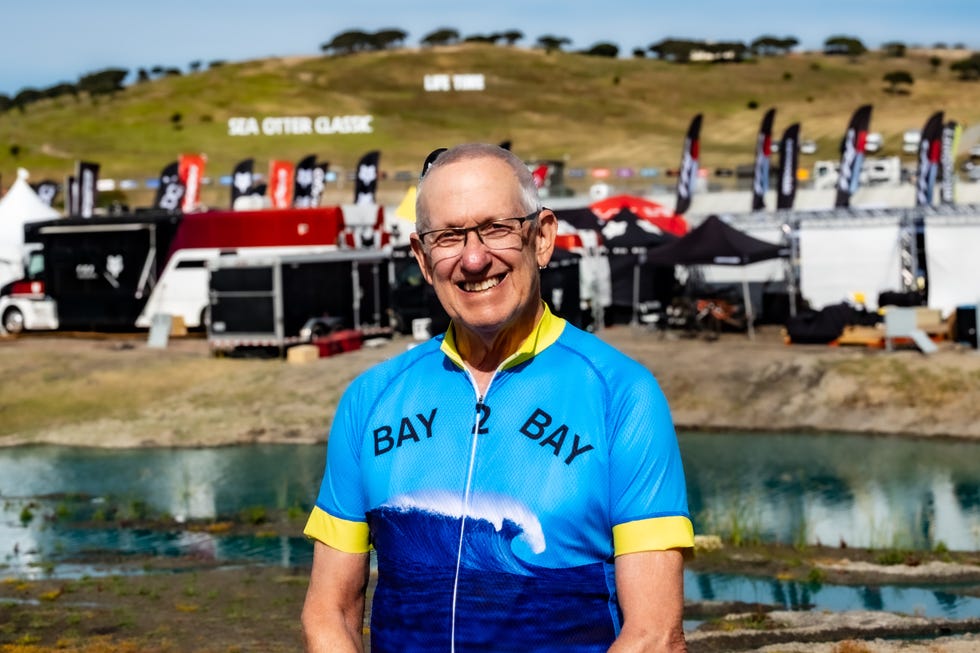
For Bicycling member Rich Kerbel, 75, Sea Otter is not some big annual pilgrimage. It’s just part of the rhythm. The event is 5.5 miles from his winter home in Seaside, California, close enough that he and his wife, Claudia, 75, plan their return to their primary residence in Rhode Island around it. “My wife knows it’s always after the Sea Otter,” he said. That tells you a lot. For Rich, Sea Otter is not really a destination. It’s part of the season, woven into daily life.
Being that close means he feels the event before he even gets through the gates. “You ride around here normally and you see other cyclists,” he said, “and all of a sudden you see, wow, those guys passed me faster.” This year he took his friend John, visiting from Rhode Island for his first Sea Otter, on a ride toward Pebble Beach and watched group after group fly by. “There were like four or five groups of 30 people who just shot past us,” Rich said. “And you sit there and go, that’s impressive.” John was seeing it all for the first time. Rich enjoyed that almost as much as the event itself. “I think his eyes have bugged out a little bit,” he said.
Matt Phillips
That’s one of the things Rich likes most about Sea Otter. Not just the products, though he likes the products. Not just the riding, though obviously that too. More the feeling of being dropped into the middle of a world where everybody is speaking some dialect of bike. “I enjoy seeing all the different things that are available on bikes,” he said, “even though I don’t understand half of it, or maybe more than half of it.” He likes the expo, likes seeing what’s new, likes the conversations that happen when you stop at a booth and start asking questions.
One of his favorite moments this year came at Bridge Bike Works, where he talked with the founders and then rode one of their bikes. “That was exciting, to hear their energy and then to ride it,” he said. “You feel a part of something if you’ve talked to somebody like that.”
He also lit up when talking about Clik Valve, though not for the reasons a gear nerd might expect. “I have familial tremors, so my hand shakes a little bit,” he said. That sometimes causes him to snap delicate Presta valve cores when he’s inflating his tires. He appreciated Clik Valve’s more robust construction and its press-on/pull-off pump interface, which eliminates the need to open or close the valve by hand.
He later talked about two products that had most improved his riding life over the past year: a mini electric inflator and a rearview radar. The inflator made things easier. The radar felt more important. “I think that increased my safety a whole lot,” he said, and these days he thinks about his safety a lot more. There are people he needs to be there for.
That detail, small as it seems, underscores what makes Rich’s relationship to cycling more complex than a simple love of bikes. He still enjoys Sea Otter for the obvious reasons. The spectacle. The people. The chance to see what’s new. But the bike occupies a different place in his life now than it once did.
In late 2021, Claudia was diagnosed with Langerhans cell histiocytosis (LCH), a rare cancer can damage organs and tissues, particularly the bones, skin, and lungs. “If I don’t ride, I get overwhelmed,” he said. “The caregiving is toughest the job in the whole world.”
How Rich Got Into Cycling
Rich didn’t come to cycling as some lifelong bike obsessive. He was a runner. In his early 30s, doctors warned him to stop if he wanted to avoid a knee replacement. Eventually, at 56 and a half, he had the replacement anyway. “It led me into cycling,” he said. “I knew how to ride a bike. But I mean, I used to be a runner.” Then cycling did what cycling does sometimes. It stopped being the substitute and became the thing itself.
Courtesy Rich Kerbel
By then, cycling was no longer just rehab or exercise. It was becoming a part of him.
In cycling, he found some of what he had always loved in endurance sports, plus a few things particular to the bike. He talked about being a kid with asthma, about being told he would struggle to breathe his whole life, and about learning that endurance exercise changed that. “So long as I do endurance activities, I don’t have trouble,” he said. Then he started ticking through what cycling has given him: Beauty, freedom—finally, he got to the simplest word for it: “Joy.”
Courtesy Rich Kerbel
By 2010, on his 60th birthday, he rode his age in miles and started a tradition he still keeps. It is exactly the kind of thing a cyclist says once as a joke and then winds up doing for years because the bike has a way of turning little rituals into identity. Rich even did a version of it while teaching in China. The students, worried about sending out “some old guy” with a scarred knee and a shaky hand, arranged for two younger riders to go with him. “They were toast,” he said.
Finding a Purpose
For a while cycling might have stayed a solitary thing. Exercise, stress relief, pleasure, his own little corner of the world. But something changed along the way. “I realized that cycling is all about me,” he said. It nagged at him enough that when a friend in New York sent a fundraising request for an MS ride, he said: “I’m not going to give you money. I’m going to ride the ride with you.”
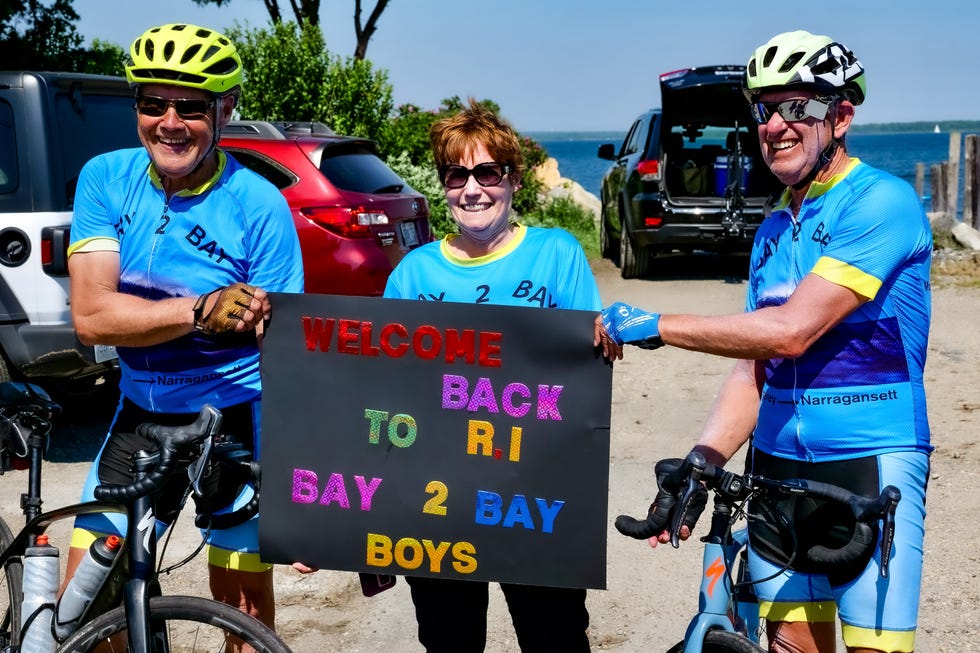
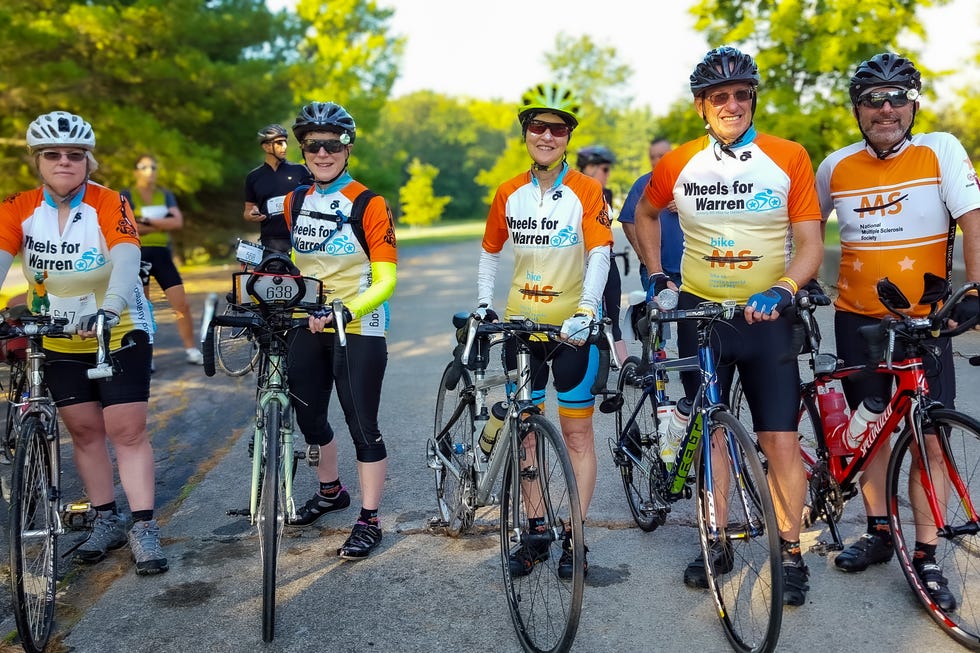
That changed the shape of things. “There was a point where I was really conscious of making sure 10 percent of my miles was charity related,” he said. Over the years that meant MS rides, AIDS/LifeCycle, and helping with Rhode Island’s Tour de Cure, laying out routes and painting arrows on the road. “The charity rides are a way of giving back,” he said. Simple enough. Ride the bike, raise the money, help somebody.
Courtesy Rich Kerbel
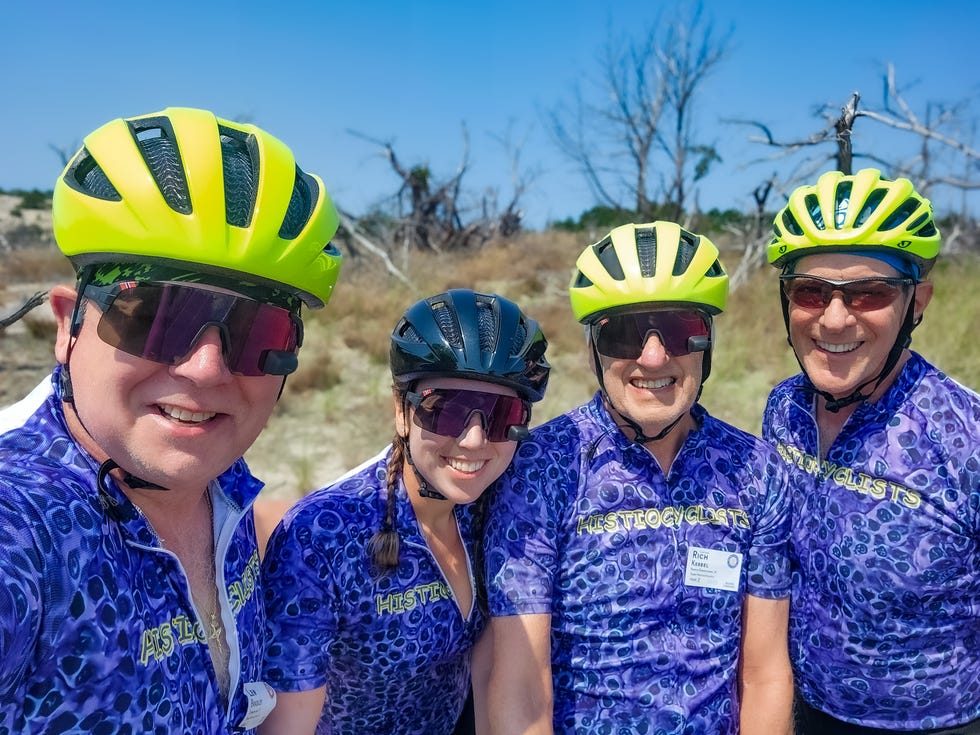
At first the causes belonged to other people. A friend’s sister with MS. Communities he came to know through riding. Then Claudia got sick, and suddenly the whole thing was much closer. After a cross-country ride, Rich and Claudia knew something was wrong, though they did not yet know what. Once she got the diagnosis, he started thinking about what he could do for her. Through the Pan-Mass Challenge, he formed a team called Histiocyclists, named for her disease, to raise money for LCH research. “The name is pretty cool,” he said. “And that makes me think of her.” Then, after a pause, he added, “It’s tough.”
He said she’d had a rough night before we talked. He was anxious about an upcoming appointment at Dana-Farber.
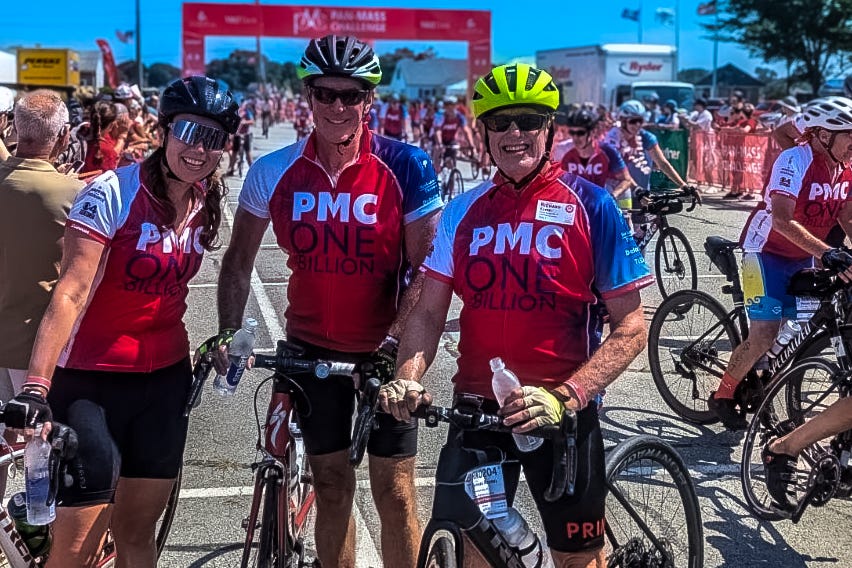
He is proud of what the Histiocyclists have done. “Last year we raised over $88,000,” he said. But the number isn’t the most important thing for him. It’s the ride itself, especially the second day when the route reaches Cape Cod.
“There are all these people yelling thank you,” he said. “It gets to me.” At a rest stop after the first day, riders sign banners, and Rich wrote a note to Claudia. “That meant a lot to me,” he said.
You can hear, in the way he talks about it, how cycling stopped being just his escape and became something else too. A way to do something for her.
What the Bike Gives Him Now
Beyond showing up for Claudia and for other people, riding gives Rich somewhere to put his mind for a while. “If I am pushing on a ride, everything else goes away,” he said. “You need that. You need that for work. I needed it for caregiving.”
He described the loop his thoughts get into when he is riding hard. “I’m looking at my Garmin saying, come on, Rich. Push your cadence. Get your average speed up.” And then: “It’s like, oh wow, I worried about that for an hour or two and didn’t worry about anything else.”
But cycling is more than just a way to distract himself. “It means my time,” he said. “It means getting outside. It means escape and relaxation.” Before she got sicker, Claudia would walk three or four miles a day. They used to go for walks together after dinner and talk. She cannot do that anymore. “I miss that,” he said. “But with my cycling, I get to still be outside.”
Courtesy Rich Kerbel
And, like most people who stay in cycling long enough, he can’t talk about bikes without talking about people. He estimates he still does “about 90 percent” of his miles alone, but the community around him matters a lot. There are his teammates on the Histiocyclists. There is John and the Cedar Street Posse, a faster group he jokingly calls “the big boys.” There is the Narragansett Bay Wheelmen, who advocate for cycling in Rhode Island. There is a California ride group he finally linked up with this year.
That communal support shows up on the charity rides as well. He feels it on Pan-Mass, on AIDS/LifeCycle, on MS rides, on Tour de Cure. “There’s always somebody who gets up and says…this is what you did for me,” Rich said. “And you go, wow, all I did was send a bunch of emails and hit up my friends to raise money and ride my bike.”
He paused, then added: “I’m not some speed demon. I’m in decent shape for 75, but this is something I can keep doing for people.”
And then there’s his local shop, NBX Bikes in Narragansett, Rhode Island. “They have the world’s best mechanic in Ben Stone there,” he said, and he praised owner Matt Bodziony too.
“They take care of you,” he said. “If you ask them to participate in a charity ride, they always do it.” Then he added that the shop is “a fountain of knowledge.” Good bike shops do that. They fix the bike, obviously, but they also help hold together the life built around it.
Courtesey Rich Kerbel
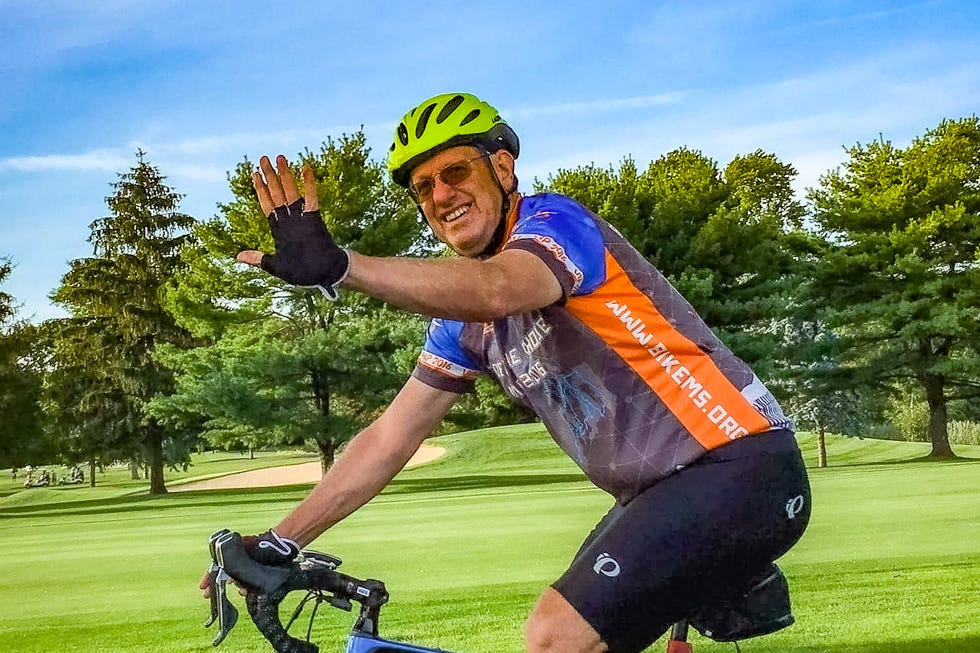
Rich Kerbel rides because he needs what the bike gives him. The small rituals and escape hatches and communities that help hold life together when life gets hard.
“If I don’t ride, I get overwhelmed,” he said. He rides for Claudia. He rides for other people. What started as rehab and stress relief became something more than that.
Sea Otter still matters to Rich because it puts him in the middle of that world for a few days. He gets to walk the expo with a friend, talk to builders, see gear that might make riding a little safer or easier, and be around thousands of other people who care about bikes.
Then he goes home to the much harder part.
A gear editor for his entire career, Matt’s journey to becoming a leading cycling tech journalist started in 1995, and he’s been at it ever since; likely riding more cycling equipment than anyone on the planet along the way. Previous to his time with Bicycling, Matt worked in bike shops as a service manager, mechanic, and sales person. Based in Durango, Colorado, he enjoys riding and testing any and all kinds of bikes, so you’re just as likely to see him on a road bike dressed in Lycra at a Tuesday night worlds ride as you are to find him dressed in a full face helmet and pads riding a bike park on an enduro bike. He doesn’t race often, but he’s game for anything; having entered road races, criteriums, trials competitions, dual slalom, downhill races, enduros, stage races, short track, time trials, and gran fondos. Next up on his to-do list: a multi day bikepacking trip, and an e-bike race.