

Listen to this article
Estimated 3 minutes
The audio version of this article is generated by AI-based technology. Mispronunciations can occur. We are working with our partners to continually review and improve the results.
The attorney general of Canada has filed an application to prevent disclosure in the case against the husband of homicide victim Trina Hunt, citing a need to protect national security.
Iain Hunt has been charged with one count of indignity to human remains in connection with the unsolved homicide of Trina Hunt in January 2021.
In a statement, the Department of Justice Canada said the application seeks an order from the federal court “confirming the prohibition on disclosure of certain information to prevent an injury to national security.”
It said an application was filed with the federal court in March 2026, “pursuant to subsection 38.04(1) of the Canada Evidence Act (CEA), regarding disclosure in R. v. Iain Hunt.”
The statement said Section 38 of the Canada Evidence Act “governs the protection and use of information that could injure international relations, national defence or national security if publicly disclosed in the course of proceedings.”
‘Extremely unusual’
The department did not comment on why releasing evidence in the case against Iain Hunt could pose a risk to national security.
Michel Juneau-Katsuya, a former Canadian Security Intelligence Service (CSIS) officer, said the use of Section 38 is “extremely unusual.”
“It is not meant to be used lightly,” he said, speaking from Montreal.
Juneau-Katsuya said the application will be made to the presiding judge without the defence present — adding the situation is complicated by the fact the case against Iain Hunt is being conducted by the B.C. Prosecution Service.
“You have a form of tug of war, and in the middle you have Iain Hunt, who has information that obviously the federal government wants to protect. So somewhere, somehow, he has an ace in his hand and it is playing in his favour at this point because the government needs to protect that information,” he said.
Juneau-Katsuya said since the definition of national security is wide-ranging, it’s impossible to interpret what evidence the attorney general may be concerned about.
“At this point we can’t speculate on exactly what it is — is it something to protect a specific operation, or maybe an undercover agent working somewhere? But one thing is certain, the man in the centre of this plot is Iain Hunt.”
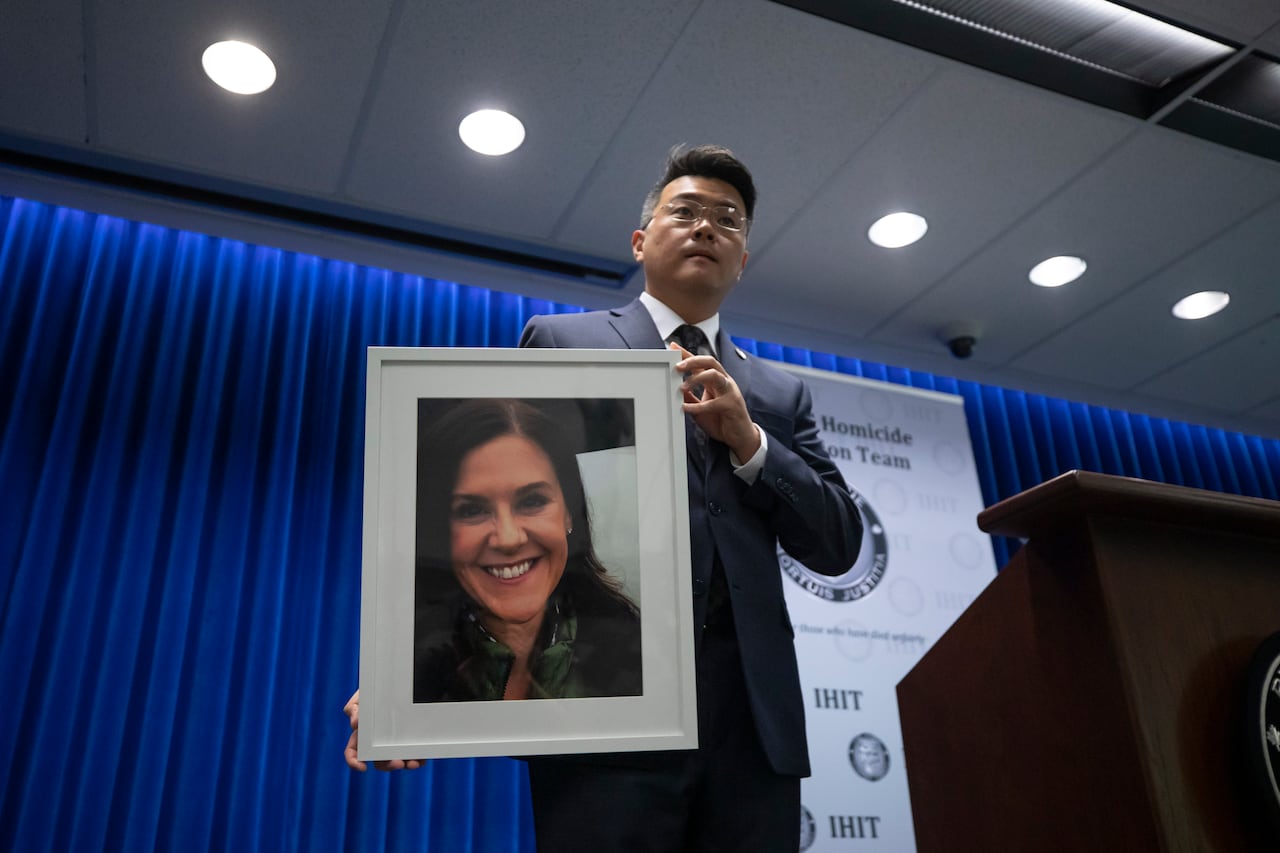 Frank Jang with the Integrated Homicide Investigation Team (IHIT) holds a picture of Trina Hunt during a news conference at RCMP headquarters in Surrey, B.C., on May 31, 2021. (Ben Nelms/CBC)
Iain Hunt was charged in February 2025, more than four years after Trina Hunt’s remains were found near Hope, B.C.
He reported Trina Hunt missing from their house in the Heritage Mountain neighbourhood of Port Moody on Jan. 18, 2021.
According to online court information, Iain Hunt is alleged to have interfered with his wife’s remains on Jan 16, 2021, two days earlier.
The Integrated Homicide Investigations Team (IHIT) confirmed the 48-year-old’s death was a homicide, but has not revealed how investigators reached that conclusion. No one has been charged with her death.
A charge of indignity to human remains “occurs when a person neglects to perform their legal duty to bury a dead human body, or if a person interferes in an improper, indecent or undignified way with a dead human body or human remains,” according to police.
The department of justice said a hearing date to review the application has not yet been confirmed.
The Attorney General of B.C. said it is unable to comment on matters before the court.