
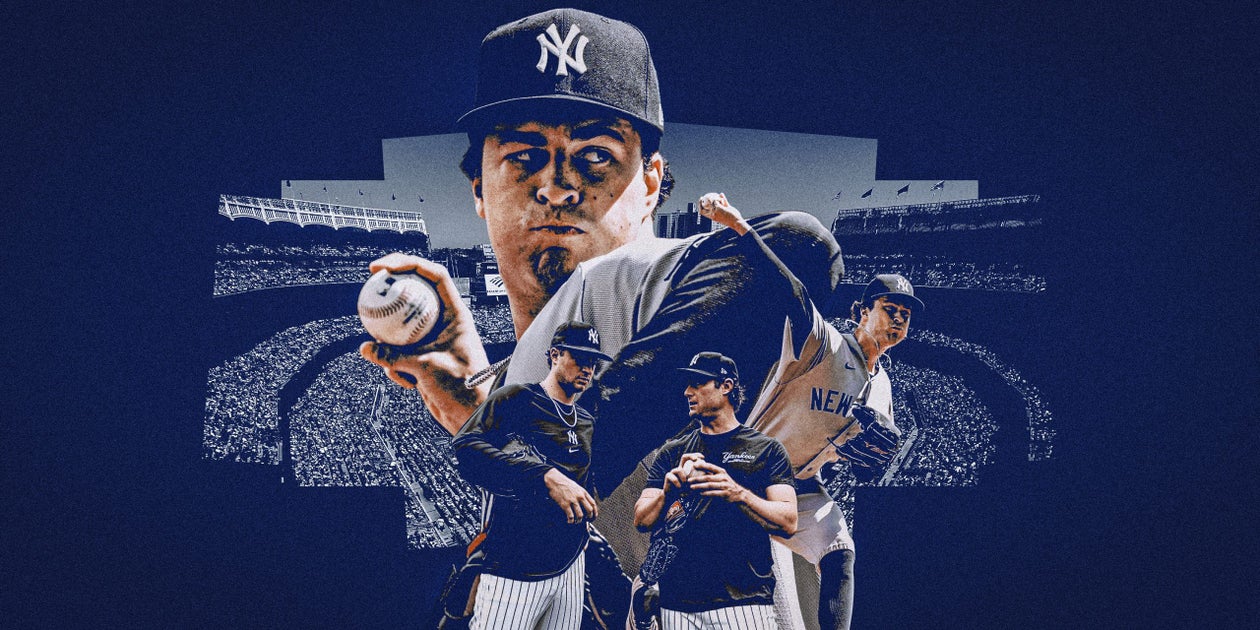
The 2023 American League Cy Young Award winner, navigating his own reinvention while rehabbing from Tommy John surgery, reshaped the trajectory of a rising ace — one talented enough to claim that same pinnacle of pitching excellence one day.
It was late September last year, and Gerrit Cole and Cam Schlittler were playing catch in the outfield at Yankee Stadium when Cole had a suggestion for Schlittler: He should throw his cutter harder and focus on keeping it at the top of the strike zone.
It’s a pitch that helped propel Cole to his Cy Young win, but he said it was only a coincidence that he recommended it for Schlitter, who was readying for another test in his first season, facing the Baltimore Orioles in successive outings. The rookie knew that he’d have to show something different in the second start, and he wanted to prove that he could be trusted in a playoff rotation.
In the last two innings of his final regular-season start, Schlittler unleashed his new weapon. He struck out Orioles star Gunnar Henderson on a 95 mph cutter. He threw back-to-back hard cutters to Dylan Beavers before setting him up with a four-seam fastball that he swung through. He then struck out Jeremiah Jackson on a cutter in the next inning.
That cutter allowed Schlittler to get through seven innings, the longest start of his rookie season, and he walked off the mound with one thought in his head.
“I was kind of like, ‘S—, I’m getting really good results with this.’” Schlittler said. “I can take this into the playoffs.”
That he did.
With his new-look arsenal, Schlittler completed eight innings of shutout ball and struck out 12 against the Boston Red Sox in the Wild Card Series. It is one of the most dominant starts in Yankees postseason history. The Massachusetts native will make his first start against Boston since that October night on Thursday, and suffice to say, he’s been looking forward to this one.
The 25-year-old right-hander is a different pitcher now than he was when he last faced the Red Sox. He’s getting nastier movement on his cutter this season, and he’s throwing his two-seamer more often. By the Yankees’ pitch design grading model, only one comparison appears for Schlittler’s cutter: Corbin Burnes. It’s considered one of the game’s best pitches when the four-time All-Star is healthy. With Burnes out injured, no one is throwing a cutter as hard with as much horizontal and vertical movement as the Yankee standout.
“I think it’s his most unique pitch,” Yankees pitching coach Matt Blake said. “There aren’t many cutters in the league that are thrown that hard with that kind of profile. There are four-seams like his and two-seams like his. Just to have that cutter in combination with the other two is unique.”
“It’s very hard, and it breaks very late,” said Cole of why Schlittler’s cutter works. “It seems like it’s a natural pitch for him.”
“It’s a good feeling to have a pitch that guys don’t see, but also having two different variants of fastballs to play off that definitely make things a lot easier,” Schlittler said.
The cutter is part of one of the most fascinating arsenals in MLB. No pitcher is throwing different variations of fastballs — four-seamers, two-seamers or sinkers, and cutters — as often as Schlittler. Since the Statcast era began in 2015, only three starting pitchers have finished a season with a higher fastball percentage than Schlittler’s current 89.5 percent: Tyler Chatwood (2016), Lance Lynn (2020) and Drew Rasmussen (2025).
This year, Schlittler is throwing his four-seamer 39.6 percent of the time, his cutter 26.2 percent and his two-seamer 24.2 percent. The difference between Schlittler and the three who have higher overall fastball usage than him is the overpowering velocity that the righty possesses.
He can throw 100 mph four-seamers, along with 97 mph cutters and sinkers that move in different directions. Against his fastballs this season, hitters have a paltry .433 OPS. This video provides a good look at why Schlittler is virtually unhittable:
Cam Schlittler throws a fastball 90.9% of the time, leading the league.
Here’s an overlay of his four-seam, sinker and cutter all from the same at-bat against Junior Caminero pic.twitter.com/tuujubKY9z
— Alex Fast (@AlexFast8) April 16, 2026
“When you face some of these pitchers that can really manipulate the ball at those velocities, it becomes a real challenge,” Tampa Bay Rays manager Kevin Cash said. “I remember Yandy (Díaz) talking about his fastball at Yankee Stadium last year, just saying you don’t see many guys that create that type of extension and the type of ride that he creates with the fastball. Now he’s added this (cutter). Hitting is tough.”
“That’s the game right now,” Kansas City Royals manager Matt Quatraro said. “Everyone’s got them all — two-seam, four-seam, cutter. And with him, with the elite velo, it really, really compounds that.”
Schlittler’s rise to becoming one of MLB’s best starting pitchers began in 2023 with High-A Hudson Valley. There he worked with pitching coach Preston Claiborne, who is now the Yankees’ bullpen coach. Schlittler said no coach has been more influential to his success than Claiborne, who helped overhaul his mechanics in the minors. He also credits Sam Briend, the Yankees’ director of pitching, for his use of motion capture technology to fully break down all that was wrong in Schlittler’s delivery.
He went from averaging 89 to 90 mph on his four-seamer coming out of Northeastern University four years ago as a seventh-round draft pick to throwing the fifth-hardest average fastball among major-league starting pitchers. It wasn’t until last year that Schlittler was considered one of the Yankees’ better prospects, and even still, he didn’t have much pedigree, ranked 12th in the organization by MLB Pipeline.
“He always knew he had something else in him,” Claiborne said. “We just wanted to get that out of him. That’s where, over time, the work that he put in, not only during the season, but in the offseason, we saw those incremental increases not only in his velocity but his ability to throw strikes and develop the other pitches, too.”
Before Schlittler’s major-league debut last July against the Seattle Mariners, he stood in the outfield at Yankee Stadium with Claiborne. The coach wanted to check in before the rookie went up against one of the best offenses in the sport.
Normally, Claiborne said, players will have some level of nerves before their first MLB game. Schlittler, by contrast, seemed like a 10-year vet. That’s when Claiborne knew this pitcher might be different.
“When he’s on the mound, he acts like he’s the best player on the field,” Claiborne said. “That’s how you want a young guy thinking, especially when they’re going up against the best of the best in the world. He wasn’t concerned with what the hitters do well. He was concerned with what he does well.”
What he does well is overpower hitters with his three different fastballs and a sprinkling of a curveball. All of Schlittler’s pitches are harder than the average offering, and all of his pitches grade out above average in Stuff+ rankings, which measure the physical characteristics (release point, velocity, vertical and horizontal movement, spin rate) of a pitch.
Highest Fastball% among SP
Schlittler said he experimented with mixing in a changeup over the offseason, but opted against it. In numerous conversations with hitters, they told him how difficult life in the batter’s box is when pitchers throw both four-seamers and two-seamers. Then add in a third fastball at that velocity, forget it.
“You have 100 mph rising, you have 100 mph cutting, and you have 100 mph barreling into your barrel if you’re a righty,” Yankees slugger Giancarlo Stanton said. “There’s not much of a slow down for your barrel. You’ve got to pick right.”
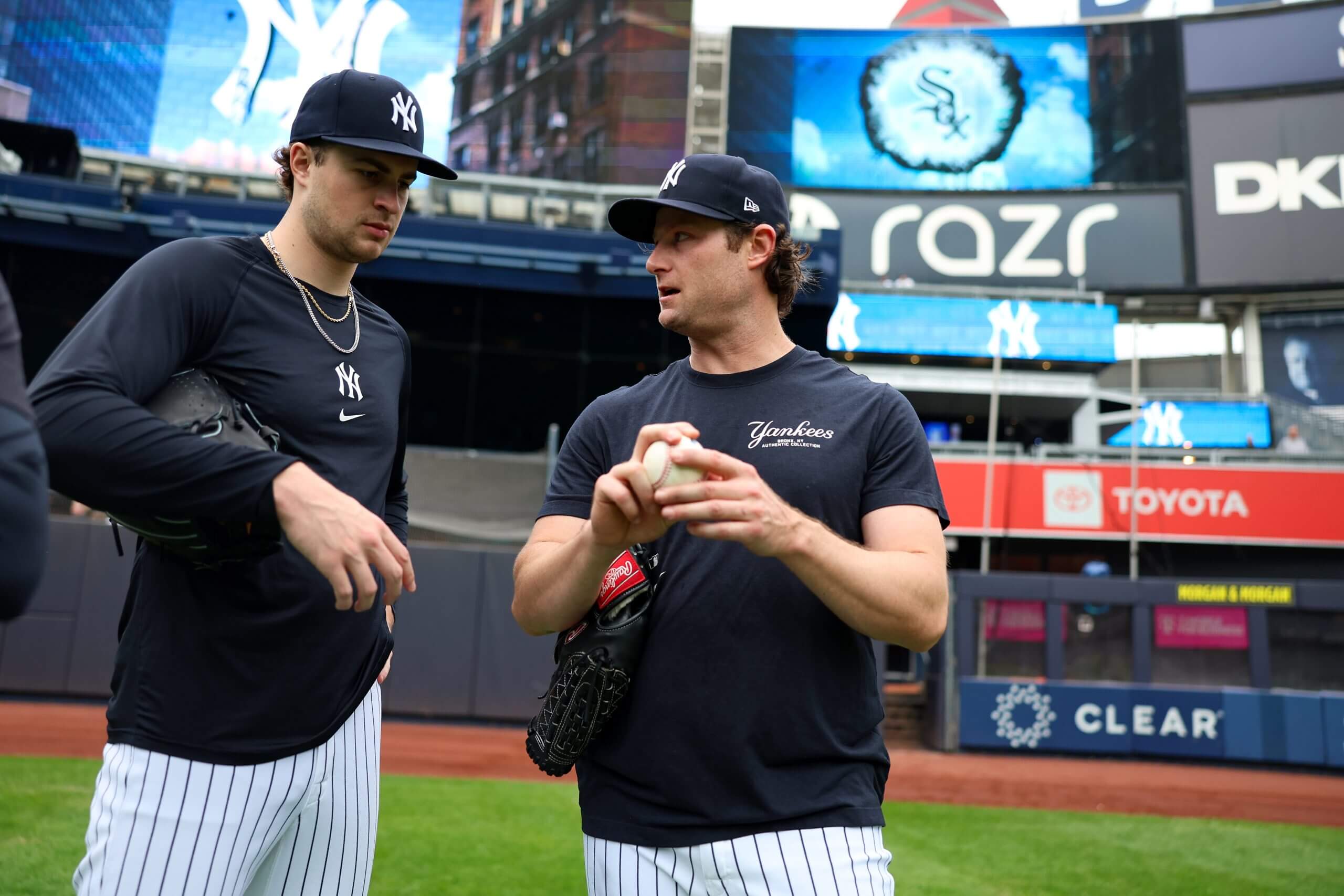
Cam Schlittler and Gerrit Cole talk in the Yankee Stadium outfield on Sept. 24, when Cole offered the rookie some suggestions on his cutter. (New York Yankees / Getty Images)
“They’re all going in different directions, and there’s not much time to make a decision,” Cole added. “As long as the separation of the movement is good and the velocity and location are good, it puts him in good positions to have success.”
That’s why Schlittler and the organization believe his unusual arsenal can work long term. There’s not enough of a reaction time at the plate if a hitter guesses wrong. Adding in a changeup now, Blake feels, would only benefit the hitters because Schlittler wasn’t able to get enough velocity separation with his fastball, and the movement profile wasn’t different enough. It would only help hitters be on time for the slower pitch.
The Yankees will continue experimenting to find the right grip for the changeup because of what it could mean for Schlittler’s ascension. Not only would he have three fastballs moving in different directions, but also a pitch that looks like a fastball out of hand that would drop and tail away for lefty hitters.
Yet Schlittler knows that he can be dominant without it. Only five starters in MLB history have at least 36 strikeouts and three or fewer walks in their first five starts of a season: Frank Viola (1990), Adam Wainwright (2013), Cole (2021), Burnes (2021) and Schlittler (2026).
Since debuting in July last season, Schlittler ranks inside the top 10 in ERA, FIP, SIERA, fWAR, batting average against, chase rate and zone-contact percentage among all qualified starting pitchers. He’s established himself as a top-end starter who could one day rival Cole’s longevity of greatness. That outcome wouldn’t be unexpected to Schlittler.
“In terms of a competitive standpoint, I’m not surprised that I’m in the position I am right now,” he said.