
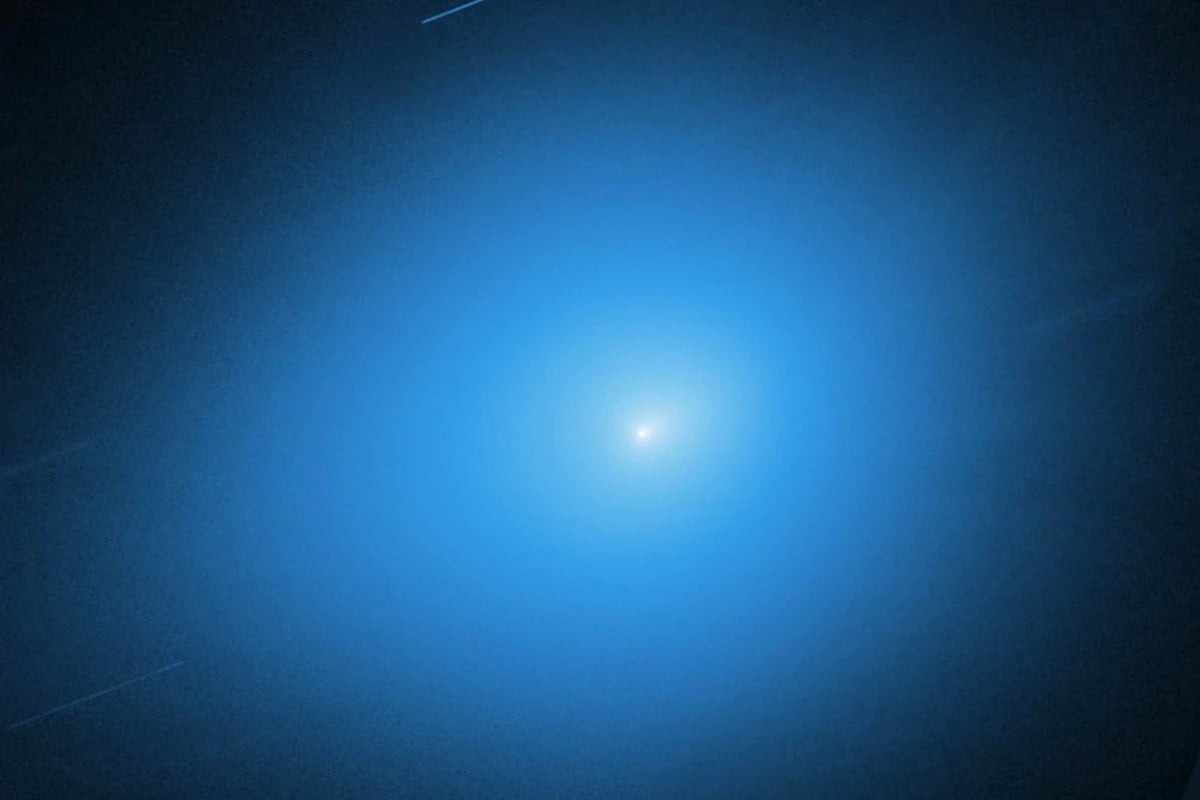
On July 1st, 2025, 3I/ATLAS became the third known interstellar object (ISO) to pass through our Solar System. By October 30th, it made its closest pass to the Sun, disappearing behind it from Earth’s point of view, and began making its way out of the Solar System. As of April, it passed beyond the orbit of Jupiter and is well on its way back to interstellar space. Over the many months during which it was observed by multiple missions and ground-based telescopes, scientists collected extensive data on this ISO, which has proven quite revealing.
One such mission was the NASA/ESA/CSA’s James Webb Space Telescope* (JWST), which observed 3I/ATLAS on August 6th, 2025, observing a coma largely composed of carbon dioxide. And now, a team led by Caltech researchers has examined the mid-infrared signatures emitted by 3I/ATLAS as it approached the Sun to learn more about the environment in which it formed. Their results, published in The Astrophysical Journal Letters*, show that the interstellar comet is rich in methane (CH4).
Since comets and asteroids are essentially material left over from the formation of a planetary system, their composition can reveal details about the conditions at the time. Ergo, studying ISOs like 3I/ATLAS is the best way to learn about other star systems in our galaxy, short of sending interstellar missions to study them directly. Specifically, scientists are interested in determining the ratios and compositions of these chemical compounds, which differ from those of objects in the Solar System.
With its sensitive infrared instruments and spectrometers, the JWST can detect and map many of these compounds as ISOs experience outgassing. “It’s a very interesting object. It has been traveling through the galaxy for at least a billion years,” said Caltech graduate student Matthew Belyakov, lead author on the new paper. “The high speed at which it flew past us gave just a narrow window to study it. JWST is going to look at 3I/ATLAS one more time this spring. It’s already getting tough to observe; it’s now out by Jupiter.”
The two previous ISOs detected in our Solar System, 1I/’Oumuamua in 2017 and 2I/Borisov in 2019, did not exhibit the same behavior as 3I/ATLAS. When ‘Oumuamua was first detected, it was already on its way out of our Solar System, and scientists were only able to observe it for 80 days, and the data was inconclusive, indicating that it behaved as both an asteroid and a comet, leading to speculation that it might be something else entirely (including an alien spacecraft!)
In contrast, 2I/Borisov was detected by an amateur astronomer when it was more than 3 AUs from the Sun (three times the distance between the Earth and Sun). While it showed activity consistent with that of a comet early on, it was relatively faint compared to 3I/ATLAS. In addition to being very bright, 3I/ATLAS was larger than expected and experienced intense periods of outgassing before and after making its closest approach to the Sun. This makes it an ideal target for study using the JWST’s instruments.
Since the comet had been irradiated by cosmic rays during its journey through interstellar space, most of its surface ices were only weakly outgassing on approach. However, Belyakov and his team’s analysis of data obtained as it left the Solar System in December 2025 showed that the comet began emitting more methane after its close flyby of the Sun. The change indicated that it had shed its ancient outer layers and was now outgassing from its underlying layers, revealing its interior composition.
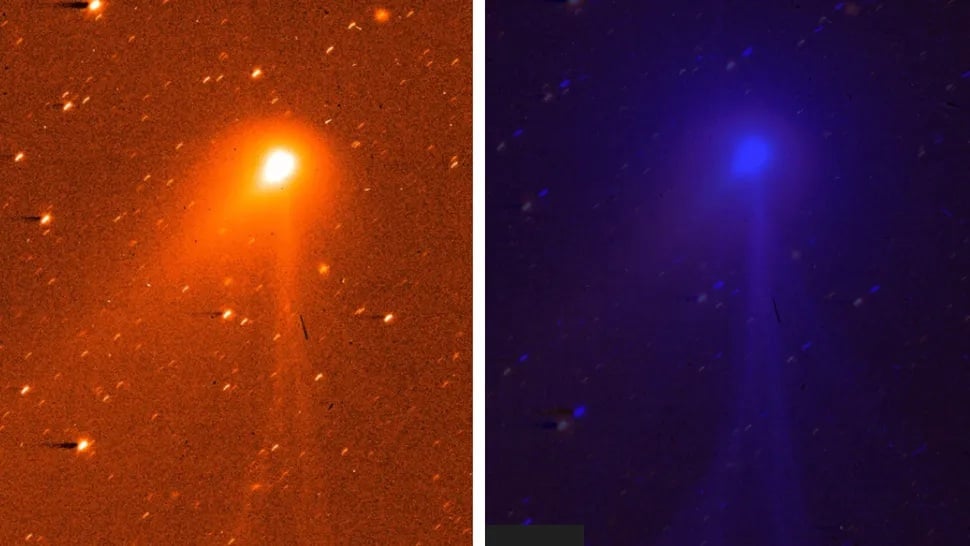 *Images of 3I/ATLAS acquired by the Moons and Jupiter Imaging Spectrometer (MAJIS) instrument aboard the ESA’s Juice mission. Credit: ESA/Juice/MAJIS*
This information is already revealing vital details about other star systems in our galaxy and what kinds of objects formed in them long ago. Combined with recent data obtained by the Atacama Large Millimeter-submillimeter Array (ALMA), it could also help scientists constraint where it formed in the Milky Way.
The paper, titled “The Volatile Inventory of 3I/ATLAS as Seen with JWST/MIRI,” was co-authored by Ian Wong of the Space Telescope Science Institute (STScI) and Professor Mike Brown of Caltech’s Division of Geological and Planetary Sciences (GPS). Other co-authors included researchers from Caltech’s Center for Comparative Planetary Evolution (CCPE), the JHUAPL’s Planetary Exploration Group, Auburn University’s Leach Science Center, Eureka Scientific, and NASA’s Jet Propulsion Laboratory (JPL).
Further Reading: Caltech