
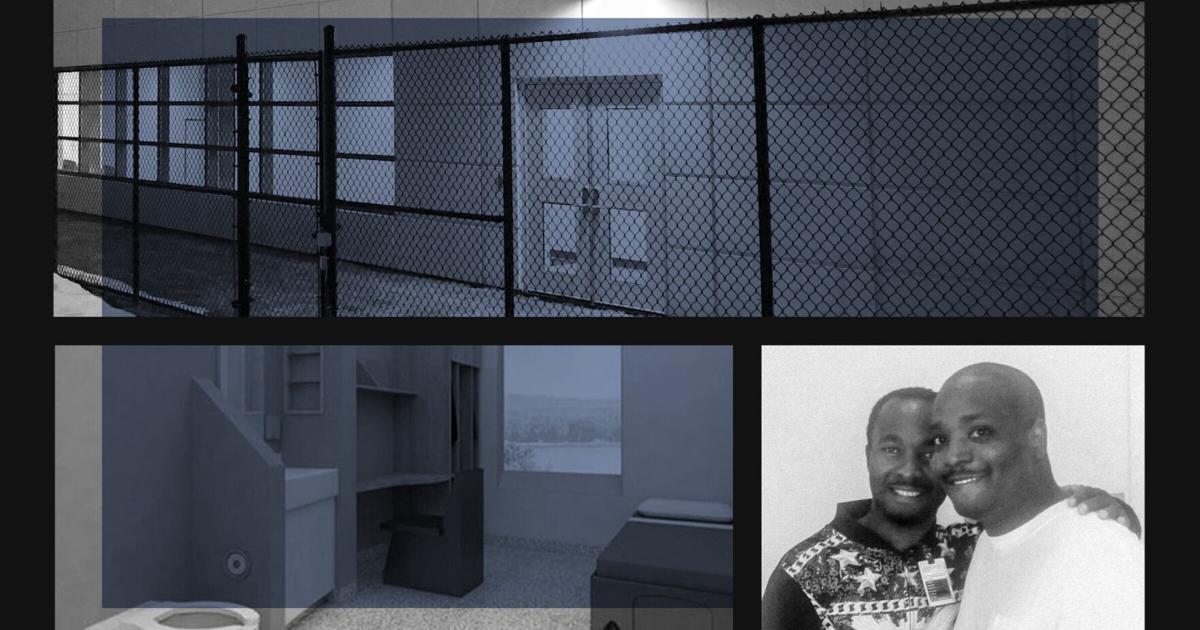
This is Part 2 of 20 Years in Isolation, a four-part investigation into the use of seclusion at Waypoint Centre for Mental Health Care. In Part 1, the Star told the story of Camelott Hamblett, who may be the person who has spent the most time in psychiatric seclusion in any Ontario hospital.
It’s the province’s only high-secure forensic psychiatric hospital, whose patients have some of the most complex mental health needs in Ontario.
And it’s behind the historic walls of this Penetanguishene, Ont., facility overlooking Georgian Bay that Camelott Hamblett has spent the past 20 years locked in isolation in a sparsely furnished room.
As the Star reported in Part 1 of this series, the 43-year-old Toronto man has remained in seclusion at Waypoint Centre for Mental Health Care due to aggressive behaviour caused by treatment-resistant schizophrenia. He was found not criminally responsible (NCR) for a sexual assault two decades ago, after he followed a woman he didn’t know, exposed himself, and, before he fled, declared they were going to have sex.
After expressing shock at his living situation and the lack of progress in his treatment, the Ontario Court of Appeal ordered an independent assessment of Hamblett’s case in January, in the hopes that he would finally get out of seclusion.
He may well represent the longest anyone has ever spent in isolation in an Ontario hospital. His story has spotlighted how Waypoint is an outlier in its continued reliance on seclusion for prolonged periods of time, despite a larger move away from it at other hospitals.

Camelott Hamblett as a teenager.
In fact, the hospital’s practices have been described as “grossly in excess” of other North American psychiatric facilities, and were the focus of a proposed class-action lawsuit on behalf of others held in seclusion at Waypoint.
Writing an expert report for that lawsuit, U.S.-based mental health nurse Kevin Ann Huckshorn and psychologist Janice LeBel said Waypoint’s use of seclusion is “completely inconsistent with recovery-oriented, trauma-informed care.” And they wrote “without hesitation” that no U.S. facility uses seclusion the way Waypoint does.
Huckshorn and LeBel are the experts behind the best practices that Waypoint itself claims to be implementing.
Waypoint president and CEO Dr. Nadiya Sunderji said in a statement to the Star that the hospital is committed to reducing and even discontinuing the use of seclusion and restraint where it is clinically appropriate. She said the hospital has achieved meaningful improvements over the past few years, including a decrease in violence and a “reduced reliance” on seclusion.
“Waypoint is dedicated to protecting the dignity and rights of every patient in our care, and to fulfilling our responsibility to provide a safe, secure, and therapeutic environment. We work tirelessly to maximize quality of life for individuals living with severe and treatment-resistant mental illness,” Sunderji said.
“Whenever possible, patients are supported in exercising freedom of movement within the hospital and its grounds, and participating in a wide range of therapeutic, recreational, and social programs. For most patients, this is clinically appropriate and is the norm.”
Waypoint Centre for Mental Health Care.
Sophie Bouquillon for the Toronto Star
The lawsuit against Waypoint
Toronto-based firm Rochon Genova tried for almost six years to get the courts to certify a class-action against the hospital on behalf of several plaintiffs who have been kept in long-term seclusion and are alleging the hospital’s use of the practice is excessive and arbitrary; Hamblett is not one of the plaintiffs. The lawsuit was originally filed in 2020 in the name of Ruben Stolove, a then-25-year-old man with schizophrenia who had spent time in seclusion over five years at Waypoint.
Lower courts rejected the certification bid, concluding that the decision to restrain or seclude a patient is an individualized process and that there was no basis to find systematic wrongdoing by the hospital. In other words, to determine whether it was justified to seclude a patient, an assessment would have to be done on their individual circumstances at the time, including their behaviour, medications, and level of risk, the courts found.
Earlier this month, the Supreme Court of Canada denied Rochon Genova’s request to hear its appeal.
20 years in isolation: Part 1
Hamblett may be the person who has spent the most time in psychiatric seclusion in any Ontario hospital. In a four-part series, the Star
20 years in isolation: Part 1
Hamblett may be the person who has spent the most time in psychiatric seclusion in any Ontario hospital. In a four-part series, the Star
Ultimately, the treatment of patients confined indefinitely against their will in forensic psychiatric hospitals is a reflection of our society as a whole, “who we are and how we value people,” said the plaintiffs’ lawyer, Golnaz Nayerahmadi.
In 2023, Dr. John Bradford, one of the world’s leading experts in forensic psychiatry, who briefly worked at Waypoint, filed an affidavit for the proposed class action. In it, he said he was shocked at “the prolonged confinement of patients in horrific conditions, the likes of which I have never seen in any other psychiatric hospital in Ontario.”
Bradford, who said he’s “sympathetic” to the challenges Waypoint faces with its patient population, told the Star that seclusion “probably does need to be in the tool box,” but it should be more like “psychiatric intensive care,” where psychiatrists, pharmacists and other health-care professionals come together to treat difficult cases to ensure the person spends the least amount of time possible separated from everyone else.
“That would be in the true spirit of patient-informed care,” Bradford said.
In an expert opinion filed by Waypoint, forensic psychiatrist Dr. Chaimowitz, then-head of forensic service at St. Joseph’s Healthcare in Hamilton, acknowledged that seclusion can be “dehumanizing,” but said the “unique challenges” posed by Waypoint’s patient population must be taken into account.
“Being sent to Waypoint is for some the last resort,” Chaimowitz wrote. “Managing these patients can be complicated and, not surprisingly, they may have higher rates of seclusion and restraint.”
Chaimowitz is also the lead author of the Canadian Psychiatric Association’s position statement on seclusion, which says it should only be used in emergency situations when no alternatives exist.
“For every situation, there are extremes,” he said in an interview. “There may be circumstances where somebody is that unwell and the treatment non-responsive that they may require some form of being secluded from the rest of the patient population, or restrained for periods that go beyond a short term.”
In such cases, it’s crucial to do regular assessments and get several outside opinions, he said.
“There will unfortunately be a small group of people — a very, very small group of people — who don’t respond to regular treatments,” Chaimowitz said.
“But we should never stop looking for treatments and options.”
Seclusion vs. segregation
The similarities between segregation in the prison system and seclusion in hospitals are striking, though until now the former has received far more public and political attention; the federal government brought in legislation in 2019 to eliminate what was known as “administrative segregation” in the correctional system, though experts have cautioned that segregation for prolonged periods of time continues.
Former correctional investigator Howard Sapers
Sean Kilpatrick/The Canadian Press
Former federal correctional investigator Howard Sapers stated in a report filed in the proposed class-action lawsuit against Waypoint that “the conditions of confinement at the facility are similar, and in certain respects harsher than those of administrative segregation.”
Sapers told the Star that people who have had either experience will describe it in “remarkably similar language”: they don’t fully understand why they’re in there, they don’t feel their best interests are being looked after, and their mental health deteriorates.
“I can tell you that in both systems, health care and correctional, there are active debates about the degree to which segregation or seclusion are even necessary,” Sapers said.
Camelott Hamblett has spent the last 20 years of his life living in isolation at Waypoint hospital in Penetanguishene, Ontario.
The general counsel for the Ontario Review Board, the independent body that decides the fate of people found not criminally responsible or unfit to stand trial, told the Star that the Mandela Rules “were developed in the context of inmates in prisons and jails and are not related to the use of seclusion in psychiatric hospitals operating under mental health legislation.”
Gavin MacKenzie said that the use of seclusion in Ontario is regulated by the Mental Health Act, as well as professional standards and hospital policies. “Together, these require that any use of seclusion be clinically justified, proportionate to risk, and no more restrictive than necessary,” he said.
“At the very least, it reflects so poorly on us as a society,” said Sen. Kim Pate. “And at the very worst, it’s an expensive, ineffective, inhumane, punishing approach.”
The best practices Waypoint says it’s adopting
A method known as the “six core strategies” is increasingly being adopted in many facilities around the world. In one example, the model was successfully implemented to reduce, over an eight-month period, the use of seclusion and restraint by 93 per cent and 96 per cent, respectively, in a 275-bed Massachusetts facility for people with serious mental illnesses who have committed violent offences, including murder.
Finland also applied the model to its only high-security hospital and reported “significant decreases” in seclusion and restraint, along with incidents of violence.
Details are included in a 2023 expert report by Huckshorn and LeBel, the mental health nurse and psychologist who jointly developed the six core strategies in 2002.
The strategies focus on: consistent involvement by senior leadership in the management and oversight of people in seclusion — including the “daily involvement” of the CEO or chief operating officer “in all seclusion/restraint events”; collection of detailed data on the use of seclusion; workforce development, including training staff on how to avoid triggering conflicts; using seclusion-prevention tools that may differ depending on the facility; including patients, families and advocates in seclusion oversight; and a practice of rigorous debriefing.
The grounds of Waypoint Centre for Mental Health Care in Penetanguishene, Ont.
Sophie Bouquillon for the Toronto Star
Huckshorn and LeBel, whose report was filed in the proposed class-action against Waypoint, rejected the suggestion that the hospital’s population of extremely ill patients justifies the prolonged use of seclusion not seen elsewhere.
“Suggesting that a given facility is unique or special is simply a way to avoid making changes,” they wrote.
The pair concluded that the lack of involvement by Waypoint’s senior leaders in the use of seclusion and restraint is an “abdication of their leadership roles and responsibilities,” noting that the “critical task” of trying to reduce seclusion had been left to various middle managers.
They wrote in 2023 that while Waypoint had suggested it was adopting the six core strategies, it was clear the facility’s practices “depart significantly” from the model, and if any training had been done, “it appears to have been ignored.”
In her statement to the Star, Sunderji said Waypoint had not fully implemented the six core strategies at the time of the Huckshorn and LeBel report.
Waypoint president and CEO Dr. Nadiya Sunderji, second from left, is joined by Ontario health minister Sylvia Jones, then-Waypoint board chair Ernie Vaillancourt, and Simcoe North MPP Jill Dunlop at an event in December 2023.
File photo
“Formal work to begin to implement the six core strategies began in 2023,” she said. “Substantial progress has been made since that time. Waypoint remains committed to further integrating the six core strategies as part of its ongoing quality-improvement and patient-safety priorities.”
Asked whether she plays any role in the daily decisions placing people in seclusion, Sunderji — a psychiatrist who became president and CEO of Waypoint in 2022 after previously serving as vice-president of medical affairs and chief of staff — said it would be “inappropriate for an administrator to participate in, or make decisions about, a patient’s evidence-informed treatment plan.”
Huckshorn and LeBel wrote that at least eight Canadian psychiatric hospitals had requested training on the model and adopted the six core strategies, including several in Ontario, such as CAMH and Ontario Shores.
Unique or special
Suggesting that a given facility is unique or special is simply a way to avoid making changes.
They wrote that the use of seclusion and restraint at Waypoint “is grossly in excess of anything we have encountered” in any other North American facility, stating that the “appropriate duration” of seclusion and restraint is measured in minutes or hours, not weeks, months, or years.
“We can state, without hesitation, that no civil or forensic mental health facility in the U.S. uses seclusion/restraint like Waypoint. Federal U.S. standards flatly prohibit seclusion/restraint being used as it is at Waypoint. It is egregious. It is abusive. It is completely inconsistent with recovery-oriented, trauma-informed care.”
Camelott Hamblett’s mother, Audrey Watson-Pinnock, is urging Waypoint to allow her son out of isolation.
Giovanni Capriotti for the Toronto Star
‘Have faith, have hope’
The independent assessment of Hamblett’s case is expected to happen in the coming months; his family is hoping that it will recommend changes that finally get him out of seclusion and well enough to be transferred one day to a facility closer to home in the Greater Toronto Area.
“I am not begging for his immediate release,” said his younger sister, Cheyenne Phillip. “I am asking for him to be given the proper care and the proper doctor to help him work back to that road to release.”
His mother, Audrey Watson-Pinnock, a registered practical nurse, said that her son just needs to be given a chance to show that he can live a fulfilling and law-abiding life, with the support of his many relatives and the right medication.
“I always tell him: ‘Have faith, have hope, and just trust God,’” she said. “I know that God is going to give me back my son.”
As for other individuals living in long-term seclusion at Waypoint, all is not lost despite the courts’ refusal to certify the proposed class-action. Rochon Genova intends to explore other ways of pursuing its lawsuit against Waypoint.
“We think it’s critical to find a path forward for individuals who have been horribly treated through the use of seclusion in this maximum-security psychiatric institution,” said lawyer Joel Rochon.
“We’re committed to moving forward and standing by these vulnerable individuals.”
In Part 3 on Saturday: The role of the Ontario Review Board, the independent body responsible for those kept in long-term seclusion.