
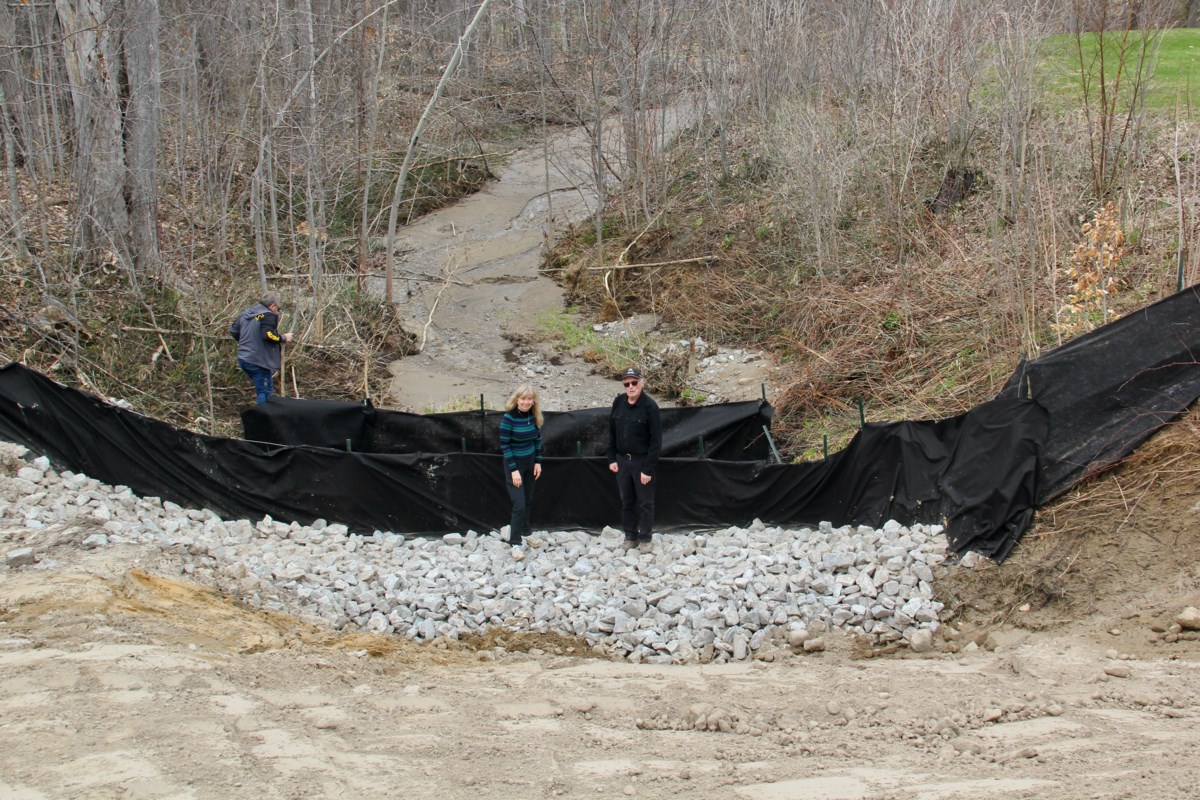
‘The brook trout are gone from a beautiful, healthy cold water stream … now it’s filled with muck and sand. Everything is gone, dead,’ laments frustrated neighbour
A once-healthy cold water stream running out of LIV Communities Hawk Ridge development site has virtually dried up after failures of new stormwater ponds resulted in tons of fill choking approximately 500 metres of creek bed earlier this month.
The Silver Creek tributary was well known as a healthy stream, supporting brook trout and many other aquatic species. That is no longer the case.
City officials promised they had taken steps to protect the cold water stream and LIV Communities’ environmental engineer assured residents at a public meeting last year that the stormwater ponds were sufficient to handle the flow of water through the former wetland.
These days, you can easily walk on the bottom of the sandy creek bed which has barely a trickle of water wending its way north into Severn Township’s Hawk Ridge Golf Course, which is also owned by LIV Communities, which has ambitious plans for another large residential development there.
“I’m just devastated,” said Lynne Westerby, who lives near the development.
“The environmental destruction is the big issue,” said the graduate of the master naturalist course at Lakehead University’s Orillia campus.
“The brook trout are gone from a beautiful, healthy cold water stream … now it’s filled with muck and sand. Everything is gone, dead. There is no way it can sustain life because the dam has broken twice,” she said.
“They assured us at the (public) meeting that they had those things under control, but obviously they don’t because their dams have broken twice,” she said.
LIV, the developers of the city-approved 350-home project, has brought in approximately two metres of fill on site, raising it well above the natural stream, say neighbours. A couple of roads have been built and two stormwater ponds were constructed last fall. House construction has not yet begun.
“Once it’s covered in roads and foundations and sidewalks, there’s going to be no place for the water to go. These places are going to be in a flood zone,” Westerby warned.
On Friday, the city’s development services and engineering department, in a memo to city councillors, said the issue is on their radar.
“As a result of significant snowfall this past winter and early spring flooding in 2026, in the days prior to April 16, a sediment control pond on the LIV Development site gave way at one end and associated erosion control measures were overwhelmed,” notes the memo.
This resulted in a “spill of erosion material and sand into an adjacent tributary and Silver Creek,” reads the report.
The report goes on to say the sediment spill has been registered with both the Ministry of the Environment, Conservation and Parks (MECP) spills action centre and Fisheries and Oceans Canada (DFO).
“City staff have been working with LIV, the developer’s engineer (Crozier and Associates) to understand the sequence of events, implement mitigation measures, and determine next steps,” says the memo.
“As of April 23, all damage to the sedimentation pond and erosion control measures have been restored. Additional sediment control measures are in place and have been reinforced on the site in accordance with recommendations provided by Crozier. Further measures to remediate the creek will be done in accordance with an approved remediation plan approved by the MECP and the DFO.”
John Pfeiffer, who lives near the development, said the first problem in the former wetland came last May when the city upgraded the underground services of Uhthoff Line at Murphy Road, behind Walmart.
There was so much water that the ditch couldn’t handle it and the road flooded. Massive amounts of water had to be pumped out of the hole so that services could be installed, he explained.
At about that time, the city’s senior planner, Jill Lewis, suggested the new arterial road, within the Hawk Ridge Heights (Inch Farm) development, be called Brook Trout Drive.
“There has been extensive work and expense that has gone into protecting the tributary to Silver Creek, which transects the new arterial road,” Lewis told council last May. “It is a cold water stream, which is necessary to sustain brook trout and other fish species.”
There is a buffer zone on either side of the tributary and Silver Creek officially starts 400 metres downstream in Severn Township, she added.
With no fish able to live in that tributary now, Pfeiffer said his main concern is further wildlife destruction.
“We see and hear the wildlife in there and we know it’s going to be devastated,” said Pfeiffer, who lives near the development.
Pfeiffer said if the overflow is this bad on absorbant sand, it’s going to be much heavier when all the water pools off the hard surface roads, sidewalks and roofs into the fragile stream.
“It will come out of the management pond and into the creek. It’s got nowhere else to go because that is the natural course,” he said.
Ben Jones, director of land development for LIV Communities, stated in an email to OrilliaMatters that the company became aware of the breach in the berm at the north end of the property a couple of weeks ago.
“This breach was noted after the significant snowfall through winter 2025-2026 and the multiple rain events in late winter/early spring 2026 that caused flooding in many areas throughout the region,” said Jones.
The sediment that washed into the stream was from clean fill that was imported to the site from a local source through “earthworks operations” in order to grade the site for development purposes, said Jones.
“LIV has already reinstated the berm to original specifications, and added additional protective measures as recommended by our civil engineers,” he said.
LIV’s consultants are in discussion with MECP and DFO to determine what remedial actions are appropriate for the tributary, and the timing of any works (particularly based on DFO guidance), wrote Jones.
“It is important to note that what is presently on the site currently is not the final pond, but an interim measure.”
The completed development will have a permanent stormwater management pond (the design of which is currently being finalized with the City of Orillia) which will include landscaping, an appropriate liner, and measures to control the thermal regime of the outflow of treated water from the pond, wrote Jones.
“This pond will control stormwater flows from all of the lands in the western portion of the Inch Farm, and ensure that the post-development flows to any stream/tributary match the pre-development flows to protect the streams and tributaries,” he said.
“In terms of the proposed future development of the Hawk Ridge Golf Course, the proposal that we have advanced actually represents a significant expansion of natural habitat and protection of Silver Creek on the golf course lands, since the proposal includes the naturalization of lands in the Silver Creek floodplain.”
Local environmentalist Bob Bowles — who created and teaches a master naturalist course at Lakehead — said the wetland area was first surveyed in 1993 by the Ministry of Natural Resources. At that time, fish biologists reported the tributaries as “the best trout streams going,” he said.
“When I found out about the Inch Farm (development plans) I said it’s a wetland … I’ve been saying you can’t build houses on a wetland,” he recalled.
“Last fall, LIV Communities had their professionals lined up … I said to the engineer, ‘This area is going to flood.’ It should never have been approved. The engineer said these sediment ponds are going to work.”
Once they build the houses, those basements will flood, predicted Bowles.
“The big thing is they are destroying Silver Creek. Cold water streams are precious. They need to be protected,” he said.
Westerby said she remains worried for the future of the natural environment under the Doug Ford Conservative government now that it has effectively gutted environmental protection.
The Ontario Species at Risk Act was rescinded this year. Last year, the passing of the Protect Ontario by Unleashing our Economy Act paved the way for reduced regulatory burdens, including environmental protections, to speed up development projects.
“Now, nothing is protected,” Westerby said.
“It’s left no leg to stand on to protect anything anymore. It used to be if a pond was loaded with species at risk turtles, you had that Species at Risk Act. Now the politicians have left us powerless,” she said.