
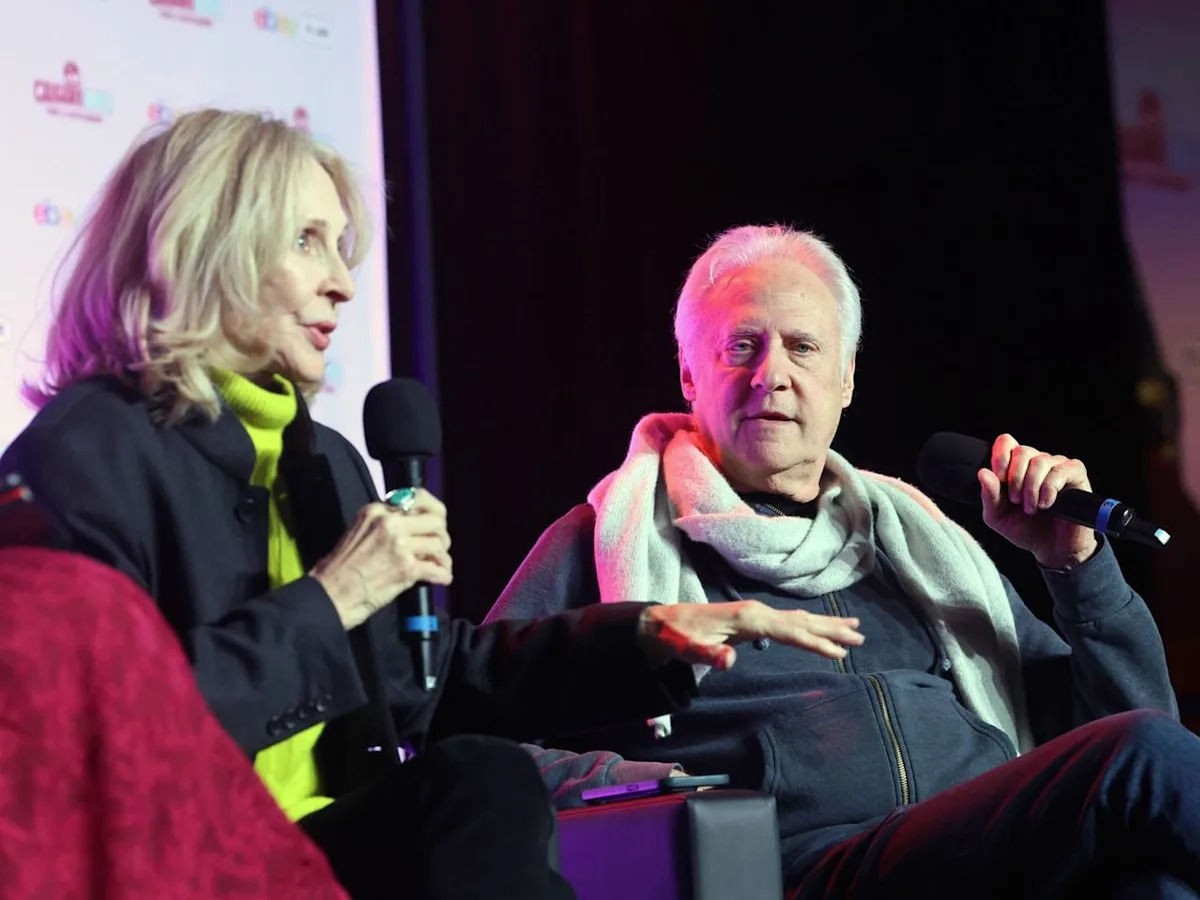
It’s perhaps not surprising that a panel dedicated to Star Trek would eventually land on the subject of real-life space travel.
At Calgary Expo yesterday, actors Gates McFadden and Brent Spiner — who played Dr. Beverly Crusher and Data on the TV series Star Trek: The Next Generation, a number of films and most recently on the new Picard — touched on Artemis II space mission, a 10-day mission that launched April 1 and sent four astronauts around the moon. William Shatner, the 95-year-old actor who played Captain James T. Kirk on the original series and films, actually made the media rounds to CNN and the CBC to talk about his thoughts on the mission.
Of course, Shatner’s real-life space adventures — in 2021, he boarded the Blue Origin New Shepard Rocket for a 10-minute suborbital flight into space — perhaps makes him more qualified than most actors to discuss blasting off into the cosmos. He may touch on the subject Saturday when he makes his own appearance at Calgary Expo.
But it seems Spiner and McFadden have differing views on whether they would ever take on such a mission in real life.
“I don’t want to fly, I’m not really keen on flying,” Spiner says. “I would not do what Bill Shatner did. It’s an incredibly brave to go up into space. I have no interest in that whatsoever.”
“I think all of us — especially President Trump — should go up and look at how unimportant we really are and that we’re part of a community at the top of the world,” said McFadden. “I think it’s a good perspective. I think that would be a gift.”
The question of whether they would boldly or not-so-boldly go into space came up after moderator Maggie Lovitt asked McFadden and Spiner it they would want to live in the sort of idealized future that Gene Roddenberry imagined for the Star Trek universe. It was the line of questioning that eventually led to Spiner to say “your questions are profound and deeply thought and I, personally, am completely shallow. So it makes it difficult.”
For the most part, the half-hour talk was a light-hearted affair with McFadden and Spiner adopting self-deprecating humour and irreverence about their role in the cultural juggernaut of Star Trek. When asked about specific episodes, Spiner admitted that he hadn’t watched many of them and has few memories of specific plots. He also said the pace of production for the series, which ran fro 1987 to 1994, made it difficult to think too deeply about the themes the show was presenting.
“I was just trying to remember my lines,” he says. “Honestly, just trying to deliver the character and remember everything I had to say and try to do it as believably as possible. But I didn’t reflect on it that much. We didn’t have time to reflect. It was like a moving train, it really was. We were doing 14- to 16-hour days for 10 months. It was relentless.”
As with many actors who enter the Star Trek universe, both were ill-prepared at first for the level of fandom the show received. McFadden did talk about her character as a role model for women in medicine and how Beverly Crusher being a single parent to Wesley had a profound impact on many fans who grew up in a single-parent household. She continues to hear these stories at fan conventions.
“They watched it all the time with this single parent, it was one of the ways they just related,” McFadden said. “The parent is now gone, now passed away. So when they come up to the table, it reminds them of that parent and they often get emotional because I’m the channel that they can feel the power of the love that they miss and that they had with that parent. “
“It’s been an interesting thing to be up close and personal with so many people, and we’ve met so many people,” Spiner says. “I don’t know what other fandom is like — like, say, George Clooney’s fans or Brad Pitt’s fans. I’m sure they’re fine people, but we have a special bond with our fans. It’s really incredible. That’s gone on well before us. I think it started with Gene Rodenberry and Bill and Leonard and Jimmy and George and Walter — all of the original. A connection was made that said the show is for you. We made the show for you. They relate to the characters and to the people and it changes their lives too and made us aware of that. It’s kind of overwhelming, really, to find out that we had that kind of impact on people. Our idea when we started was let’s entertain some people. That was it. We’re not going to educate you, we’re not going to change your lives, we’re not going to make you feel seen. And, yet, that happened.”
Calgary Expo continues until Sunday at Stampede Park.