
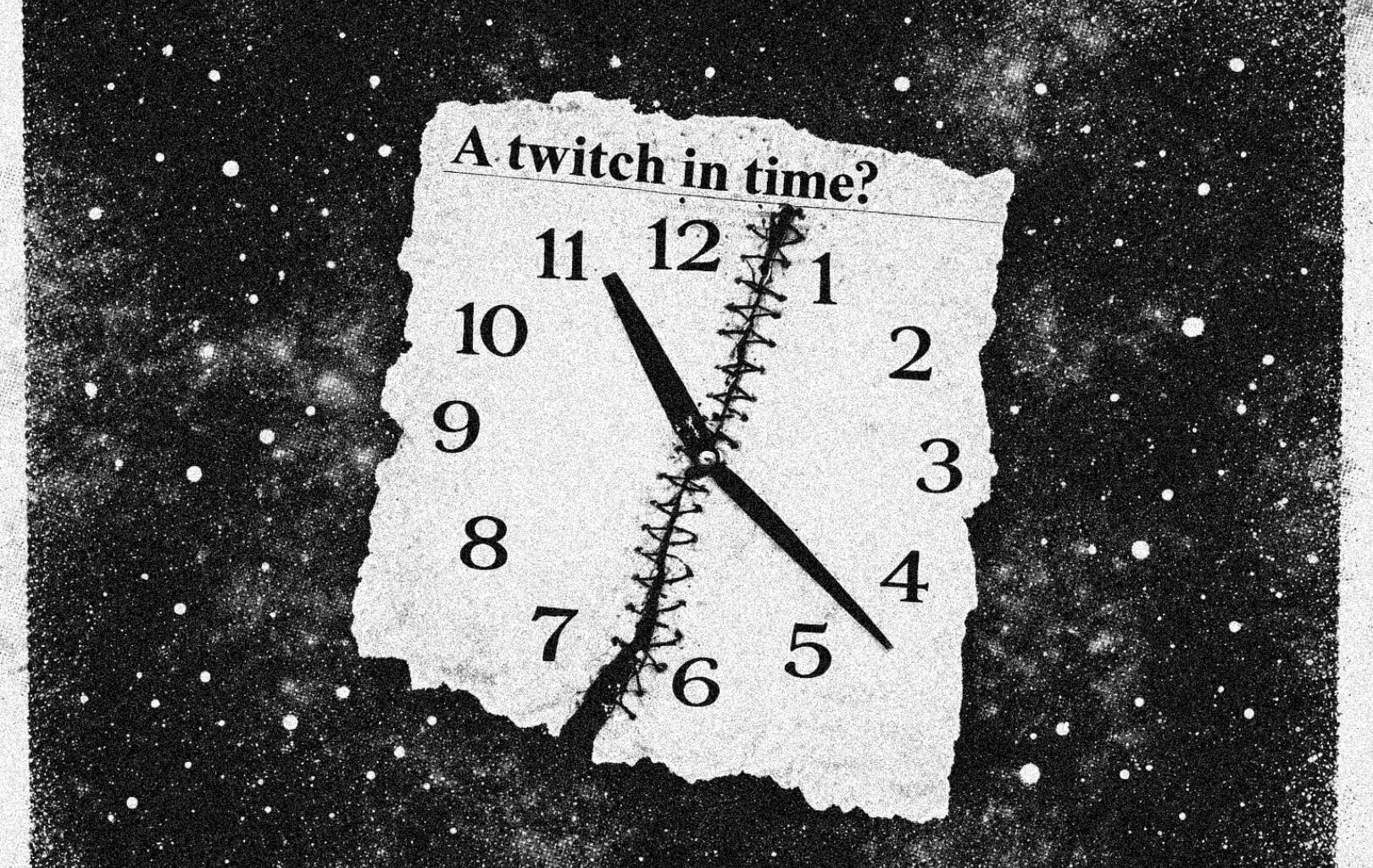
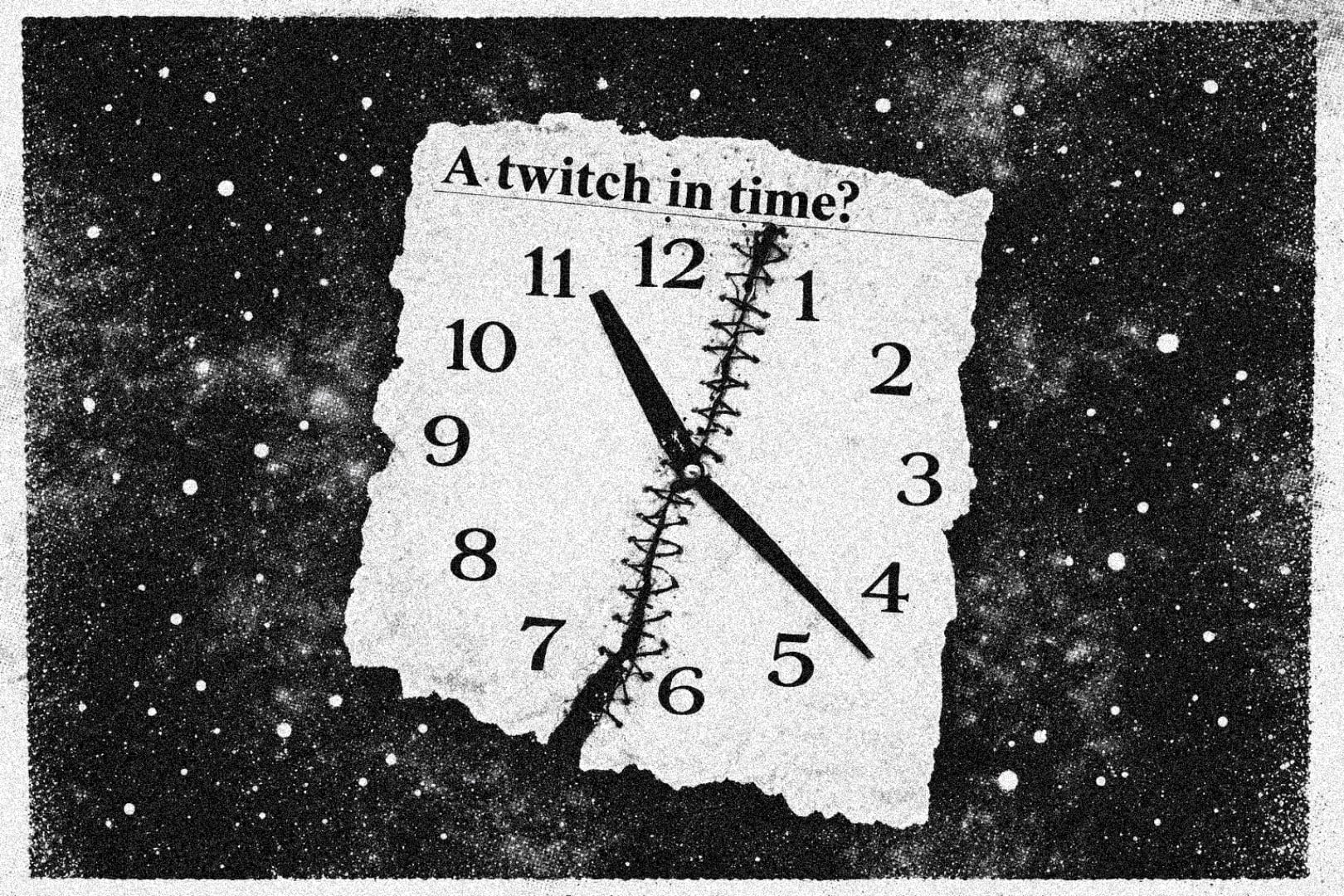
 Quantum collapse models hint at tiny time fluctuations. Credit: FQxI/Gabriel Fitzpatrick (2026)
An FQxI cofunded study suggests hidden connections between quantum mechanics, gravity, and time.
Scientists have taken a new look at one of quantum physics’ strangest problems and found that the answer may reach all the way to time itself.
In quantum mechanics, particles do not behave like everyday objects. Instead of existing in one clearly defined state, they can occupy several possible states at once, a phenomenon known as superposition. Physicists describe this blurry quantum behavior with a mathematical object called a ‘wavefunction.’
But in the ordinary world, things do not seem to work that way. A chair is in one spot, not two. A clock shows one time, not many. Bridging that gap between the quantum world and daily experience has challenged physicists for decades.
To reconcile this difference, physicists typically argue that when a quantum system interacts with a measuring device or observer, its wavefunction ‘collapses’ into a single, definite outcome.
With support from the Foundational Questions Institute, FQxI, an international group of physicists has now investigated a set of unconventional approaches to this measurement problem known as ‘quantum collapse models,’ revealing that they could have significant consequences for how time behaves and how precisely it can be measured. Their findings, published in Physical Review Research, also propose a new strategy for experimentally distinguishing these models from standard quantum theory.
“What we did was to take seriously the idea that collapse models may be linked to gravity,” says Nicola Bortolotti, a PhD student at the Enrico Fermi Museum and Research Centre (CREF) in Rome, Italy, who led the study. “And then we asked a very concrete question: What does this imply for time itself?”
Spontaneous Collapse
During the 1980s, researchers began developing quantum models in which wavefunction collapse occurs spontaneously, independent of observation or measurement. Unlike standard ‘interpretations’ of quantum mechanics, which tend to be philosophical frameworks that cannot be distinguished experimentally, these collapse models produce specific predictions that can, in principle, be tested in the lab.
“What we did was to take seriously the idea that collapse models may be linked to gravity. And then we asked a very concrete question: What does this imply for time itself?” says Nicola Bortolotti.
To explore this idea, Bortolotti and colleagues Catalina Curceanu, a member of FQxI and research director at the Laboratori Nazionali di Frascati of the National Institute for Nuclear Physics (INFN-LNF) in Frascati, Italy, Kristian Piscicchia, at CREF and INFN-LNF, Lajos Diósi, of the Wigner Research Center for Physics and Eötvös Loránd University, in Budapest, Hungary, and Simone Manti of INFN-LNF examined two leading collapse models. One is the Diósi-Penrose model (named after FQxI members Lajos Diósi and Sir Roger Penrose), which has long proposed a connection between gravity and wavefunction collapse. The team also established, for the first time, a quantitative relationship between another model, Continuous Spontaneous Localization, and fluctuations in gravitational spacetime.
The study shows that if these collapse models accurately describe nature, then time itself would carry a minute intrinsic uncertainty. This would introduce a fundamental limit on how precisely time can be measured, although the effect is extraordinarily small. “Once you do the calculation, the answer is clear and surprisingly reassuring,” said Bortolotti.
Importantly, this predicted uncertainty has no impact on practical timekeeping. Even the most advanced atomic clocks, now or in the foreseeable future, would remain unaffected. “The uncertainty is many orders of magnitude below anything we can currently measure, so it has no practical consequences for everyday timekeeping,” says Curceanu. “Our results explicitly show that modern timekeeping technologies are entirely unaffected,” adds Piscicchia.
Linking quantum theory and gravity
For decades, physicists have been searching for a unified framework that can reconcile quantum mechanics with gravity. Each theory is remarkably successful within its own domain. Quantum mechanics governs the behavior of particles at the smallest scales, while Einstein’s general theory of relativity describes gravity and the large-scale structure of the universe. However, the two frameworks treat time in fundamentally different ways. “In standard quantum mechanics, time is treated as an external, classical parameter that is not affected by the quantum system being studied,” explains Curceanu. By contrast, in general relativity, time and space are dynamic and can bend and change in response to mass and energy.
“The uncertainty is many orders of magnitude below anything we can currently measure, so it has no practical consequences for everyday timekeeping,” says Catalina Curceanu.
The new results build on the idea that quantum mechanics may be part of a deeper and more comprehensive theory. By revealing a possible link between collapse models, gravity, and the behavior of time, the work points toward previously hidden connections between these foundational aspects of physics.
Curceanu also emphasized the role of FQxI in supporting unconventional research directions. “There are not many foundations in the world which are supporting research on these types of fundamental questions about the universe, space, time, and matter,” says Curceanu. “Our work shows that even radical ideas about quantum mechanics can be tested against precise physical measurements, and that, reassuringly, timekeeping remains one of the most stable pillars of modern physics.”
Reference: “Fundamental limits on clock precision from spacetime uncertainty in quantum collapse models” by Nicola Bortolotti, Catalina Curceanu, Lajos Diósi, Simone Manti and Kristian Piscicchia, 13 November 2025, Physical Review Research.
DOI: 10.1103/p6tj-lg8l
This work was partially supported through FQxI’s Consciousness in the Physical World program.
Never miss a breakthrough: Join the SciTechDaily newsletter.
Follow us on Google and Google News.