
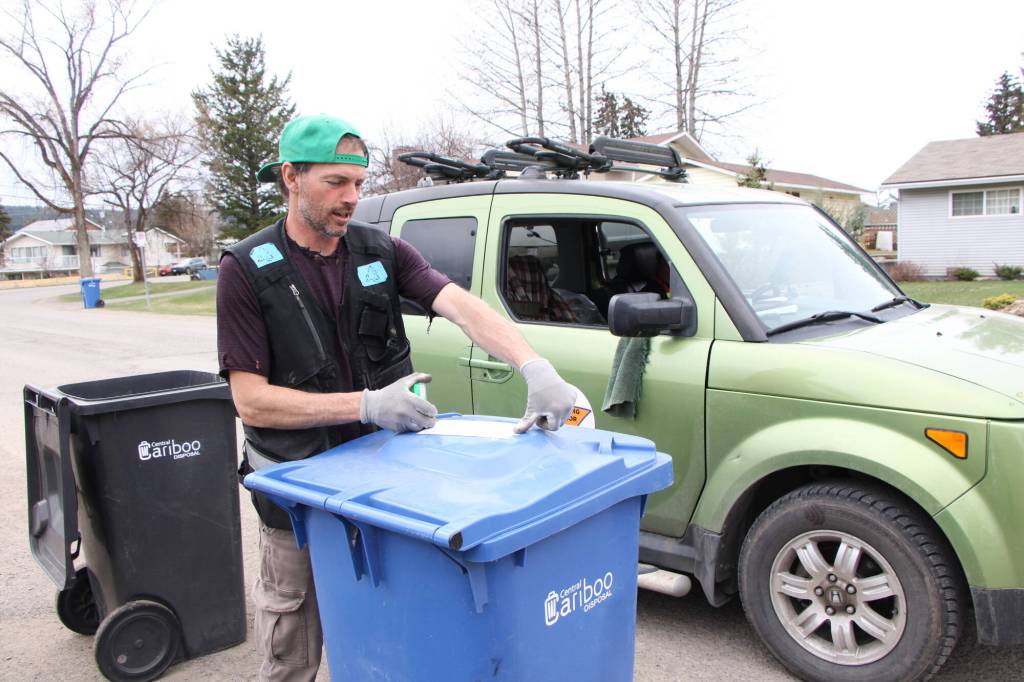
First audit of 100 Mile House recycling program undertaken
Published 5:00 am Saturday, April 25, 2026
Hundreds of recycling bins were checked for contamination in the District of 100 Mile House on Tuesday, April 21.
Throughout the day, waste reduction expert Mary Forbes and her partner, Oliver Berger, were out checking if what was in the blue bins was meant to be there. Forbes said that while the community didn’t receive a perfect score, she and Berger were impressed with how clean the bins were and how friendly the people of the 100 Mile House area are.
“We weren’t sure what to expect because there hadn’t been an audit there previously. We wanted to make sure, ahead of going out that the people had the best chance to know we would be coming, but not on what day,” Forbes said, noting she and Berger went to 100 Mile Elementary and the Coffee with Council meeting in early April to spread the word.
“Generally, the recycling was super clean. We had the odd few here and there that weren’t, but the recycling in town was very clean. I think that’s because (100 Mile House) is a community that bears frequent in the spring, so folks realize recycling has to be really clean. The thing that really shone was how absolutely friendly people were.”
The District of 100 Mile House hired Forbes and Berger to conduct this audit to reduce the contamination found in the district’s recycling. Contamination is a catch-all term for anything that cannot be recycled through the program. This can include non-recyclable material like household waste and recyclable materials like Styrofoam and glass, which both cannot be picked up by 100 Mile House’s curbside program.
Recycle BC requires communities to maintain a five per cent or less contamination level in recycling. Failure to do so can result in fines, which is why the District of 100 Mile House is making the effort to educate the public on what is and isn’t allowed.
Overall, Forbes said the audit was fairly typical for a community’s first-time audit. One of the most common pieces of contamination they came across was soft plastic bags for items such as chicken food bags, water softening salt bags, soil bags and lots of little snack wrapper bags. While these bags are recyclable, Forbes said they need to be taken to a depot, not put on the side of the curb.
“We realize when the ‘wrong stuff’ is taken to the curb, it’s not because people don’t care, it’s because they do care. We know people want to find the right place for these objects,” Forbes explained. “We call it ‘wishcycling’ because you wish it were recyclable.”
The three main items Forbes finds which are recyclable but not through the curbside program are loose plastic bags, Styrofoam and glass. Forbes said the proper place to take them is 360 Environment Solutions, formerly known as Gold Trail Recycling, or the 100 Mile House Transfer Station.
Throughout Tuesday, Forbes said she and Berger checked out 130 different bins, noting there are 700 homes in 100 Mile House. This gave them a good snapshot of the community they can use for future audits.
One thing Forbes said the audit showed is that most people in 100 Mile House do know what can and can’t be recycled. More than once, she said a bin would miss a gold star due to only one or two items not meant to be in the bin. When this happened, an ‘Oops card’ was left detailing what was wrong and why.
“For 10 hours, we searched bins in 100 Mile House and we kept being impressed. If we handed out a gold star, it meant your recycling had no contamination at all, but there were a lot of bins that had, like, a single plastic bag, it was so close to a gold star. A lot of them were pretty close to perfect,” Forbes said. “We expect the next time we audit, many of the people who got the Oops card will get a gold star.”
In general, Forbes reiterated she found the people she and Berger interacted with friendly, noting many came out to ask questions as they moved through their neighbourhood. Forbes remarked that this good humour was maintained even when she or Berger were a bit disappointed in the contents of a bin.
“100 Mile House was super welcoming and kind and we were very grateful for that,” Forbes said.
Forbes said that anyone who wants to learn more about recycling has a few different options to choose from. For general recycling tips, you can check out the Recycling Council of British Columbia’s App or call them at 1-800-667-4321. If you have specific questions about 100 Mile House’s system, you can contact the District of 100 Mile House at 250-395-2434.
Finally, Forbes said anyone with questions about the results of their personal audit can call her or Berger at 250-398-7129.