
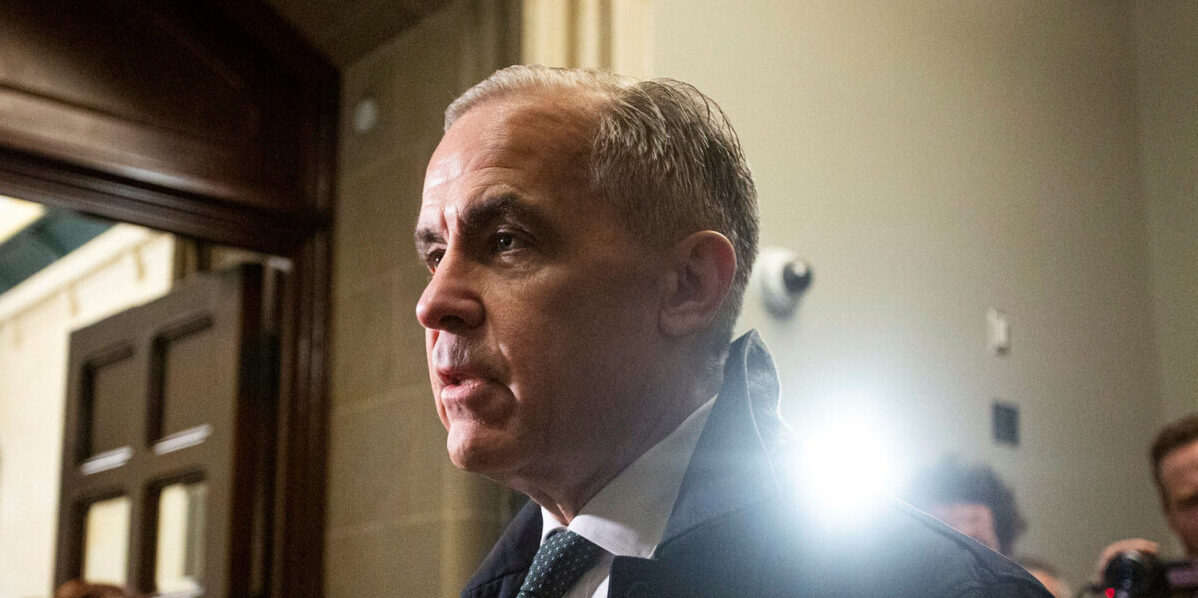
Separatist sentiment in Alberta and Quebec pose risks to investor confidence that could damage Canada’s economy, presenting a challenge for Prime Minister Mark Carney as he tries to pursue a national unity agenda in the face of global instability, according to pollsters and economists.
“Within the broader context of the Carney government looking to attract investment from around the world into Canada, the situation in Alberta and Quebec poses a little bit of a challenge for potential investors,” said Nik Nanos, chief data scientist at Nanos Research.
“Even if these votes don’t pass, the uncertainty that the sentiment exists could impact the appetite for companies to invest in Canada.”
A province-wide referendum in Alberta is scheduled for Oct. 19, which is set to include questions related to immigration policy and constitutional reform. A petition led by the group Stay Free Alberta is seeking about 178,000 signatures by May 2 in order to add a question about whether the province should become an independent state. A counter-separatist initiative, Forever Canadian launched by former deputy premier Thomas Lukaszuk, gathered more than 456,000 signatures on a petition with the goal of having the provincial government consider making it official policy for Alberta to remain a part of Canada.
Alberta isn’t the only province where separatist attitudes are currently brewing. Quebec’s general election is scheduled for Oct. 5, and Parti Québécois (PQ) Leader Paul St-Pierre Plamondon has promised a referendum on sovereignty if he were to form government. Although the PQ currently leads in the polls with about 31 per cent, a Léger poll published in Le Journal de Montréal on April 21 showed Plamondon’s party could rise in support by about eight points if he were to drop its intention to hold a referendum.
Get Today’s Headlines Newsletter
Wake up to the day’s top political and policy headlines. Weekday Mornings.
By entering your email address you consent to receive email from The Hill Times containing news, analysis, updates and offers. You may unsubscribe at any time. See our privacy policy
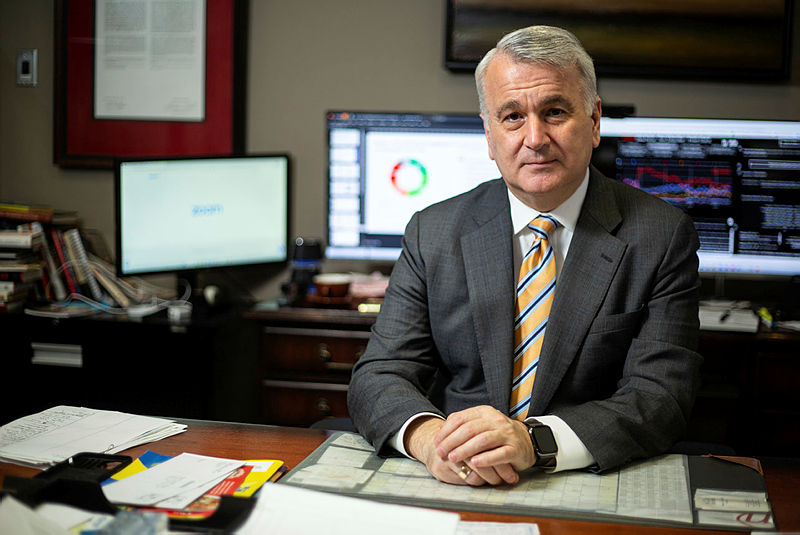 Nik Nanos, chief data scientist at Nanos Research, says, ‘the situation in Alberta and Quebec poses a little bit of a challenge for potential investors.’ The Hill Times photograph by Andrew Meade
Nanos told The Hill Times that, when it comes to the question of a referendum on sovereignty in two provinces, Carney has “probably handled it best that he could,” adding that “the worst thing that he can do is intervene.”
“Setting aside the fact that [Carney] does consider himself an Edmontonian and Albertan because of his youth [spent there], he still has to be very careful on how he treads on this because, I think the fact of the matter is, for many of these referendums, the voters tend to prefer that there aren’t external players in these referendums, one way or another,” said Nanos.
“I think, for the prime minister, what he has to hope for is that these things are decisively put to rest so that he can focus on attracting investment, and not having to answer any questions about Alberta separation or the possible win of a PQ government in Quebec.”
In terms of the economic repercussions of sovereignty referendums, Nanos said much will rest on the final number of votes.
“If it’s a decisive rejection of separation [in Alberta], [Carney will] be able to put it behind him, in terms of having to deal with that issue. If it’s a significant proportion of the population, I think especially if it’s anything over 40, then that casts a different pall, in terms of a significant proportion of people, at least in Alberta, believing that they have a better future outside of Canada.”
Data released by Nanos Research on April 16 shows Canadians rate Carney 7.2 out of 10 in his contribution to making Canada a better country—an all-time high. These numbers are based on hybrid telephone and online survey results from 1,007 Canadians ages 18 years or older between Feb. 8 and Feb. 16.
The Hill Times reached out to the Prime Minister’s Office to ask about Carney facing a national-unity challenge amid provincial referendum questions, but did not receive a response by deadline.
Brexit an example of how separatist feelings affect a national economy: Trevor Trombe
Colin Busby, the C.D. Howe Institute’s director of policy engagement, told The Hill Times that besides the investment uncertainty created by separation talk, Canada faces financial turbulence with the upcoming review of the Canada-United States-Mexico Agreement (CUSMA) in July.
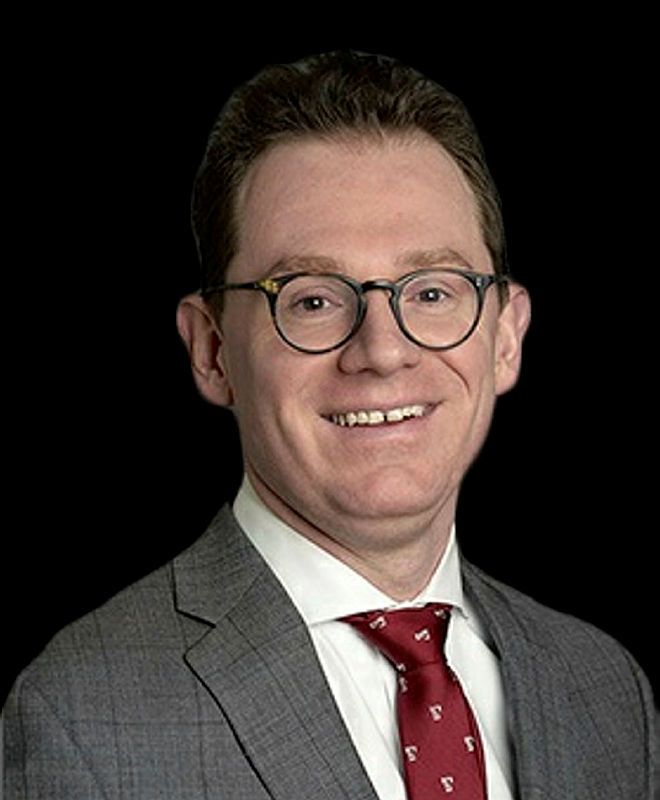 Colin Busby, director of policy engagement at the C.D. Howe Institute, says the level of perceived threat from referendums in Alberta and Quebec, as well as the CUSMA review, are ‘to be determined.’ Photograph courtesy of the C.D. Howe Institute
“What I think we’re trying to all understand is the level of perceived threat and perceived risk, and how great that is, and that really is kind of a ‘to be determined’ at this point in time,” he said.
“The greater threat to investment confidence right now, in my opinion, is the threat coming externally through the CUSMA trade negotiations.”
During the Intersect 2026 conference in Toronto on April 22, former Alberta premier Jason Kenney said that, while he doesn’t expect separatists to win in the province, he warned that if relations between Ottawa and Alberta do not improve, separatists could garner a substantial number of votes, and that would create “a permanent divisive fact in our politics,” as reported in The Globe and Mail.
Darrell Bricker, CEO of Ipsos Public Affairs, told The Hill Times he agrees with Kenney that “this thing could just explode in Alberta if we’re not careful.”
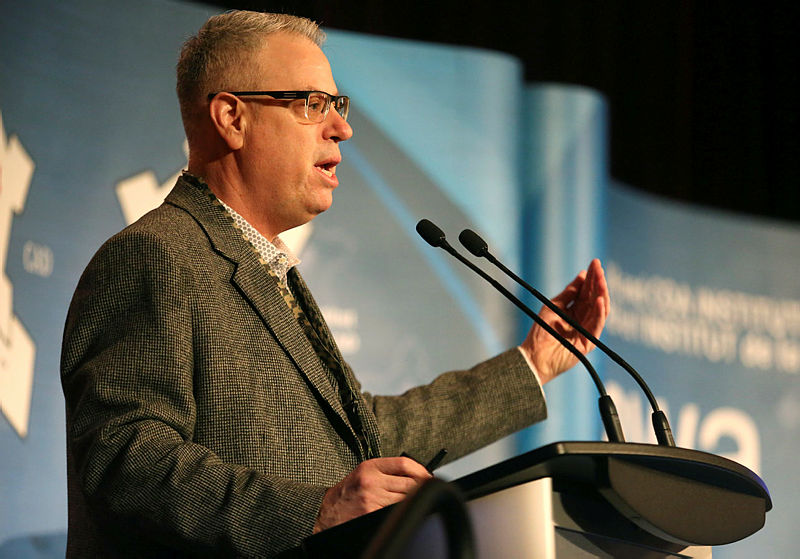 Darrell Bricker, CEO of Ipsos Public Affairs, says the separatist movement in Alberta is ‘really about grievance.’ The Hill Times photograph by Andrew Meade
“When you take a look at what is driving the separatist feelings in the province of Alberta, it’s not really about separatism. It’s really about grievance with … the perceived view of the way Alberta is treated by the federal government,” Bricker said.
“It’s not that people in Alberta who are supportive of voting ‘yes’ in a referendum have given a tremendous amount of thought to what happens the day after. The point is really more about how the system isn’t working for them, and they want to send a very strong signal to the rest of the country, and especially to Ottawa, that the country, as it’s currently working is not working for them, in their view.”
Trevor Tombe, an economics professor at the University of Calgary, told The Hill Times that the desire for separation in Alberta and Quebec could have “considerable effect on investment.”
 University of Calgary economics professor Trevor Tombe says anytime there is uncertainty about the economic landscape ahead, firms ‘might naturally pause investment until some of that uncertainty is resolved.’ Photograph courtesy of Trevor Tombe
“Anytime you have uncertainty about the economic or policy landscape ahead, you, as a firm, might naturally pause investment until some of that uncertainty is resolved,” he said.
“Because that ultimately would lead to bigger regulatory differences between jurisdictions that can affect your ability to trade across borders, operate subsidiaries across borders, and therefore lowers the return to investments.
As an example of the effect of separation sentiment on a national economy, Trombe pointed to Brexit, the formal withdrawal of the United Kingdom from the European Union in 2020.
A 2025 study led by researchers at King’s Business School, Stanford University, the Bank of England, and the University of Nottingham found that Brexit reduced the United Kingdom’s GDP by six to eight per cent, and investment by 12 to 18 per cent by early 2025.
“If this goes forward, and especially if the vote itself is at a meaningful share of the population, say 20 to 30 per cent … then the uncertainty will remain for many years to come because it will effectively demonstrate a non-trivial share of the population is interested in this, and therefore we should expect pressure to separate to continue. Quebec saw that when they had a 40 per cent vote in 1980; that it just mounted from there, and wasn’t put to bed until many years later,” said Tombe.
“It’s quite clear that Alberta separation would be worse for both Alberta’s economy and Canada’s, but how best governments should approach diffusing this kind of pressure, I don’t know. Other than to say that it is an issue that is certainly not helping Canada’s economy, and should be a priority issue for governments to try to resolve in a way that doesn’t inflame tensions further.”
Carney ‘irresponsible’ for not calling out Smith’s separation talk: NDP MP McPherson
NDP MP Heather McPherson (Edmonton Strathcona, Alta.), her party’s foreign affairs, trade and development critic, told The Hill Times that “every single politician in this country should be unequivocally saying that Canada is stronger with Alberta and Quebec,” adding that “we should be calling out leaders that are spreading divisive politics.”
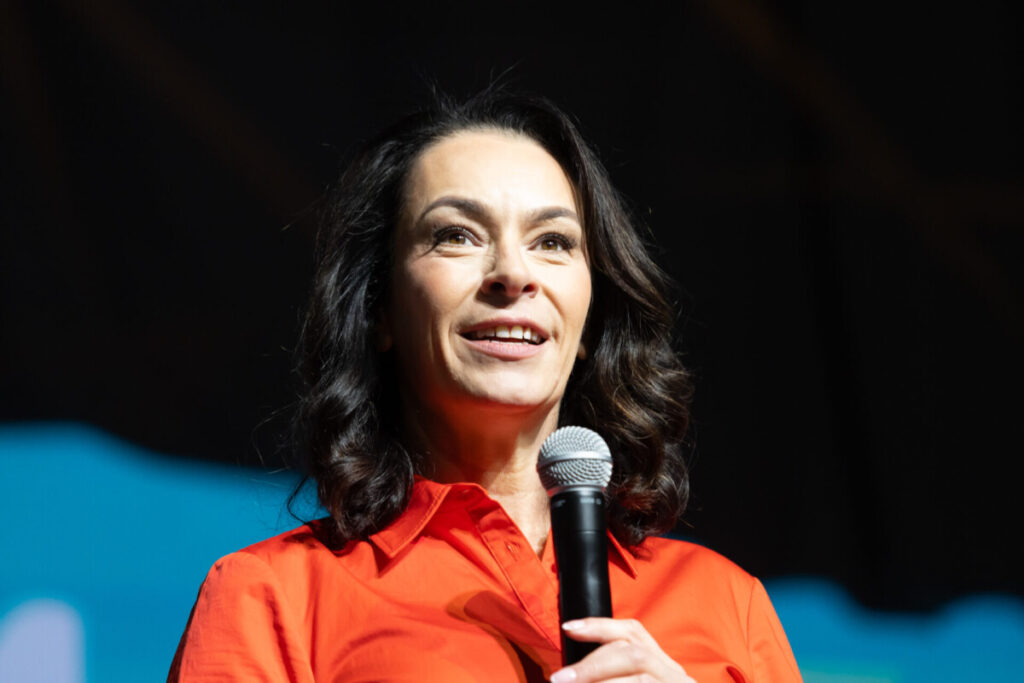 NDP leadership candidate Heather McPherson says Carney should be protecting the federation instead of rewarding Smith with an MOU. The Hill Times photograph by Matthew Merkel
“This threat is not good for any Canadians. It’s not good for our economy. It’s not good for the services Canadians depend upon. It is a threat, and we should be taking it seriously,” she said.
McPherson said she was “disappointed” in Carney, in terms of his response to the question of national unity in the face of separatist sentiment in Alberta and Quebec.
“I think about the Canada Health Act. I think about our Canada Pension Plan. These are things that the prime minister should be standing up and protecting, instead of allowing [Alberta Premier] Danielle Smith to continue to take swings at our cherished public health care system, or at our cherished Canada Pension Plan,” said McPherson.
“Allowing that backsliding is not helping to protect the federation. It’s a mistake. Mr. Carney is making a mistake. And instead of calling out Danielle Smith when she plays games with separatists, he rewards her for that behaviour by signing an MOU with her. That’s irresponsible.”
Smith’s government passed Bill 11, the Health Statutes Amendment Act 2025 (No.2) in the Alberta Legislature on Nov. 24, 2025, establishing a two-tier health care system allowing physicians to work concurrently in public and private systems while enabling private payment for insured services. Critics, such as the Council of Canadians, have argued the bill creates a “for-profit fast lane” for the wealthy, and “a slower, public lane for those who can’t afford to pay.”
In May 2025, Smith paused plans to withdraw from the Canada Pension Plan in favour of a provincial pension plan, citing a lack of public appetite for a vote on the subject.
Duane Bratt, a professor and chair in the department of economics, justice, and policy studies at Mount Royal University in Alberta, told The Hill Times that discussions about secession in Alberta and Quebec are not only bad for the economy, but also potentially create other problems, including for labour mobility.
“What about labour mobility? Would people be moving to Alberta if there was a risk that Alberta might leave Canada? Would there be people leaving Alberta?” he said.
“We saw a massive outflow of people in Quebec in the lead up to the 1980 referendum and the election of the PQ in 1976, so we have historical data that it’s not just about investment, it’s also about labour flight.”
Bratt added another concern is the possibility of interference from the U.S. into the Alberta referendum.
Jean-Christophe Boucher, a professor of political science at the University of Calgary, said that Alberta is “excessively vulnerable to American interference,” as reported by CBC News on March 4, 2026. Boucher argued that in the event of a provincial referendum, “there would be no one within the Alberta government who could analyze and collect data to ensure that the conversation about the referendum is not being manipulated by foreign actors.”
“We also have a [U.S.] president who has talked about annexing Canada, and so if he can try to take efforts to break up Canada, that furthers his agenda. It’s a firestorm that Carney is facing—an economic challenge and a political challenge, not just Canada-U.S. relations, but across Canada. That is going to be exploited by the Americans,” said Bratt.
jcnockaert@hilltimes.com
The Hill Times
Nanos Research Data on What Makes Canada a Better Country:
Nearly three in four Canadians (71 per cent) report being satisfied with Canada as a country. This represents a significant increase in the satisfaction of Canadians compared to previous years (60 per cent in 2025; and 52 per cent in 2024). The last witnessed peak of Canadians satisfaction of Canada as a country was 2021 (74 per cent). Across provinces, the highest level of satisfaction (mean of 7.5 on 10) can be witnessed with residents of British Columbia.
Prime Minister Mark Carney was rated a 7.2 out of 10 in terms of his contribution in making Canada a better country. This is an all-time high since the beginning of the tracking in 2021 since which the rating ranged between 5.7 (2021) to a 4.9 (2023).
Canada’s universities and colleges were seen as the highest contributor to making Canada a better country, with a mean of 7.5 out of 10, followed by the health system with a mean score of 7.4. Amongst the provinces, Quebec residents attributed the highest rating to universities and colleges with a mean of 8.1 out of 10, followed by B.C. which received a 7.5 out of 10.
Source: Nanos Research data released on April 16, 2026.

Jesse Cnockaert is a reporter for The Hill Times, covering lobbying, federal ministers, and important legislation before the House and Senate. As the policy briefings lead, he also covers must-read federal policy issues across a broad range of sectors. Cnockaert started writing for The Hill Times in July 2021 following three years as editor of The Lobby Monitor. He previously worked for Metro Ottawa, and spent eight years covering news for three different municipal newspapers. He can be reached at Jcnockaert@hilltimes.com. See all stories BY JESSE CNOCKAERT