
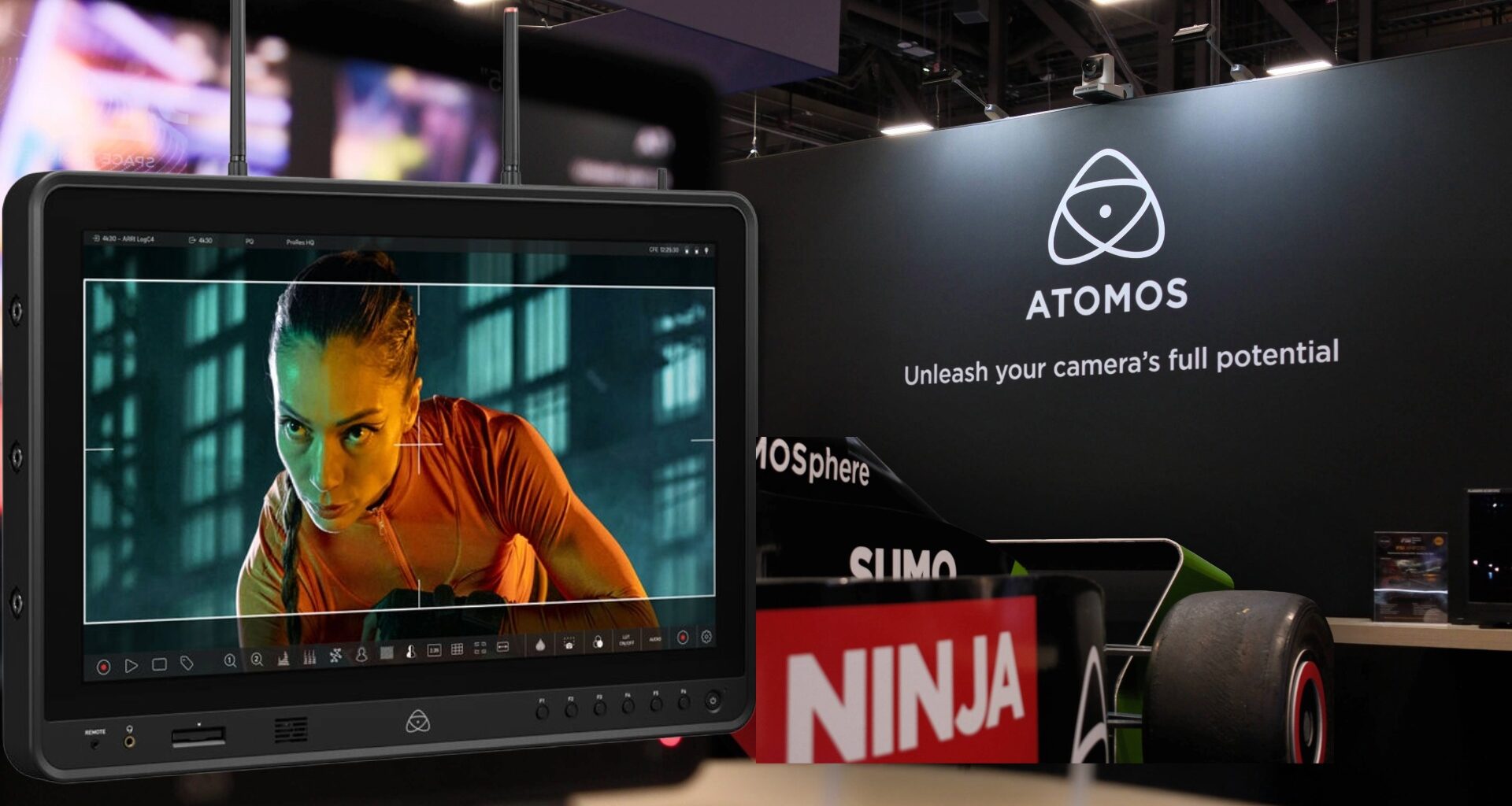
At NAB 2026, we caught up with Peter Barber, CEO of Atomos, to talk about the new Sumo PRO-19, a 19-inch 4K HDR monitor-recorder-switcher built around camera control, NDI HX3, and camera-to-cloud workflows. The conversation also covered the recently announced acquisition of Flanders Scientific, the year-long rebuild of the Ninja and Shinobi lines, and where Atomos is heading as a broader production ecosystem.
For many readers, Atomos is still primarily associated with the Ninja, Shinobi, and Shogun monitor-recorders that defined the brand. The company has gone through a turbulent post-COVID period, with leadership changes, inventory issues, and a pause in major releases. The picture in 2026 looks very different. Under Peter Barber, who has been in the CEO role for roughly a year, Atomos is presenting one of its broadest NAB lineups ever, with seven new products on the booth and a clear strategy that spans on-camera, on-set, and now reference-grade monitoring.
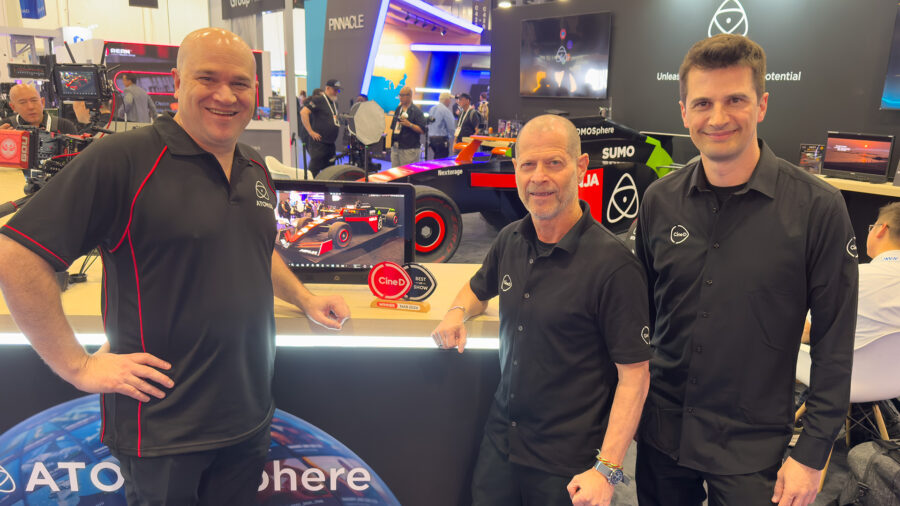 The Atomos Sumo PRO-19 is our winner in the monitoring category. Credit: CineDFrom Blackmagic Design to leading Atomos
Peter is a veteran of the production and post-production industry, having attended his first NAB back in 1993. His career started in online editing and visual effects in Australia, before he moved into post-production in Singapore. He later joined Autodesk to demonstrate Flame compositing systems, then spent several years at Apple helping roll out the early versions of Final Cut Pro across the Asia Pacific. In 2001, he co-founded Blackmagic Design, where he eventually held roles including President of Post-Production and Creative Services, and led an M&A program that brought seven companies into the group over an eight-year period.
He joined Atomos as COO in early 2024 at the invitation of company co-founder Jeromy Young, before stepping into the CEO role in May 2025. As Peter put it on the booth, “Atomos had been through a difficult time for a few years, especially post-COVID. The company, like many companies, had suffered through that period.” His brief from the board was straightforward: rebuild the engineering team, refresh the product line, and broaden the ecosystem.
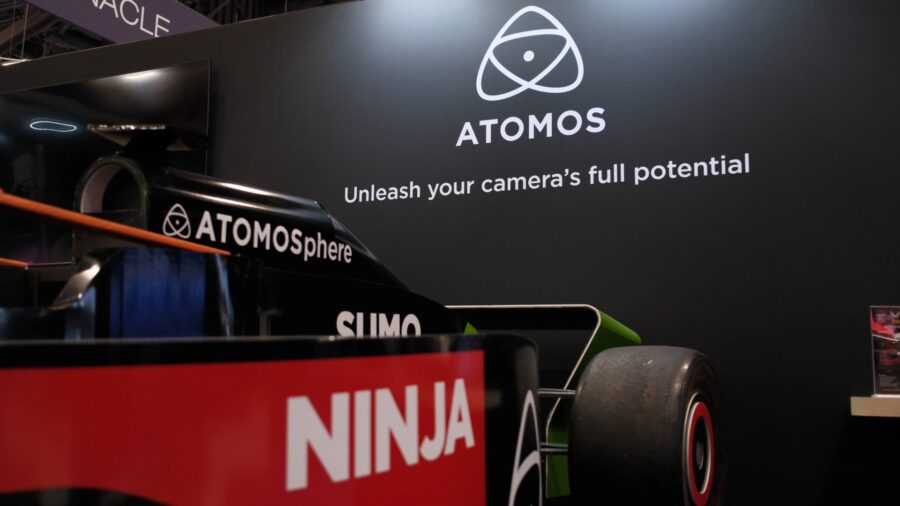 Atomos at NAB 2026. Credit: CineDRebuilding the product line, then expanding it
Peter is candid that the first priority on arrival was engineering. “The first thing we did was to double down in engineering,” he told us. “Some of the monitor-recorder products were getting quite old, using older recording formats.” The goal was to deliver a new generation of Ninjas while still finding ways to support existing customers in the meantime.
That investment started to show last summer with a steady cadence of releases. The 5-inch Ninja family was rebuilt around CFexpress Type B media, brighter HDR displays, and integrated camera control, beginning with the Ninja TX, followed by the HDMI-only Ninja TX GO, and most recently the more affordable Ninja RAW at $699. The Shinobi II and Shinobi 7 RX have rounded out the on-camera monitoring side, and the Studio Pro 2710 reference monitor, previewed at IBC 2025, signals the company’s first push into post-production reference displays.
Alongside core monitor-recorders, Atomos has also branched into adjacent categories that occasionally raised eyebrows in the community, including the StudioSonic headphones, the A-Eye PTZ cameras, and the ATOMOSphere cloud platform. Asked about the rationale, Peter framed it as customer-driven: “We had a lot of people asking, do you have a video transmitter, do you have a microphone? So why don’t we offer these things? It gives users more options, while staying compatible with whatever camera, recorder, or color correction software they want to use.”
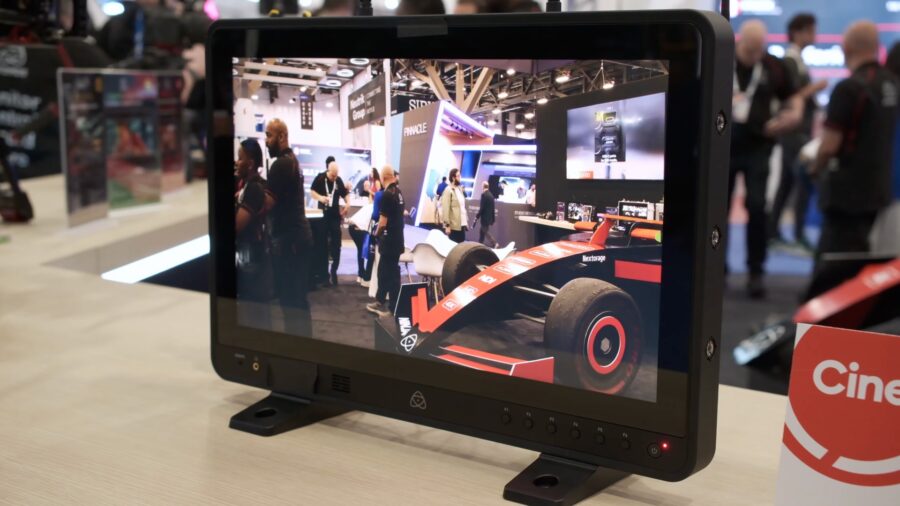 Sumo PRO-19. Credit: CineDThe Sumo PRO-19 takes center stage
The flagship hardware announcement at NAB 2026 is the Sumo PRO-19, a complete redesign of the long-running Sumo line rather than a refresh. The original Sumo 19SE arrived in 2022 with a 1080p touchscreen and asynchronous multi-cam switching. Peter’s view was that the form factor still made sense, while the technology underneath was due for a major overhaul.
The new unit features a 19-inch 4K HDR display with 1200 nits of brightness, 10-bit processing, and coverage of 100% Rec.709 and 99% DCI-P3, with support for Calibrite calibration via the Atomos Calibrator app. Recording moves to CFexpress Type B and external USB-C SSDs, in line with the rest of the new Ninja generation, and the device captures Apple ProRes, ProRes RAW, Avid DNx, and 10-bit H.265 up to 30 Mbps over SDI or HDMI. Atomos states that ProRes RAW capture is supported up to 8Kp30 from compatible sources. For multi-camera work, the Sumo PRO-19 can record up to four ISO feeds plus a fifth program output, with NDI HX3 send and receive over Wi-Fi or Ethernet.
The big additions over the previous Sumo are camera control and connectivity. Via the touchscreen, operators can adjust ISO, shutter, aperture, white balance, and start/stop on supported Canon, FUJIFILM, Nikon, Panasonic, and Sony mirrorless cameras, with touch-to-focus on the table for compatible models. Six assignable front-panel buttons give quick access to monitoring tools, LUTs, and anamorphic de-squeeze. The full monitoring suite is here too, including EL Zone false color, waveform, RGB parade, vectorscope, and focus peaking. Direct cloud upload is supported to ATOMOSphere, Frame.io, and Dropbox over Wi-Fi or Ethernet, and AirGlu timecode sync runs over RF or Bluetooth. The aluminum chassis includes an integrated carry handle and removable desktop feet, with the unit weighing 7.1kg (15.7lb).
As Peter described it: “We didn’t upgrade the product. We built a brand new Sumo. So now you have a 20-inch on-set monitor where you can sit there and control your exposure and other camera features, even touch-to-focus on your director’s monitor, and it still has all the recording and review features.”
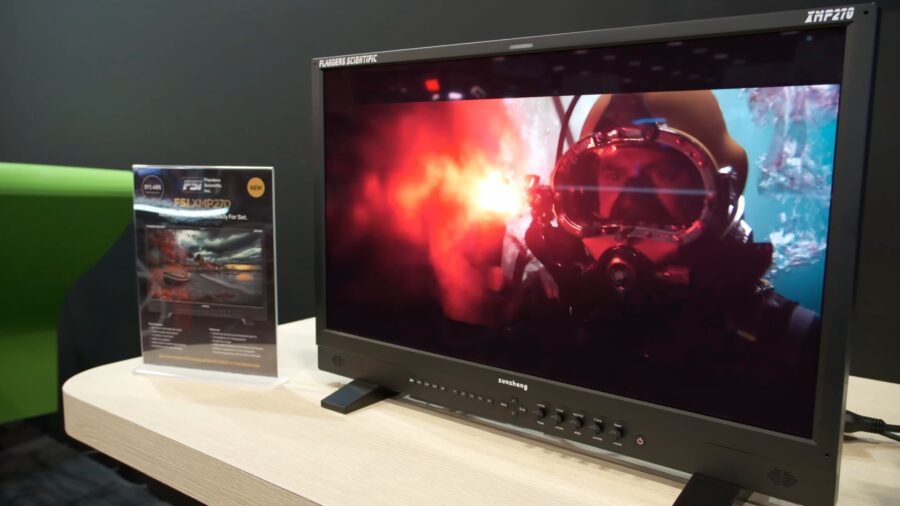 Flanders Scientific. Credit: CineDAcquiring Flanders Scientific
The strategic announcement that landed shortly before NAB was Atomos’ acquisition of Flanders Scientific (FSI), a brand long trusted by colorists, DITs, and broadcast facilities for reference monitoring. For Peter, this was a logical extension of his post-production roots. “When you’re doing editing and color correction, you need to know that what you’re looking at when you deliver to a client is correct. That’s why quality, calibrated reference monitoring has always been very important to me.”
He noted that Atomos had already started building a reference monitoring engineering team, with the Studio Pro 2710 as a first preview, while FSI offered something hard to replicate from scratch: industry trust. Reference-grade monitors take years to earn facility-level qualification at major broadcasters and post houses, and FSI’s portfolio, including the QD-OLED XMP series and DM160 OLED, has that adoption already in place.
Importantly, FSI will continue to operate as a distinct brand within the Atomos family, with its own engineering and product philosophy. Peter argued that the deal benefits both customer bases. “Flanders is very strong in America, but not so strong outside of America. We have more infrastructure in Europe and Asia, so we can solve that problem. And we now have a bigger team in America to support both the Flanders products and the Atomos products.” Bram Desmet, CEO of Flanders Scientific, will continue to lead the brand. The FSI deal is the fourth acquisition Peter has led since joining Atomos, following Aaton Digital, eCinema, and a separate strategic IP purchase.
A broader monitoring pipeline
With FSI on board, the Atomos monitoring pipeline now stretches from the 5-inch Shinobi II and Ninja models on camera, through the Sumo PRO-19 and the rackmount Shogun AV-19 on set and in the gallery, up to the Studio Pro 2710 and the FSI reference range in finishing and mastering. That breadth was unimaginable for the Atomos of two years ago. Asked where he sees the company three years from now, Peter framed it as continuing to fill gaps in the workflow rather than chasing new categories for the sake of it. “Our role as Atomos is to try to help filmmakers, colorists, and editors as much as we possibly can. We’ll continue to do that, while staying compatible with everybody else and giving content creators as many options as possible.”
Pricing and availability
The Sumo PRO-19 is available to pre-order now from Atomos directly and through dealers, priced at $2,899 (€2,799), with shipping expected to begin in May 2026. Atomos has also confirmed pricing for several of the other NAB launches, including the new USB4 CFexpress Card Reader at $129, and the FieldPro Vest at $89, both shipping in the same window.
You can find full details on the Sumo PRO-19 on the Atomos product page, and our coverage of the FSI acquisition with the strategic context here.
Does the Sumo PRO-19 fit your on-set monitoring workflow, and how do you see Atomos and Flanders Scientific coexisting in your pipeline? Don’t hesitate to let us know in the comments below!