
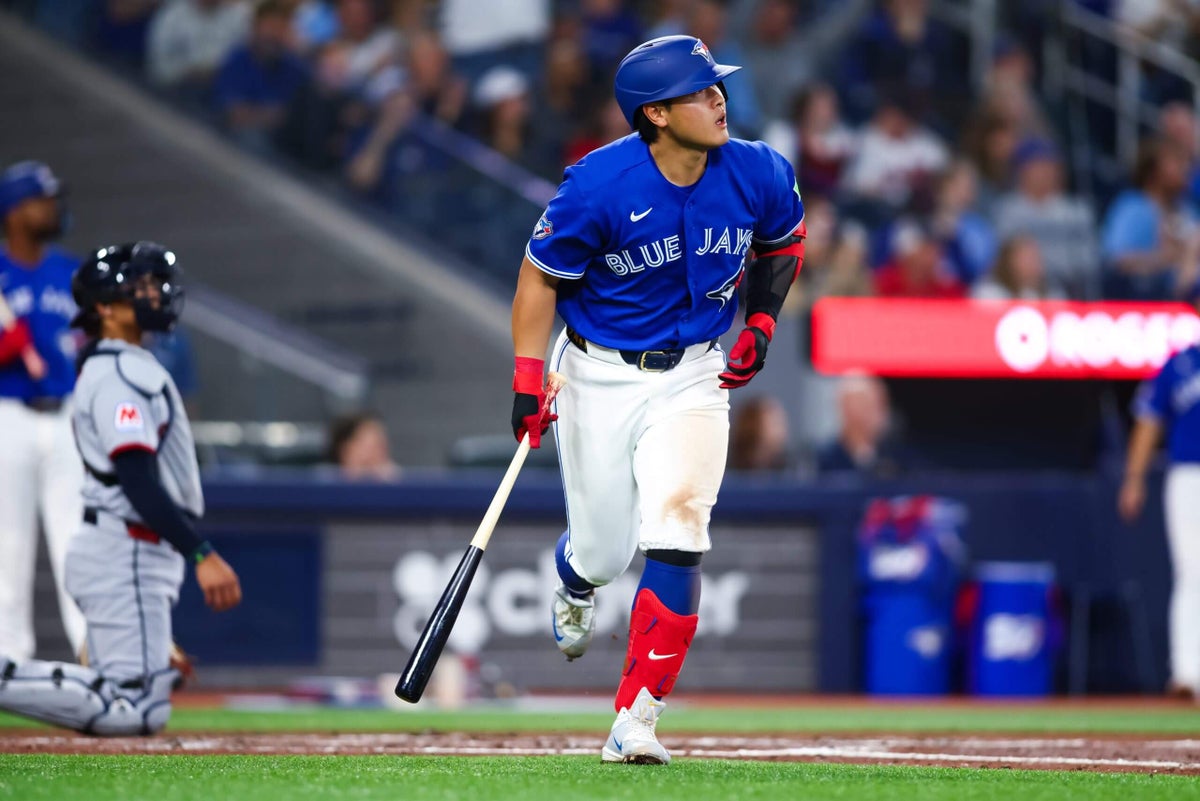
TORONTO — Kazuma Okamoto stood in the middle of Toronto’s dugout with a circle of teammates before Sunday’s game. It’s part of a new pregame tradition, with Blue Jays players and coaches taking turns saying something they’re thankful for in that moment. They collectively bow after each shares their gratitude.
The ritual began during Toronto’s trip to Anaheim. The circle is growing, with Vladimir Guerrero Jr. sometimes taking part, Eloy Jiménez smiling along and other coaches recently joining in. The things they’re thankful for are wide-ranging. One recent participant was thankful for potstickers. After Saturday’s win over the Cleveland Guardians, Okamoto joked he was thankful for the reporters who cover the Jays.
“I think it makes Kaz feel a little bit more welcome,” manager John Schneider said of the new routine, “or just a little bit more part of it.”
That comfort has fed into Okamoto’s results, too. Before going hitless in Sunday’s series final — a 4-2 win to earn Toronto its second series win in a row — he entered the day with nine hits, three homers and a 1.274 OPS in his previous seven games.
For that reason, Schneider hopes the Jays keep bonding through their expressions of gratitude.
“I can tell you I’m thankful for Kaz,” Schneider said.
It’s all part of Okamoto becoming one with a new team after 11 seasons with the Yomiuri Giants. On Friday, for example, Schneider walked through the clubhouse after a loss to the Guardians. In the otherwise quiet room, the manager spotted two teammates he never expected to be deep in a conversation.
Okamoto and Jesús Sánchez, two new Jays from different countries and with different first languages, were chopping it up minutes after the defeat. That, Schneider said, showed him just how comfortable Okamoto has become one month into his big-league career.
“I don’t know how that was going,” Schneider said of the teammates’ chat. “I didn’t even ask them what they were talking about. But it’s one of the little things.”
Sánchez understands what it’s like to join a team filled with players who speak a different language. Born in the Dominican Republic, the Spanish-speaking outfielder first played in North America, at 18, in the Tampa Bay Rays minor-league system.
Sánchez sensed early this season that Okamoto was looking for support and advice. The outfielder decided he could provide it through patchwork attempts at conversation.
“I’ve tried to be there for him, just trying to talk to him,” Sánchez said Sunday through team interpreter Hector Lebron. “Sometimes we don’t understand each other, sometimes we do. I’ve tried to learn some Japanese words, he’s teaching me.”
Whatever Sánchez said after Friday’s loss must’ve been good advice, as Okamoto sent a towering ball to centre for a 425-foot blast the next day. It was his second deep drive in as many days.
“My teammates have been awesome,” Okamoto said through his interpreter, Yusuke Oshima. “They welcomed me with open arms since Day 1, and they’ve had my back through the ups and downs.”
Ultimately, the Jays signed Okamoto for $60 million in the offseason to produce on the field. Under contract for the next three seasons after 2026, Toronto hopes he’ll be a core part of the lineup that can provide the blend of contact and power that made the 2025 batting order so threatening.
Over the past week, Okamoto has popped out of the clubhouse four hours before first pitch, joining Toronto’s small group of regulars at early batting practice. As 1990s alternative rock filled an empty Rogers Centre, the Japanese third baseman mixed in with Myles Straw and Davis Schneider against the high velocity machine, jogging to the plate when it was his turn.
Okamoto has made some swing adjustments, working with hitting coaches David Popkins and Lou Iannotti, to close off the front foot in his stance and to better cover the high-and-away part of the zone. Both of his gargantuan home runs this weekend came off outside fastballs.
Those results are, undeniably, part of the third baseman’s increasing comfort in Toronto. But there are subtler signs, too. To see them, just look in the dugout minutes before a game or walk through the clubhouse after a loss.
“He’s really likeable,” Schneider said. “He’s really funny. Results help too, he’s been going really good the last week. That helps. But he immediately, it’s easy to see, is a guy you can kind of gravitate towards.”