

Listen to this article
Estimated 3 minutes
The audio version of this article is generated by AI-based technology. Mispronunciations can occur. We are working with our partners to continually review and improve the results.
An eastern Ontario farmer is hopeful a conservation area she put together on her property will help Canada meet its targets for protecting nature.
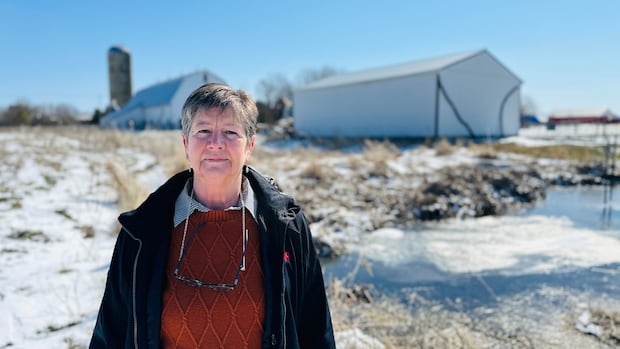
At her small beef farm near Winchester, where her husband’s family once operated a large dairy farm, Jackie Kelly-Pemberton has constructed a wetland.
With cattle outside all year, “we wanted a way to manage the manure runoff,” she said.
Just like a naturally occurring wetland, this one has sedges, bulrushes, cattails and ponds that filter the barnyard runoff before it flows beyond her property line toward the South Nation River and ultimately to the Ottawa River.
“Water has no boundaries and fences don’t hold it in. Water quality has always been important to me,” said Kelly-Pemberton.
Expertise and money for the project came from ALUS, formerly known as Alternative Land Use Services, a Canadian organization that helps farmers design and build conservation projects on their properties.
WATCH | Hopes that a built wetland can be a model for others: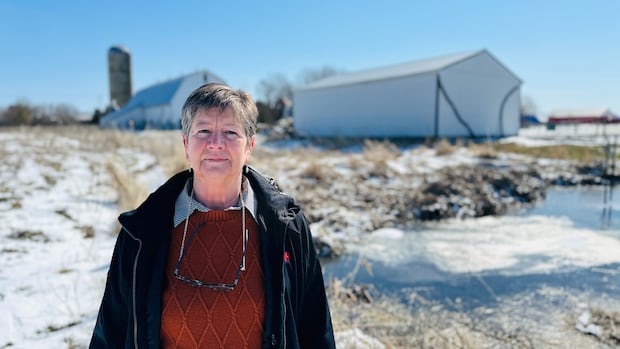
Farmer-led conservation projects could help Canada meet national targets
Farmland stewardship could help Canada reach its conservation targets. The CBC’s Stu Mills explains how.
ALUS President Jordan Sinclair says nature-based farmland projects like this one could put 65,000 hectares toward the federal government’s nature protection targets.
“We’re not looking at converting productive acres of the farm, but [rather] those edge-of-field projects where the farmer’s not making money anyway,” Sinclair said.
Last month, Prime Minister Mark Carney laid out a new nature strategy for Canada to get to “30 by 30” — referring to a national plan to protect 30 per cent of lands and oceans by the year 2030.
That’s about double what’s protected right now.
The strategy, released March 31, includes getting businesses and investors to put private funding into conservation. It also involves recognizing what are known as “other effective area-based conservation measures,” or OECMs, which are areas that are protected by local communities and private groups.
“Creating these spaces is ambitious and requires significant funding,” Carney said in that news conference. “We can’t do it with public money alone.”
Among other things, in order for an area like Kelly-Pemberton’s to be recognized as an OECM, it must have a defined boundary, permit authorities to control activities within the boundaries, and prohibit activities that would be incompatible with conservation objectives, according to Environment and Climate Change Canada.