
WARNING: This story contains allegations of sexual violence and may affect those who have experienced it or know someone impacted by it.
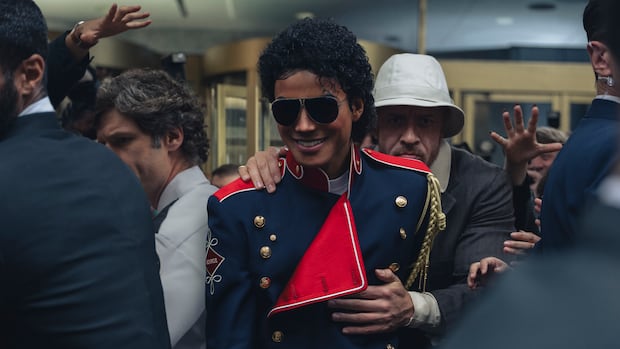
This weekend, Michael, the new biopic directed by Antoine Fuqua, opened to a record-breaking $97 million debut.
Despite middling-to-negative reviews from critics and questions about the Estate of Michael Jackson’s role in erasing allegations of Jackson’s sexual abuse from the film, audiences worldwide continue to flock to theatres to catch some of the most iconic moments in Jackson’s career re-created on film.
Today on Commotion, host Elamin Abdelmahmoud is joined by Black pop expert Prof. Mark Anthony Neal, film critic Sarah-Tai Black and culture critic Jay Smooth to discuss the new film, and how it handles the high, lows and controversies of Michael Jackson’s pop legacy.
We’ve included some highlights below, edited for length and clarity. For the full discussion, listen and follow Commotion with Elamin Abdelmahmoud on your favourite podcast player.
WATCH | Today’s episode on YouTube:
Elamin: Let’s get into the tensions around this movie. There are reports that Janet Jackson asked not to be portrayed in it at all. She’s not even alluded to. You don’t even know that Janet Jackson exists if you watch this movie. Michael’s daughter, Paris Jackson, was very publicly distancing herself from the movie altogether. But the biggest controversy is, of course, what’s not in the movie. There’s no reference to the child sexual abuse allegations against Michael.
Jay, an entire third act of this movie was removed. What happened? What is that story?
Jay: Yes, I think the version of the film we have is being rightfully criticized for ending around ’88 and just avoiding the questions of the allegations altogether.
But there was an original cut of this film that used Jordan Chandler’s allegations and the subsequent investigation as the third act. The film, by all accounts, [would be] portraying Michael as falsely accused, and would take what it would show [as] this unfair persecution as the main source of drama. But at the last minute, the lawyers realized one of the stipulations in the settlement with Jordan Chandler was that the estate was not allowed to say anything involving Chandler in a product like this. So they had to scramble at the last minute to rewrite, reshoot [and] recut the film into what we have here. Which, apart from the ethical questions of avoiding the allegations, I think it’s very obvious just from a storytelling standpoint that this is a movie that’s missing its main source of dramatic tension and is just sort of stretched out into… this paper-thin collection of anecdotes interspersed around musical numbers.
Elamin: Sarah-Tai, I’m realistic enough to know that a Hollywood blockbuster about Michael Jackson is going to get a lot more eyeballs than the documentaries made about the real Michael, the stories that sort of got us closer to what Michael Jackson was actually like. But what’s the danger when that happens when we end up flattening history?
Sarah-Tai: I think most biopics are involved to some degree in this ideological project of mythmaking. And I think that a good biopic comes out of the tension between authenticity and good PR. We can look at something like Ray, where we saw this caring charting of [Ray Charles’s] artistry alongside his womanizing and substance use. We can look at something like What’s Love Got to Do with It — truly the gold standard for an artist biopic in my opinion. But I think that Michael takes it to a level that is almost unbelievable, given how intertwined the allegations against him are with not just his star image, but [with] his artistry, his artistic output, his legacy. I think for those of us who were alive at the time, the media frenzy alone was such a deeply embedded moment in pop culture.
I also think that we’re in a really unprecedented time of misinformation and disinformation, and I do believe that the Jackson family are involved in the film in a very poor faith way. I think that the family and as a state are going into this seeing dollar signs, which of course involves broadening that Jackson family IP to a new generation who might not have actually lived through that media history in the way that we have.
Elamin: Mark, there’s been a lot of debate around how the legacy of our pop icons should be presented at all, particularly when those legacies have been marred by all of these really polarizing controversies. How are you thinking about Michael Jackson’s legacy after watching this movie?
Mark: There’s a way in which his legacy is unchanged. You know, this is a film that in many ways was made for 17-year-olds who have no relationship to Michael Jackson other than the idea of Michael Jackson. I mean, to Sarah-Tai’s point, when you think about Ray, when you think about What’s Love Got to Do with It, these are stories of incredible icons, but they weren’t brands in the way that Michael Jackson is a brand.
If Michael Jackson was not a brand, if there [wasn’t] a continuous amount of millions of dollars being made off of the name “Michael Jackson” since he died, this film doesn’t get made, right? Because no one would be interested in that story.
So it is really low-hanging fruit storytelling that will buttress his brand and his legacy for folks who don’t know any different unfortunately.
Jay: In a way, it makes me think about how the legacy of Michael Jackson [the] brand is going to overshadow the legacy of Michael Jackson the artist and the human being. I mean this film just feels so disinterested in really getting to know the person, which is such a complex, fascinating story.
It fully leans back into the old myth of Michael as this sort of guileless, innocent childlike figure, when to me, it’s so much more interesting to get to know the Michael Jackson who had that childlike side, but also was very savvy, strategic [and] calculating about managing his own brand and career. But of course, if you complicate the narrative of Michael being this innocent childlike soul with no complexity, that you’d also be complicating the work of dancing around these other questions around Michael.
You know, one thing I think the film gets correct is [in] how it shows Joe Jackson seeing Michael as a cash cow more than a human. And I think that’s the meta narrative of the existence of this film. It is a story about the power of celebrity and the power of money; two forces that shaped Michael’s life profoundly for good and for ill. And now in the end, we’re seeing those forces erase whatever the real human story is in the interest of preserving his brand. So in a way, it’s yet another tragedy.
You can listen to the full discussion from today’s show on CBC Listen or on our podcast, Commotion with Elamin Abdelmahmoud, available wherever you get your podcasts.
Panel produced by Ty Callender.