

Listen to this article
Estimated 4 minutes
The audio version of this article is generated by AI-based technology. Mispronunciations can occur. We are working with our partners to continually review and improve the results.
A woman accused of murdering her infant son more than four years ago in Ottawa may have to stand trial a second time.
The Crown is now deciding what to do in the case of Boravy Buth — try her again or let her be — after a jury found her former partner Patrick O’Connor guilty as charged of second-degree murder over the weekend, but couldn’t reach a unanimous verdict for Buth.
The jury was on day six of deliberations Sunday after hearing evidence, submissions and instructions for about eight weeks. Jurors could have made any one of the following findings for Buth: not guilty of second-degree murder, guilty of second-degree murder, guilty of manslaughter, or that it was unable to reach a verdict.
At about 6:30 p.m. Sunday, Superior Court Justice Kevin Phillips told counsel he had “no choice” but to declare a mistrial after the jury wrote him an eleventh letter. (The jury had a lot of questions for the judge during deliberations, submitted to him in letters.)
“This is day six and as the content of their latest note makes clear, the jury has reached the end of its reasoning path,” Phillips added.
‘Long, complex and heartwrenching’
After calling the jurors back into the courtroom, Phillips told them they grappled meaningfully with the issues they had to debate.
“Over the course of this trial it’s not been lost on any of us that you have worked very hard … and over these last days [displayed] yet again how much work you were willing to put in and how seriously you took your job,” he told them.
“This trial was long, complex and heartwrenching. You have done your duty, and on behalf of the community and those of us involved in the administration of justice, I extend our heartfelt gratitude.”
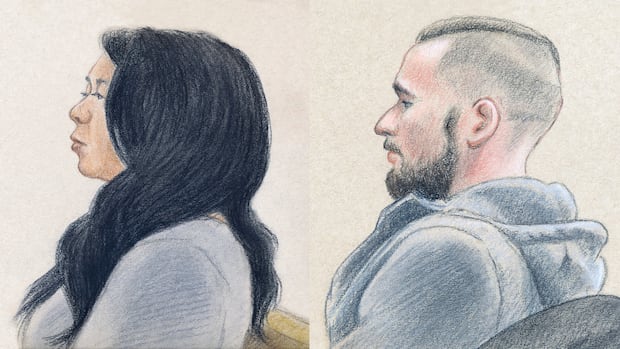
 Buth and O’Connor are scheduled to appear in court again in June: O’Connor for an update on sentencing, and Buth for an update on a Crown review into whether she should be tried again or not. (Guy Quenneville/CBC)Back in court in a couple months
An update on Buth’s case is expected in June.
Murder is one of the most serious charges in the Criminal Code and there is public interest in seeing serious cases through, especially for vulnerable people like children. On the other hand, murder prosecutions are lengthy and costly, and a co-accused has been found guilty as charged.
A Crown review will determine how to proceed.
For O’Connor, second-degree murder carries an automatic sentence of life in prison. But the judge will determine how many years O’Connor will have to serve in prison before he becomes eligible to apply for parole (not the same as getting parole).
The jury was invited to make a recommendation for O’Connor’s parole eligibility, and it will be heard at a sentencing hearing later on. An update on scheduling is expected in June.
Said 7-week-old fell off bed
CBC is not identifying the seven-week-old boy who died.
Ottawa police arrived at the former couple’s home at about 4:30 a.m. one night in October 2021 after getting reports of a child who wasn’t breathing.
According to an officer who testified during the seven-week trial, Buth said the baby had fallen off the bed in the middle of the night, sometime between 2 a.m. and 2:30 a.m. She said she walked him around the room and brought him back to bed once he was OK.
Then around 4:15 a.m., she said she was awoken by O’Connor, who told her the baby wasn’t breathing.
Conflicting evidence at trial
But the jury heard conflicting evidence. Another constable testified that O’Connor told him he was the one who picked up the child, carried him around the room, went back to bed and woke up to find the baby wasn’t breathing.
A forensic pathologist also testified during the trial, likening the boy’s injuries to something seen after a vehicle collision or a fall from a significant height.
Dr. Christopher Milroy outlined evidence of severe hemorrhaging in the child’s brain and extensive bruising on his body.
Milroy said some of the injuries were consistent with those found in child abuse cases and several were likely present before the boy suffered a fatal blow to the head.
During their closing statements, the two defence lawyers attempted to pin the guilt for the child’s death on each other’s clients.