
Paving for eight Surrey roads in May
Published 11:00 pm Monday, April 27, 2026
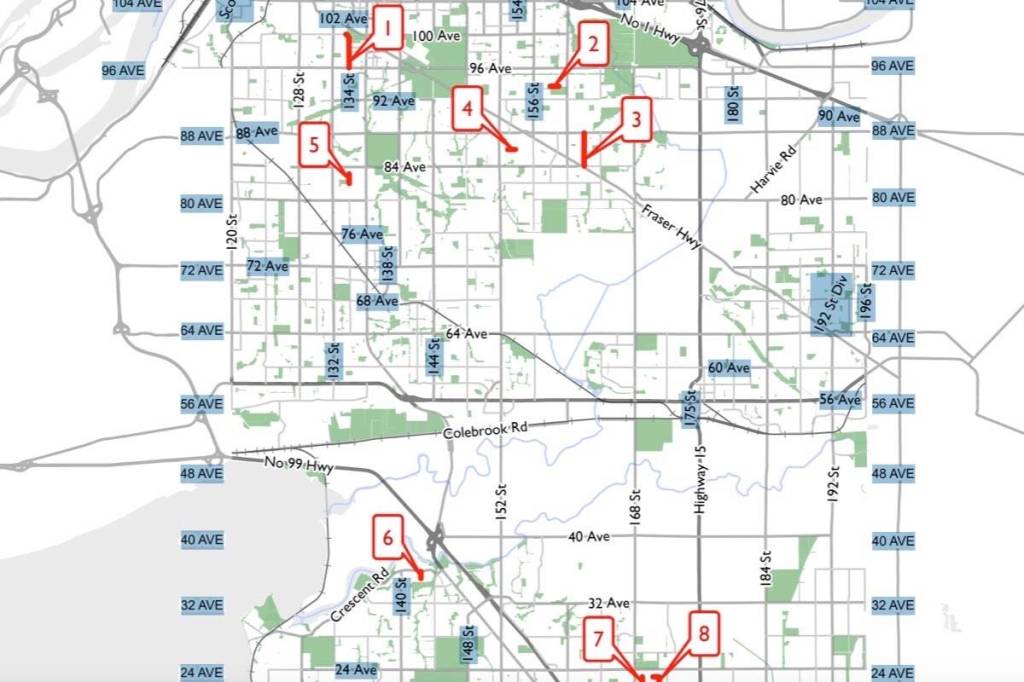
Surrey council has approved a $2,443,373.57 contract for Save on Blacktop for local road paving at eight locations in the city – five in the north end and three in South Surrey.
Council voted on this on Monday, setting the spending limit at $2,630,000. The package includes repaving 6.5 lane-kilometres of local roads as well as 2.6 lane-kilometres of arterial road paving and 0.8 kilometres of protected cycling infrastructure improvements.
Paving and cycling-related work is to be done at 134 Street from 96 Avenue to 100 Avenue, and roads will be paved at 93A Avenue from 158 Street to 159 Street; 162 Street from 84 Avenue to 88 Avenue; 86 Avenue from August Drive to 154 Street; 134 Street from the 8200-block to 83 Avenue; 142A Street from Crescent Road to Greencrest Drive; 23 Avenue and 171 Street from 170 Street to 22 Avenue and 169 Street from 22 Avenue to 23 Avenue.
Construction will be permitted from 7 a.m. to 10 p.m. Monday through Friday and is expected to begin in May and be done by August.
Councillor Mandeep Nagra said the feedback he’s getting from Surrey residents “when we pave the new roads, the lanes are too narrow, I don’t know why, but compared to the ones we built 10 years ago or more, the new lanes are narrower than what we used to build back in the days.
“I don’t know what the reason is but I have seen sidewalks that can fit two cars side-by-side, but the two lanes cannot fit two cars side-by-side. I don’t know what the theory is behind that, but this is the feedback that I’m getting from the community.”
Scott Neuman, Surrey’s general manager of engineering, replied that this contract involves “simply repaving, so the lane would stay the same.
“But on our road widening projects,” he said, such as 64 Avenue, 80 Avenue and 132 Street, “the lane widths on the curb lane are about the same width that accommodate a bus or a heavy truck but there is a perception that the lane width is narrower than the curb lane because we’ve moved from on-street bike lanes to off-street.
“So that lane, that space that was being used for the cyclist is no longer there, however, it gave a perception to a driver that they had more room but it’s safer to move pedestrians off-street. The fast lane, if you would call it that way, the passing lane and then the left turn lanes are getting a but narrower.”
This is by about four to six inches, Neuman said.
“The intent there is to try to give more space to larger boulevards and sidewalks so we can plant larger trees and have wider sidewalks and passing for pedestrians, so that’s kind-of the trade-offs but they’re still meeting industry standards and in fact some areas of other municipalities have gone even smaller but we’ve tried to keep this thing at a reasonable width in the curb lane for buses and trucks and emergency vehicles.”