
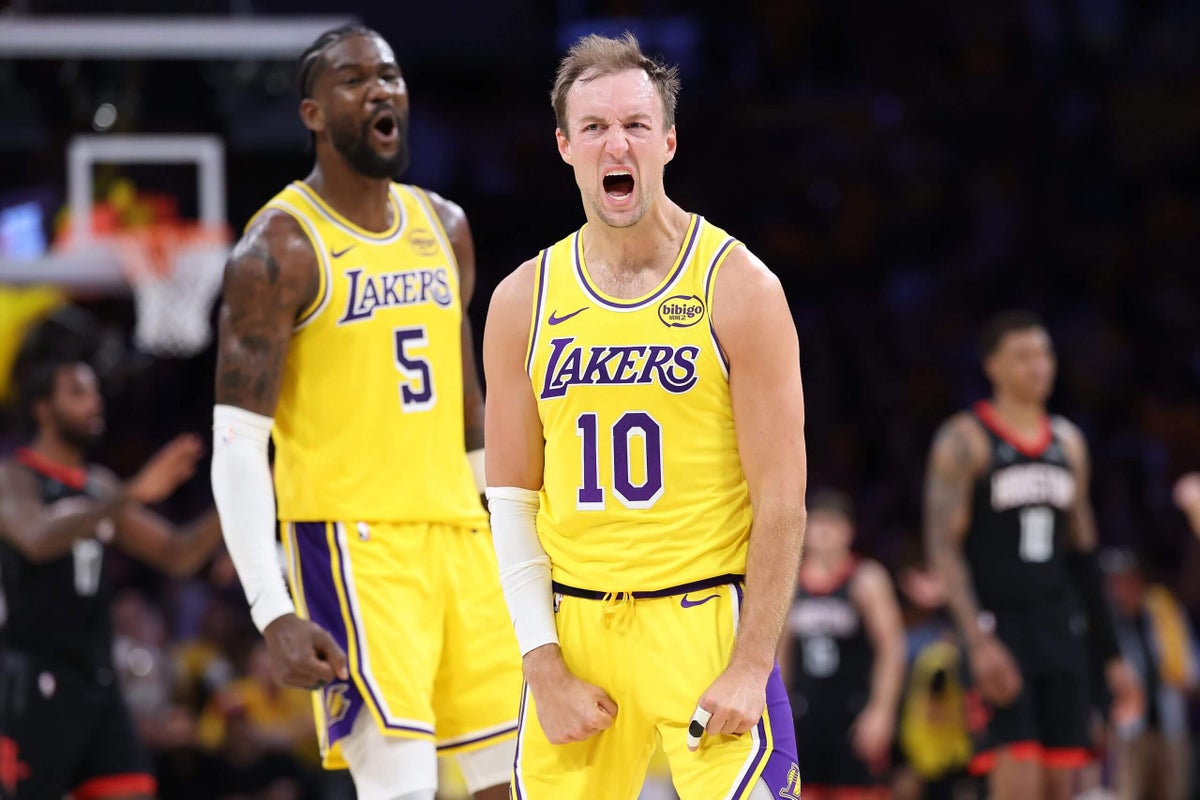
By the winter of 2015, the buzz had made it to Loveland, Ohio, where 13-year-old Jaxson Hayes knew he needed to see it for himself. Word of a high-school junior hanging 51 points on Edgewood, 45 on Valley View and 53 on Bellbrook had people talking, and Hayes and his friends wanted in.
“This was a really big deal,” Hayes told The Athletic.
A group of Hayes’ friends, AAU teammates, middle school friends and some basketball-crazy dads piled into cars and made the 40-minute drive to Franklin, squeezing shoulder-to-shoulder into sold-out gyms. Like so many others in the area, Hayes packed in to watch the smooth lefty from tiny Franklin High School chase down LeBron James’ high school scoring marks.
Luke Kennard was the main event. The star of “LukeMania.” The reason the Franklin Wildcats moved games to college arenas and traveled with police escorts to small-town gyms in southwest Ohio.
“Luke’s games?” Hayes remembered. “Oh my gosh, you couldn’t stand.”
The NBA is filled with origin stories like this. So is the G League. So are leagues across European leagues and South America. Some players, like James, ride that momentum all the way to the top of the sport. Most, like Kennard, have to be OK with leaving all of that behind as they figure out how to survive.
“The reality of 99 percent of NBA players is that they were the best player on their high school and AAU team and a star in college, or, you know, a star overseas, or whatever it may be,” Los Angeles Lakers coach JJ Redick said, “And you get to the NBA, and you got to be able to start anew.”
But circumstances have placed Kennard in a moment where the Lakers have needed him to be a little nostalgic. Injuries to Luka Dončić and Austin Reaves created a void for a star ballhandler, a perimeter scorer, a playmaker. And the guy who filled it up in Franklin knew exactly what to do.
“ It’s a big jump in intensity and the way I play, obviously, the minutes and being more involved in actions and all that,” Kennard said. “It was a quick change, obviously. But just knowing, like I had an idea of what it was gonna be like.”
The Lakers lead the Houston Rockets 3-1 in the first round of the playoffs, having survived the potentially season-altering injuries to Dončić and Reaves, thanks in part to Kennard turning back the clock.
“When I’m out there, I mean, I’m playing within the flow of the game and stuff, but I’m obviously doing things that I haven’t done in the last few years, just turnaround shots, crazy shots sometimes,” Kennard said. “Stuff I did back in high school. And I don’t feel any pressure right now to do this. I’m having a lot of fun, and I’m enjoying it, and it’s exciting.”
Back in Franklin, they’ve noticed.
“You look like you’ve got on the red and black and No. 10 that’s hanging in our rafters. You look like that guy. You look like that guy again,” Brian Bales, Kennard’s high school coach, texted him. “We always knew. I always knew what you could do.”
Kennard was good enough at Franklin to win Ohio Mr. Basketball twice. He passed James on the scoring list. He became a McDonald’s All-American and a star by his sophomore year at Duke. But the NBA’s been different, with Kennard becoming a role player with stints on five teams in nine years.
Watching this stretch, it’s fair to wonder where this version of Kennard has been. When the Detroit Pistons drafted him 12th in the 2017 NBA Draft, they certainly hoped they were getting more than a 3-point ace.
“Coming out of high school to college, I wanted to think I can just do exactly what I was doing, but I knew that wasn’t the case. And same with the NBA,” Kennard told The Athletic. But yeah, I think it was definitely a challenge at first to figure out what I was going to be at each level. But then once you find it, you just gotta maximize it and try to do the best that you can at it.”
Kennard’s made 44.2 percent of his 3s since entering the league, the best percentage of any player over his nine seasons. This year, he shot 47.8 percent from deep while cruising past the 50/40/90 benchmarks in the three common shooting categories (53.3 field goal percentage, 47.8 3-point percentage and 91.3 free-throw percentage), all while playing a career-high 78 games.
Whatever was asked of him, his early teammates noticed, was fine by him.
“He’s such a team guy, and he’s such a — not a complainer, you know? He just goes out and plays and kind of accepts his role and does whatever. And coaches love that obviously,” Blake Griffin, Kennard’s teammate in Detroit, told The Athletic. “But it also doesn’t really showcase guys’ skill sets. You know, that’s why people s— on some random guy in the NBA. And it’s like, ‘Dude, you have no idea how good this guy is.’
“This? It’s not really surprising to me.”
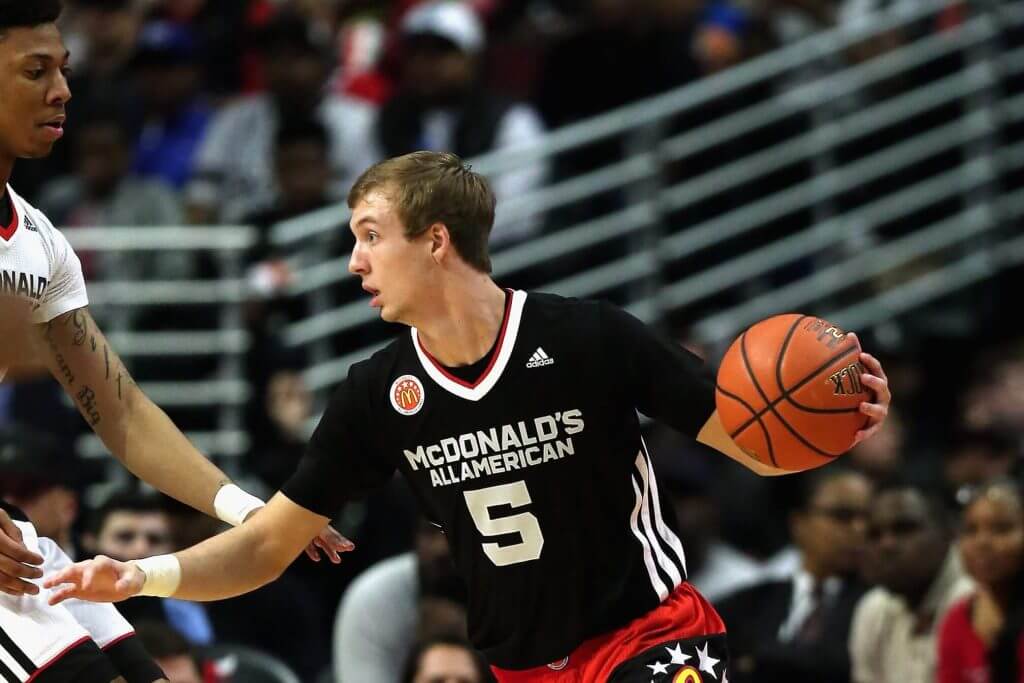
Luke Kennard looks to attack during the 2015 McDonald’s All-American Game in Chicago. (Jonathan Daniel / Getty Images)
If there has been a critique of Kennard’s game, it’s that he might value efficiency too much, that a player with such a green light to launch should do it more regularly. He quieted that concern in the Lakers’ first game after the Dončić and Reaves injuries.
Kennard shot 17 times and made only five, percentages be damned. His three-best assist totals of the regular season came in the first three games after the Lakers’ start backcourt got injured.
Griffin, now a broadcaster with Amazon Prime’s NBA coverage, said his immediate thought after the injuries was about the opportunity Kennard would soon get.
“I mean, he’s played that way more in his life than he has this way in the NBA. I’m sure as a kid, he had the ball in his hand doing everything. So it’s kind of amazing how comfortable guys can look when you give them the ball again,” Griffin said. “You don’t want to say it’s easy to go out and get 20, but when you’re getting that many shots and the ball is in your hand that much, you’re gonna get assists, you’re gonna get points. It’s just about mitigating mistakes more so than it is going out and balling. It’s so much more freeing and so easier to play that way.
“The question is, can you win that way, or can you help a team win that way? And he’s obviously shown he’s doing both.”
And while Kennard wasn’t as sharp in the Lakers’ two games in Houston, he’s proven to be such a serious threat that he’s commanded the Rockets’ best defender, Amen Thompson, for nearly all his minutes.
“You can just tell in his confidence,” said Evan Crowe, Kennard’s best friend. “If he gets a little bit of confidence going, there really isn’t stopping him. And that’s why I’m not surprised that he’s had multiple games in a row since he’s taken this role. It hasn’t been just a fluke where he went off for a big game and then back to his complementary role.”
Crowe, maybe better than anyone, knows the player Kennard was at Franklin. The two were teammates, with Crowe feasting on spot-up 3s as defenses swarmed Kennard and Division I basketball coaches watched in the stands.
He still feels the weight of Kennard’s stardom. Even Crowe’s wife, Lillie, who attended a different area high school, went to Franklin High to watch Kennard play.
“They have an old picture of them there,” Crowe said with a laugh. “That’s how much impact it made. So to this day I’ll be talking to work friends, and they’re like, ‘Oh, I definitely saw you play in high school because we used to go to those games.’”
With Reaves seemingly close to a return, this brief chapter in Kennard’s career may soon close. What the Lakers need for the rest of this season won’t be the same if the team gets a little healthier. But Kennard seems cool with letting go of this slice of his past.
“For sure. Look, I mean, I’m also at a point in my career, I’m nine years in, and I want to win, you know what I mean?” Kennard said. “So I will do whatever it takes, and if that’s shooting 17 times against Dallas or whoever and then shooting three or four and we win, it’s kind of where we’re at right now and where I’m at.”