
By Lethbridge Herald on April 28, 2026.
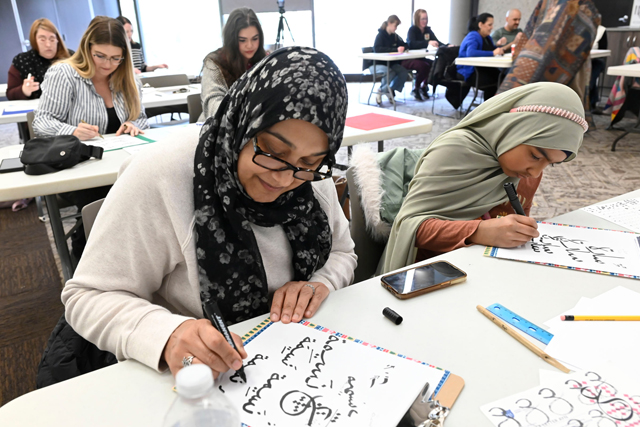
 Herald photo by JOE MANIO
Nasima Parker and her granddaughter Sarah work side by side on their Arabic calligraphy pieces during a workshop at the Main Branch of the Lethbridge Public Library Sunday, while other participants continue practicing in the background as part of Arabic Heritage Month
programming.
By Joe Manio
Lethbridge Herald
By mid-afternoon Sunday, the Community Meeting Room at the Main Branch of the Lethbridge Public Library had settled into a quiet, focused rhythm.
Heads bent over paper, pens moved slowly and deliberately, each stroke considered before it touched the page. Around a long table, 13 participants — 12 adults and one nine-year-old — weren’t just learning how to write. They were learning to pay attention.
The Arabic Calligraphy Workshop, held as part of April’s Arabic Heritage Month, offered a hands-on introduction to an art form where language is shaped as much by patience as meaning — where letters stretch, curve and connect to become something visual and architectural.
Calgary-based artist and educator Dania Khairi guided the three-hour session, walking participants through Arabic script fundamentals — how letters change depending on their place in a word, how they connect, and how balance and proportion matter as much as spelling.
For Khairi, the roots of that practice go back decades.
“I lived in the Middle East for over 20 years,” she said. “As a kid, I used to see a lot of mosques with Arabic calligraphy… it just became a passion.”
What began as admiration grew into practice, and eventually teaching — not just technique, but culture.
“In Arabic calligraphy, you have to connect the letters,” she explained. “A letter can sound one way on its own, and another when it’s part of a word. It’s about how everything flows together.”
That idea of connection — between letters, people, generations — played out quietly across the room.
At one table, Nasima Parker worked alongside her granddaughter, Sarah Syed, carefully shaping Arabic script as they practiced writing their names. Visiting from Vancouver, Parker said the workshop offered a chance to do something meaningful together.
“It’s something for us to do together,” she said. “And I wanted to perfect writing my name in Arabic.”
While Parker can read Arabic, writing it remains a challenge — one she was glad to revisit with her granddaughter learning beside her.
“It feels good,” she said. “We connected in so many ways, comparing and figuring things out together.”
Nine-year-old Sarah was more direct.
“I just really wanted to learn how to write it,” she said, adding that trying to “perfect it” was both the hardest and most fun part.
Across the room, Lethbridge resident Rus Heggie signed up out of curiosity.
“It just looked interesting,” said the 53-year-old. “I like learning about different cultures.”
While familiar with Arab culture through local events and community connections, the calligraphy offered something new — and familiar.
“It has some similarity to brush strokes I’ve seen in Mandarin or Japanese,” he said.
That kind of exchange is exactly what the workshop aimed to encourage.
“Language is how you communicate,” Khairi said. “And communication is the most important part of any culture. Writing and reading — that’s how you connect.”
Over the afternoon, participants moved from practice sheets to final pieces on watercolour paper, many writing their names framed with simple decorative borders. The process required patience — slowing down, correcting, retracing — but the results carried quiet pride.
Khairi said what stood out most wasn’t just the work, but the atmosphere.
“Everybody was so nice,” she said. “Very friendly… they understood it so well.”
She pointed to Parker and her granddaughter working side by side as especially meaningful.
“That’s amazing,” she said. “To connect like that.”
The workshop was one of several initiatives marking Arabic Heritage Month in April, a time to recognize Arab culture through art, history and contribution.
From Arabic numerals — the number system used worldwide today — to foundational work in algebra, astronomy and medicine, those contributions continue to shape everyday life.
On Sunday afternoon, those ideas weren’t presented in lectures. They were experienced more quietly — in careful strokes, steady focus, and a single curve placed just right.
By the end, each participant left with a finished piece — a name carefully written, a small work of art — and a deeper appreciation for the script behind it.
In a room defined not by noise, but by focus, writing became something more than practice. It became a way in — to a language, to a culture, and to each other.
34
-33