
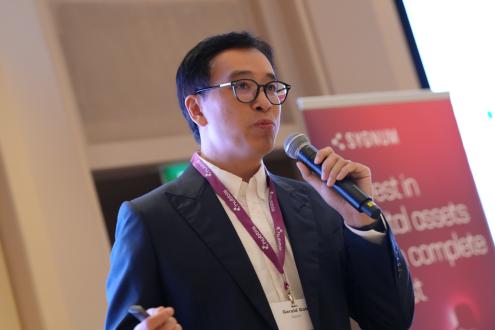
At the closed-door forum Navigating Digital Assets: 2026 and Beyond, Gerald Goh set out a practical question for private banks and external asset managers (EAMs): not whether digital assets matter, but how institutions should deliver them responsibly. The Co-Founder and Chief Executive Officer of Sygnum APAC argued that demand from wealthy investors has already shifted the conversation from curiosity to implementation. The challenge now lies in providing access, governance and advisory within a regulated framework.
Goh’s presentation focused on bridging traditional private banking with digital asset markets. Rather than positioning crypto as a standalone investment product, he described it as an expanding financial ecosystem requiring institutional-grade custody, portfolio construction advice, yield generation solutions and client education. For intermediaries, the issue is strategic positioning: institutions must decide whether to integrate digital assets into their proposition or risk losing relevance as clients seek regulated alternatives elsewhere.
Key Takeaways
Client adoption has reached a tipping point: most wealthy investors already hold digital assets and many plan to increase allocations.
Diversification now outweighs speculation: investors increasingly view crypto as a portfolio component rather than a speculative trade.
Regulation determines trust: clients prefer exposure through institutional custodians and banks rather than unregulated exchanges.
Portfolio construction matters: systematic allocation and diversification outperform timing attempts in volatile markets.
Institutions need full-service capability: trading alone is insufficient without regulated custody, yield strategies and advisory support.
The demand shift
Goh began by highlighting findings from Sygnum’s multi-year investor survey covering high-net-worth (HNW) clients across Asia. A majority already holds digital assets, and allocations have steadily increased over time. A significant proportion plans to expand exposure further within the coming year.
More revealing than participation levels was the motivation. For the first time, diversification ranked ahead of capital appreciation as the primary reason for investment. Digital assets are increasingly treated as a structural allocation rather than a speculative position.
He illustrated the shift through client behaviour. Earlier adopters entered markets independently via exchanges, often taking operational and counterparty risks. Today’s investors are more traditional in approach. They seek regulated access, structured portfolios and institutional custody. The asset class is attracting mainstream wealth clients rather than purely technology-focused participants.
For intermediaries, Goh suggested, this changes the competitive landscape. Clients do not necessarily expect banks to recommend digital assets, but they increasingly expect them to facilitate access safely.
The role of regulated access
Trust, Goh argued, is the central differentiator. Digital assets have long faced credibility issues because access was dominated by unregulated or less well-regulated venues. Institutional involvement depends on reversing that structure.
Sygnum’s approach has been to build regulated banking and securities capabilities before going to market. The objective is to replicate the safeguards familiar in traditional markets: custody, auditability and operational transparency.
For private banks and asset managers, this matters because client expectations mirror existing advisory relationships. Investors want to transact in digital assets through the same channels as other investments. They prefer integration into existing portfolios rather than maintaining separate accounts elsewhere.
This preference creates both opportunity and risk. Institutions offering regulated digital asset services can deepen relationships. Those that do not may find clients transferring assets to providers who can.
Portfolio construction over market timing
Goh then addressed a recurring client question: whether it is too late to enter the market. Instead of predicting price direction, he presented historical performance patterns.
Long-term holding periods have generated substantial returns, but missing only a small number of high-performance days dramatically reduces outcomes. The implication is that timing attempts often undermine performance in volatile markets like crypto.
For wealth managers, the lesson is procedural rather than predictive. Exposure should be systematic, diversified and aligned with long-term objectives rather than dependent on entry points.
He emphasised that volatility remains intrinsic to the asset class, but it does not invalidate allocation. Instead, it reinforces the need for disciplined allocation similar to other high-risk assets.
Determining allocation size
Another frequent question concerns allocation percentage. Goh avoided prescribing a universal figure but pointed to institutional research suggesting small allocations can materially affect portfolios.
Model simulations showed that introducing a modest Bitcoin exposure to a traditional balanced portfolio improved returns while not increasing overall volatility over certain periods. The diversification effect, rather than directional conviction, formed the rationale.
He framed the key decision not as selecting an exact percentage but as moving away from zero allocation. Once digital assets become part of the opportunity set, portfolio construction principles apply: diversification, risk budgeting and periodic review.
Structuring exposure
Goh outlined a simple allocation framework commonly used among investors.
The majority of exposure typically concentrates in Bitcoin, reflecting its role as a store of value. A smaller portion targets platforms enabling payments and decentralised applications, such as major smart-contract networks. This approach captures multiple use cases while maintaining manageable risk concentration.
He emphasised the rationale behind the structure. Different assets represent different economic functions, and diversification across them reflects exposure to distinct drivers rather than speculative variety.
For advisers, this framework provides a way to discuss digital assets in familiar portfolio language rather than technology terminology.
Making assets productive
Beyond allocation, Goh highlighted the importance of utilisation. Certain blockchain networks allow staking, generating yield by participating in network validation. Ignoring such features, he argued, leaves potential returns unused.
Institutions therefore need capability not only to hold assets but to manage them actively through income-generating strategies. For assets without native yield, alternative strategies such as market-neutral approaches can create return streams independent of price direction.
This concept reframes digital assets from passive holdings into managed investments, aligning them with established portfolio practices.
The institutional service model
Goh described a comprehensive service structure designed to support wealth intermediaries.
First is access: clients must be able to buy, sell and hold digital assets within a familiar banking framework. Second is growth: staking, funds and yield strategies enable assets to generate income. Third is optimisation: lending, structured products and private opportunities integrate digital assets into broader investment planning.
Delivery is equally important. Relationship managers remain central, supported by trading platforms, over-the-counter execution and research insights. The objective is not automation alone but advisory integration.
For partners such as private banks and external asset managers, this becomes a modular capability. Institutions can offer digital asset services under their own client relationships while relying on regulated infrastructure behind the scenes.
Education as a prerequisite
Goh emphasised that implementation requires internal understanding as much as client demand. Advisers cannot discuss assets confidently without operational familiarity.
Institutions therefore need training, research support and ongoing dialogue. This mirrors previous adoption cycles in alternative investments, where knowledge preceded recommendation.
Education also addresses reputational risk. When advisers understand drivers of volatility and regulatory frameworks, conversations shift from speculation to suitability assessment.
Strategic implications
The broader implication of Goh’s presentation was competitive positioning. Digital assets are becoming a standard client topic. Avoidance is increasingly interpreted as absence of capability rather than prudent caution.
Institutions face a strategic choice: integrate digital assets thoughtfully or allow external providers to capture that segment of client engagement. In either case, client interest will persist.
For Goh, success depends on embedding digital assets into existing wealth management processes rather than treating them as a separate activity. Portfolio construction, advisory discipline and regulatory safeguards remain unchanged. Only the asset category is new.
A service, not a product
Goh concluded that digital assets should not be viewed as a single investment offering. They represent a financial domain requiring infrastructure, advice and ongoing management.
Institutions that approach them solely as trading products risk misalignment with client expectations. Those that integrate custody, portfolio construction and advisory support can position digital assets alongside equities, fixed income and alternatives.