
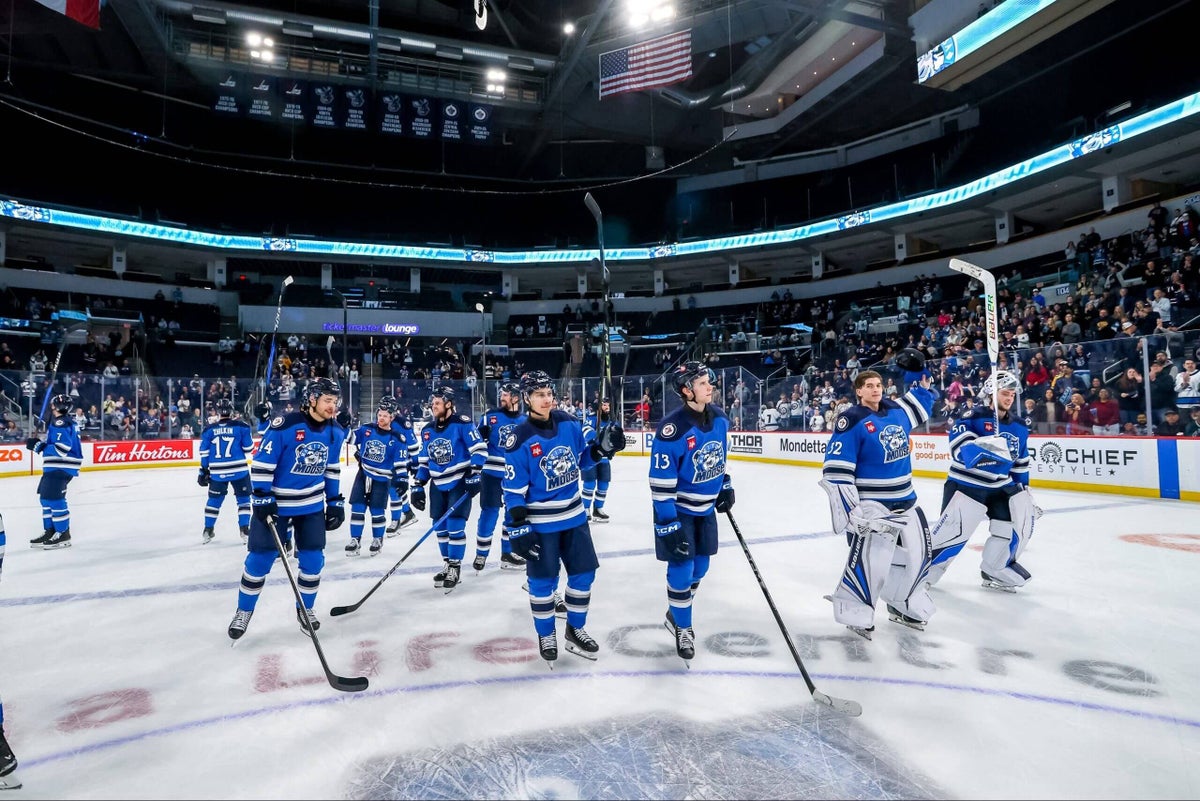
Dom DiVincentiis has played in a must-win, winner-take-all playoff game and won it. Brayden Yager has taken key faceoffs, winning 63 percent of them in the playoffs — including 14 of 17 in the defensive zone. Colby Barlow got hot at just the right time, doubling his shot rate down the stretch and scoring four goals in four games to ensure the Manitoba Moose got to play in the postseason at all.
Should this give the Winnipeg Jets hope?
It was Winnipeg’s plan, after all — one of only a few plans in a disappointing NHL season that appears to be paying dividends today. When the Jets signed top AHL veterans such as Samuel Fagemo, Walker Duehr and Phillip Di Giuseppe last summer, the idea was that their minor league excellence and experience would ensure the Moose — 31st of 32 teams in 2024-25, with the fewest goals scored — would never burn another season as they’d done one year ago.
Winnipeg’s theory was that signing minor league impact players would insulate its top prospects, helping them play on the right end of the rink more often, and help them push into the postseason to play meaningful games. The Jets needed top prospects Brad Lambert, Nikita Chibrikov, Elias Salomonsson, Yager, Barlow, DiVincentiis, Thomas Milic and company to play in high-stakes, high-pressure games.
The idea, of course, is that there’s development to be gained — that games like these will help Winnipeg’s prospects prove they’re NHL-ready sooner than would otherwise be possible.
But those prospects can’t do it all. That’s why it’s so notable — especially at a time when the Jets’ drafting and development records are coming under fire for perhaps the first time in 2.0 history — that Winnipeg’s AHL bets appear to be paying off. On Sunday in Winnipeg, veterans Fagemo and Duehr scored the goals that got Manitoba past Milwaukee and into the Central Division semifinals, while 26-year-old David Gustafsson was a force all over the ice, doing the spadework on Fagemo’s series-winning goal. They, along with Mason Shaw, Jaret-Anderson Dolan and Di Giuseppe, have been enough to give Winnipeg’s prospects a chance to show themselves — a sea change compared to last season, when getting the puck to the front of the net took everything the underpowered Moose roster could muster.
Jets GM Kevin Cheveldayoff was asked about Manitoba’s roster after the NHL trade deadline.
“You want to give your prospects an opportunity to flourish and play in roles that they need to play in to be successful, but at the same time, you need to try to win,” he said. “(The AHL) is a delicate balance because you’re serving a bunch of different masters in the sense of development vs. winning vs. making sure you get to the playoffs so that there can be development so that you can win.”
Is it working?
Retention: An underdiscussed aspect of drafting and developing
Discussion about Winnipeg’s drafting and development devotes limited time to the subject of player retention. Junior players are heavily scouted and college free agents are heavily courted. An industrious scout might travel over 1,000 miles, sneak into an arena through its side door, and hide his team logos to follow his instincts toward drafting the best goaltender in Jets history. That’s what former Jets scout Tavis MacMillan did when Winnipeg drafted Connor Hellebuyck.
When a prospect needs a contract, a hardworking GM might take a special flight to a small airport near his hometown and court that player (and his parents) over a steak dinner. Cheveldayoff did that with Dylan Samberg in 2019 — and he was accompanied by Mark Chipman, the executive chairman of the board of True North Sports + Entertainment.
What about players who are already drafted and signed? What keeps them “bought in” to their role within an organization?
The biggest factors are probably ice time and opportunity. When a player feels like they are consistently put in spots to succeed, whether that means top-line usage, power-play minutes or big end-of-game situations, they’re more likely to feel connected to the team’s success. Ability matters here, placing responsibility on the player — no organization is going to give top-line, top-unit minutes to a prospect with a bottom-six ceiling — but coaches control deployment. The downstream impact is indirect but substantial: Deployment influences points (and emotions), points influence contracts and contracts partially define careers.
This is true at the NHL level — consider Mark Scheifele and Kyle Connor, who stayed, vs. Nikolaj Ehlers and Patrik Laine, who left — but it impacts prospects’ careers, too. Rutger McGroarty told Cheveldayoff that putting on his Jets jersey “didn’t feel right” — a valid, if odd-sounding reason for departure — but he was also concerned that he would get stuck in the AHL while his peers had received NHL minutes.
The Moose have gotten to the Central Division semifinals in part by trusting their prospects to play key roles. Deployment is skewed toward veterans, with coach Mark Morrison leaning on Gustafsson, Duehr and Shaw in high-leverage minutes but otherwise rolling his lines more than one might expect — even in the playoffs.
Playoff hockey is the most intense, emotional version of the sport. It seems reasonable to believe that Lambert, Yager, Barlow and company are building formative memories as they play hockey at the highest level they’ve known. No, they’re not getting heavy usage in the way that Connor and Scheifele do for the Jets, nor does the emotional intensity of playoff hockey automatically guarantee long-term contract extensions at team-friendly rates. It just seems more likely to aid in retention than had the Moose fallen short of the playoffs.
The next step would be to create positive attachments to the city of Winnipeg. The Moose do this in part through community service. I’m not sure what the player retention version of flying into a player’s hometown for a steak dinner is, but it might include ambitious summertime programming for Jets prospects — either beyond development camp in July or as an augmentation of it. How do the Jets create the perception that they’re the team that goes the extra mile for young players compared to their rivals?
Do the Moose limit youth the same way the Jets do?
Elias Salomonsson missed the end of the Jets’ season due to a concussion, suffered when Jason Robertson caught him in the head with a reverse hit. He got into two Moose playoff games, playing in all situations and picking up an assist, but was hurt again and has yet to practice this week.
The Jets’ assumption that Salomonsson was an AHL player, despite superior performance to Luke Schenn, has been thoroughly discussed. The interesting offshoot of Salomonsson’s injury is that two-time NCAA champion Garrett Brown skated in his spot at Tuesday’s practice. Brown has yet to get into an AHL game after signing with the Jets, but he appears ready for an opportunity if Salomonsson misses the start of round two. Could the Jets’ propensity for waiting for injuries to create opportunity apply to their AHL team as well?
One must admit that the optics are similar — and what a shame it would be if other teams’ college free agents advocated for NHL playing time while Winnipeg’s college players struggled to get a look at the minor league level? Brown is a highly regarded, late-blooming prospect who may play NHL games based on his 6-foot-4 frame, mobility and puck retrieval ability.
Let’s not write off his audition quite yet, though. The AHL is (arguably) the second-best league in the world, and the leap from an NCAA championship to the physicality of the Calder Cup playoffs might necessitate some practice time. Note that Lucas Wahlin, one of Winnipeg’s three other recent college signings, played six AHL games down the stretch and has dressed for all three Moose playoff games.
One area the Moose might prioritize their young players more, short of assuring them top-six forward jobs or top-four roles on defence? Manitoba’s 11 percent power play, which was ranked last in the AHL this season. It seems reasonable that a player with Barlow’s powerful one-timer — a presumed part of his NHL skill set, should he make it that far — would have gotten heavy power-play usage, even when he struggled at even strength earlier this season.
Manitoba’s power play in Sunday’s decisive win was led by Duehr, Fagemo, Gustafsson, Yager and defenceman Kale Clague. Its second unit consisted of Barlow, Di Giuseppe, Lambert, Zhilkin and defenceman Dylan Anhorn.
Here’s how Manitoba’s players ranked in power-play ice time (per game) this season. There are a lot of underwhelming point totals here, speaking to a power play that either lacks the horses or the X’s and O’s to produce. Clague is not a dominant power-play quarterback.
Player
Pos.
GP
PP TOI / GP
PP Points
Kale Clague
D
70
2:44
7
Samuel Fagemo
F
75
2:41
11
Brayden Yager
F
71
2:35
11
Brad Lambert
F
37
2:29
3
Danny Zhilkin
F
65
2:26
2
Phillip Di Giuseppe
F
75
2:24
8
Nikita Chibrikov
F
53
2:21
3
Ville Heinola
D
44
2:17
4
Walker Duehr
F
65
2:13
3
David Gustafsson
F
51
2:04
8
Mason Shaw
F
74
1:48
4
Dylan Anhorn
D
49
1:39
4
Colby Barlow
F
68
1:28
2
Parker Ford
F
55
1:17
1
Elias Salomonsson
D
31
1:11
1
A final note on Moose ice time as it affects the Jets: The difference in even-strength ice time per game between Duehr, who led Manitoba’s forward group at 13:48, and Barlow, who was last among regularly used forwards at 10:42, is tiny — especially compared to the Jets. (Scheifele led Jets forwards with 17:55 even-strength minutes per game, while Lambert rounded out the group at 9:53.)
When we say Morrison more or less rolls his lines, we mean it.
What it all means for Winnipeg’s drafting and development
The answers to Winnipeg’s issues with drafting and development go well beyond Moose deployment. They also transcend Manitoba’s underwhelming power play.
Manitoba has developed several players on NHL rosters right now, ranging from top-four defencemen such as Johnathan Kovacevic to depth players such as Declan Chisholm, Michael Eyssimont, Jeff Malott, Jansen Harkins and Jeffrey Viel. It also played a role in the development of Samberg and Salomonsson, both of whom should be big parts of the Jets roster next season. What happens when these players get to the NHL is at least as important as what happens on the farm.
Finally, a quote from Cole Perfetti, who Winnipeg drafted 10th in 2020, who got to play AHL games as a teenager — and who has been Winnipeg’s most productive draft pick of the past 10 years. Perfetti is a restricted free agent, following an injury-impacted drop-off in production to 32 points in 68 games after scoring 50 points in 82 games in 2024-25. When asked about his pending contract negotiations, Perfetti didn’t speak in dollars — he talked about feeling valued by his team.
What would it mean to be offered a long-term contract?
“That would be a real honour — to have the team show that and express that faith in you as a player and as a person,” Perfetti said.
Players such as Perfetti want to feel like they belong, like they contribute and like their contributions are valued. If the Jets are to establish a reputation as a development-friendly, youth-focused team, they’ll need to find ways to create those feelings in as many of their prospects as possible — in the NHL, AHL and beyond. It’s especially important knowing that they’ll pick higher in this summer’s draft than they have since taking Laine No. 2 in 2016.